Bentonite Clumping Technology
Last updated:
The science behind bentonite cat litter clumping: Montmorillonite structure, swelling mechanism, odor control chemistry and how white bentonite compares.
Understanding the science behind bentonite cat litter helps buyers make informed sourcing decisions and helps brands communicate product benefits to consumers. This guide explains the mineralogy, clumping mechanism, odor control chemistry, and performance variables that determine cat litter quality.
The Mineral: What is Montmorillonite?
Montmorillonite is a phyllosilicate mineral belonging to the Smectite group. Its chemical formula is approximately (Na,Ca)₀.₃₃(Al,Mg)₂Si₄O₁₀(OH)₂·nH₂O, though the exact composition varies by deposit.
The key structural feature is its 2:1 layered crystal structure: two silica tetrahedral sheets sandwiching one alumina octahedral sheet. This creates a negatively charged surface with a very high cation exchange capacity (CEC) — typically 80–150 meq/100g for high-quality bentonite.
Why this matters for cat litter:
The negatively charged layers attract water molecules and cations (including ammonium ions from cat urine) through electrostatic forces. This is the physical basis for both clumping and odor control.
The Clumping Mechanism: Step by Step
When cat urine contacts bentonite granules, the following sequence occurs:
- Water absorption begins — water molecules enter the interlayer spaces of the Montmorillonite crystal structure
- Interlayer expansion — the crystal layers expand as water molecules are incorporated (swelling)
- Granule bonding — adjacent granules bond together as their expanded surfaces contact each other
- Clump formation — a solid, cohesive mass forms within seconds for high-purity material; the exact time depends on the test method and granule size, so verify it on your sample
- Clump hardening — as surface moisture evaporates, the clump hardens into a firm, scoopable mass
- Montmorillonite content (higher = faster)
- Granule size (smaller = faster initial contact)
- Moisture content of the bentonite (8–10% optimal)
- Temperature (warmer = slightly faster)
| Montmorillonite Content | Clumping Speed (illustrative) | Clump Hardness (illustrative) |
|---|---|---|
| 85–95% (Turkish white) | Fastest of the grades below | Rock-hard |
| 70–80% (standard) | Moderate | Firm |
| 60–70% (low grade) | Slowest | Softer, more prone to crumbling |
The illustrative mapping above shows the general direction; actual clumping times are measured with your own test protocol on an approved sample.
Odor Control: The Chemistry
Cat urine odor is primarily caused by:
- Ammonia (NH₃) — from bacterial decomposition of urea
- Mercaptans — sulfur-containing compounds
- Indole and skatole — from protein metabolism
Ammonia binding: The negatively charged Montmorillonite surface has a strong affinity for ammonium ions (NH₄⁺). When urea decomposes to ammonia, the NH₄⁺ ions are captured by the clay surface through ion exchange, preventing volatilization into the air.
Physical encapsulation: The clumping action physically seals the urine within a hard mass, reducing the surface area available for bacterial activity and odor release.
Moisture control: By rapidly absorbing liquid, bentonite reduces the moisture available for bacterial growth — the primary source of ongoing odor production.
Activated carbon enhancement: When activated carbon is added to bentonite cat litter, it provides additional odor absorption through physical adsorption of organic odor molecules. This is particularly effective for mercaptans and indole/skatole compounds that bentonite alone does not capture as effectively.
Why Granule Size Affects Performance
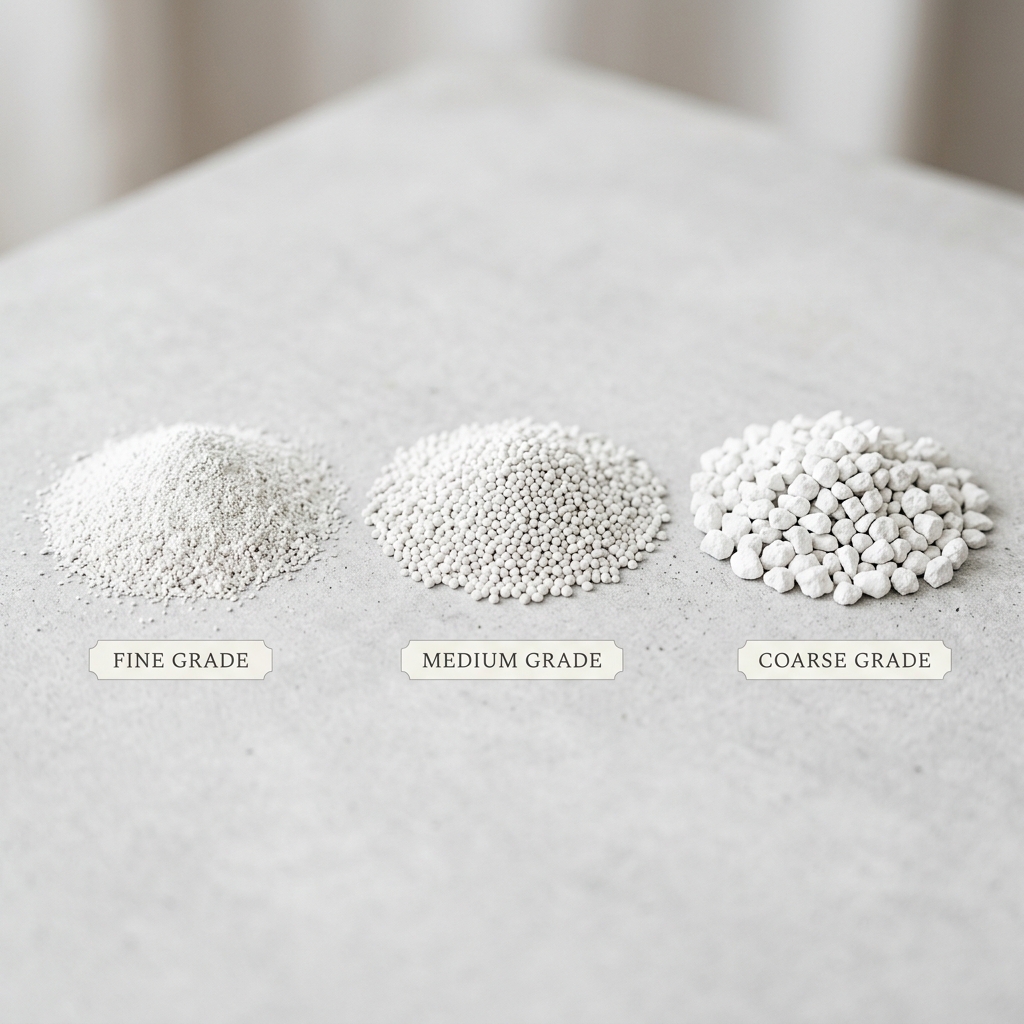
Granule size is not just a texture preference — it directly affects clumping performance:
Smaller granules (0.5–1.5 mm):
- Higher surface area per unit volume
- Faster liquid absorption
- More contact points between granules = harder clumps
- Higher absorption capacity (typically quoted at 300–320%)
- More economical usage
- Lower dust generation
- Preferred by cats that dislike fine textures
- Slightly lower absorption capacity (typically quoted at 280–300%)
- Better for automatic litter boxes with coarser sifting mechanisms
White vs Grey vs Sodium Bentonite: Technical Comparison
The table is an illustrative comparison of commonly cited differences; each row must be confirmed against the specific producer's CoA and a sample test.
| Property | White Bentonite (Turkish) | Grey Bentonite | Sodium Bentonite |
|---|---|---|---|
| Mineral type | Calcium bentonite | Mixed | Sodium bentonite |
| Montmorillonite | 85–95% | 60–75% | 70–85% |
| Color | Natural white | Grey/beige | Grey/white |
| Color origin | Natural white | Grey/beige | Grey |
| Clumping speed | Fastest of the three (test per batch) | Slower | Moderate |
| Clump hardness | Rock-hard | Soft-medium | Medium-hard |
| Odor control | High (ammonia binding) | Moderate | Good |
| Dust level | Low when well processed | Medium | Low-medium |
| Consumer perception | Premium | Standard | Standard |
Performance Testing Standards
Quality white bentonite cat litter is tested against the following parameters before shipment:
| Test | Method | Typical Target (verify per CoA) |
|---|---|---|
| Montmorillonite content | X-ray diffraction (XRD) | 85–95% |
| Moisture content | Gravimetric (105°C, 2h) | 8–10% |
| Bulk density | Standardized cylinder method | 850 ±10 g/L |
| Granule size distribution | Sieve analysis | Per grade spec |
| pH value | Potentiometric (10% suspension) | 8.5–9.5 |
| Dust content | Air classification | <0.5% |
| Absorption capacity | Standardized liquid absorption | 280–320% |
| Clumping time | Standardized urine simulation | Measured on the approved sample (no fixed seconds) |
Frequently Asked Questions
Why does bentonite cat litter clump but silica gel does not?
Silica gel (amorphous silicon dioxide) absorbs liquid through physical adsorption into its porous structure but does not swell or bond with adjacent granules. Bentonite's Montmorillonite crystals expand when they absorb water, causing adjacent granules to bond together and form a solid clump. This is a fundamentally different mechanism — crystalline swelling vs. porous absorption.Can bentonite cat litter be flushed down the toilet?
No. Bentonite cat litter should never be flushed. The same clumping mechanism that makes it effective in the litter box will cause it to clump and expand in pipes, potentially causing blockages. Additionally, cat feces may contain Toxoplasma gondii, a parasite that water treatment systems cannot reliably remove. Bentonite cat litter should be disposed of in household waste.Does bentonite cat litter expire?
The mineral itself does not expire. Unscented bentonite cat litter has an indefinite shelf life when stored in dry conditions. Scented products may lose fragrance intensity after 18–24 months. Products with activated carbon should be used within 24 months for optimal odor control performance.Is bentonite cat litter safe if a cat ingests small amounts?
Calcium bentonite (the type used in white cat litter) is generally considered safe in small quantities. It is used as a food additive (E558) and in pharmaceutical applications. However, cat litter is not formulated for ingestion and should not be consumed. Kittens are more likely to ingest litter accidentally — for kittens under 8 weeks, coarser granule grades are recommended to reduce this risk.Sourcing Information
For buyers sourcing white bentonite cat litter based on technical specifications:
- HS Code: HS 2508.10 (bentonite); confirm the applicable duty and certificate form (A.TR or EUR.1) with your customs broker
- Incoterms: FOB Ordu/Fatsa or CFR destination port
- MOQ: typically full container (FCL); fixed in quotation
- Packaging: Big bags (500–1,000 kg) or retail bags (5–20 kg)
- Lead time: quoted stage by stage (production, packing, transit) per order
- Payment: common pattern is advance before production + balance against shipping documents; LC (UCP 600) negotiable
More Frequently Asked Questions
What MOQ applies to chemical products?Often container-scale (big bags, 50 kg sacks or bulk). Confirm per product in your RFQ.
Do you provide analysis certificates?
Yes — CoA per lot is standard; third-party inspection available on request.
How is moisture/fouling controlled in transit?
Proper packing, dry holds/containers and handling guidelines are specified per product.
Are private label packs available?
Retail and distributor branding is possible on selected lines subject to MOQ.
How is pricing determined?
Market-based with volume, packing and Incoterm factors — issued via RFQ.
For project-specific terms, contact WorldwideTradeX via RFQ.
For quantities, specifications and delivery schedules, contact us or call +90 505 679 78 03 — offers are prepared against your specification and destination port.
← Bentonite Cat Litter Wholesale | Turkey Manufacturer & Exporter