
Motorized Zip Blinds: Smart Control, Automation & Building Integration
Last updated:
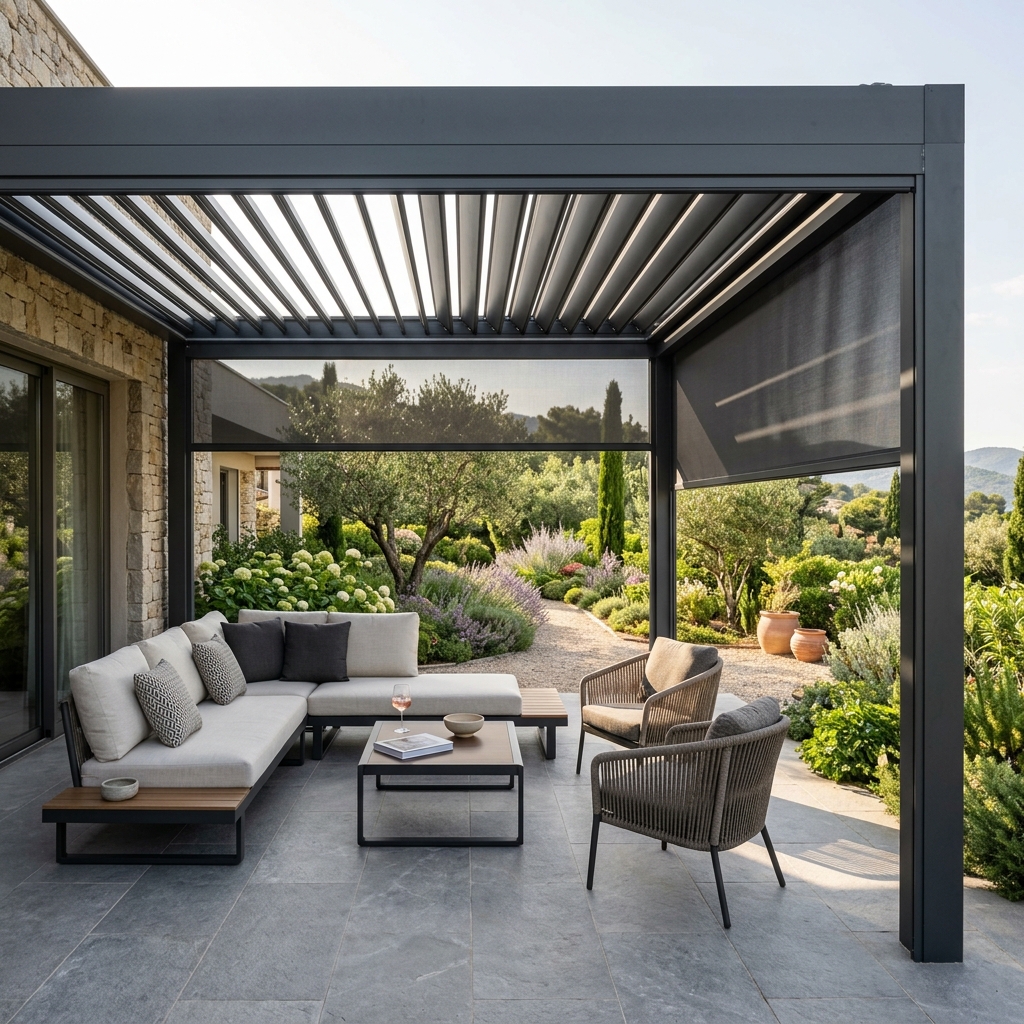
Motorized zip blind systems are the standard for commercial installations and increasingly common in premium residential projects. Manual operation is only practical for single panels in low-traffic residential settings. For any installation with multiple panels, high-frequency use, or integration with building systems, motorization is essential.
Why Motorize?
Operational efficiency:
A restaurant terrace with 10 zip blind panels would require 10 separate manual operations to open or close. With motorization, all panels respond to a single button press — critical for rapid response to changing weather. Tell us the panel count, the daily open-and-close cycles and whether the installation must follow a building system, and we will propose the motor, control and sensor set in a request a quote.
Automation:
Wind sensors automatically retract panels when wind speed exceeds the safe operating threshold, preventing fabric damage even when staff are not present. Sun sensors deploy panels automatically during peak solar hours, reducing HVAC load without manual intervention.
Guest/customer experience:
Smooth, silent motorized operation is expected in premium hotel and restaurant environments. Manual straps and cords are not appropriate for 4–5 star properties.
Energy management:
Automated solar shading integrated with building management systems can reduce HVAC energy consumption by 20–40% in commercial buildings.
Motor Types
Tubular Motors (Standard)
The most common motor type for zip blind systems. The motor is integrated inside the roller tube — invisible when installed.
Leading brands:
- Somfy (France) — market leader, widest compatibility, 5-year commercial warranty
- Nice (Italy) — strong European market presence, competitive pricing
- Elero (Germany) — premium quality, preferred for high-end commercial
- Cherubini (Italy) — specialist in shading motors
- Torque range: 6–50 Nm (higher torque for larger/heavier systems)
- Speed: 12–28 rpm
- Noise level: 45–55 dB (quiet operation)
- Power: 230V AC (standard) or 24V DC (battery/solar compatible)
- IP rating: IP44 (outdoor use), IP54 (wet environments)
External Motors
For very large or heavy systems where tubular motor torque is insufficient.
- Mounted externally on the roller tube end
- Higher torque available (up to 200 Nm)
- Easier maintenance access
- Used for panels wider than 500 cm or with heavy fabric
Control Systems
Basic Control
Wall switch: Simple 3-button control (up/stop/down). Suitable for single panels or small groups.
Handheld remote: RF (radio frequency) remote, range 30–100m. Allows control from anywhere in the space.
Intermediate Control
Multi-channel remote: Control up to 16 individual channels (panels or groups) from a single remote.
Smartphone app: Via Somfy TaHoma, Nice Home, or manufacturer-specific apps. Enables remote control from anywhere with internet connection.
Timer: Scheduled operation by time of day. Simple programming via app or wall-mounted controller.
Advanced Control (Commercial)
Building Management System (BMS) integration:
- KNX — European standard for building automation, widely used in hotels and offices
- BACnet — common in HVAC and building management systems
- Modbus — industrial protocol, used in larger commercial installations
- DALI — lighting control protocol, can be extended to shading
- Amazon Alexa compatible (via Somfy TaHoma or Nice Home hub)
- Google Home compatible
- Apple HomeKit compatible (via bridge device)
Automation Sensors
Wind Sensor
The most important safety sensor for outdoor zip blind systems.
Function: Measures wind speed continuously. When wind exceeds the preset threshold (typically 40–60 km/h), all connected panels retract automatically.
Placement: Mounted at the highest exposed point of the installation, away from obstructions.
Reset: After wind drops below threshold, panels can be redeployed manually or automatically after a delay.
Critical for: Any installation where panels cannot be monitored continuously — hotel rooftops, unattended restaurant terraces, residential balconies.
Sun Sensor
Function: Measures solar radiation (W/m²). Deploys panels automatically when radiation exceeds the preset threshold (typically 200–400 W/m²).
Benefit: Reduces HVAC load by preventing solar heat gain during peak hours, without requiring manual operation.
Integration: Can be combined with time schedules — for example, deploy only between 10:00 and 18:00 when sun sensor triggers.
Rain Sensor
Function: Detects rainfall and retracts panels automatically.
Note: Most zip blind fabrics are water-resistant but not fully waterproof. Rain sensors protect fabric from water pooling in the bottom bar and prevent mold growth from storing wet fabric in the cassette.
Energy Management Integration
For commercial buildings, motorized zip blinds integrated with BMS can deliver significant energy savings:
Summer operation:
- Sun sensor deploys blinds when solar radiation exceeds threshold
- Reduces solar heat gain through glazing
- HVAC cooling load reduced by 20–40%
- Lighting sensors can increase artificial lighting slightly to compensate for reduced daylight
- Blinds retract during daylight hours to maximize passive solar heating
- Deploy at sunset to reduce heat loss through glazing
- Net energy balance is positive in most climates
Frequently Asked Questions
What happens if the motor fails?
All tubular motors have a manual override — a hex key socket that allows manual operation in case of motor failure. The motor can be replaced without removing the fabric or frame. Replacement is typically a 1–2 hour job for a trained installer.Can existing manual zip blinds be retrofitted with motors?
Yes, in most cases. If the roller tube diameter is compatible with available motor sizes (typically 40mm, 50mm, or 60mm tube), a motor can be retrofitted. The side tracks and fabric do not need to be replaced. This is a cost-effective upgrade for existing installations.How are multiple panels synchronized?
Panels are synchronized by programming all motors to the same limit settings (fully open and fully closed positions). When a group command is sent, all motors start simultaneously and reach their limits at the same time. Fine adjustment is possible if panels are slightly out of sync.What is the power consumption of a motorized zip blind?
A standard tubular motor (10 Nm) consumes approximately 60–100W during operation and 0.5W in standby. For a 10-panel installation operating 4 times per day (2 open, 2 close), total daily energy consumption is approximately 0.1–0.2 kWh — negligible compared to the HVAC energy savings achieved.Are battery-powered motors available?
Yes. 24V DC battery-powered motors are available for installations where mains power is not accessible. Battery life is typically 1–3 years depending on usage frequency. Solar-powered charging is available for remote installations.More Frequently Asked Questions
Do you work with hotel chains and project buyers?Yes — we supply hospitality projects, distributors and multi-property programs.
Can systems be customized to site dimensions?
Yes — measure-based manufacturing is standard for ZIP screens, pergolas and many FF&E items.
What about motors and automation?
Somfy and comparable motor/control packages are available; integration scope defined per project.
Do you ship internationally?
Yes — FOB/CIF/DAP worldwide with export packing suited to the product.
How do we get project pricing?
RFQ with drawings, quantities, finishes and destination port.
For project-specific terms, contact WorldwideTradeX via RFQ.
← Zip Blind Systems: Complete B2B Guide for HoReCa & Commercial Projects