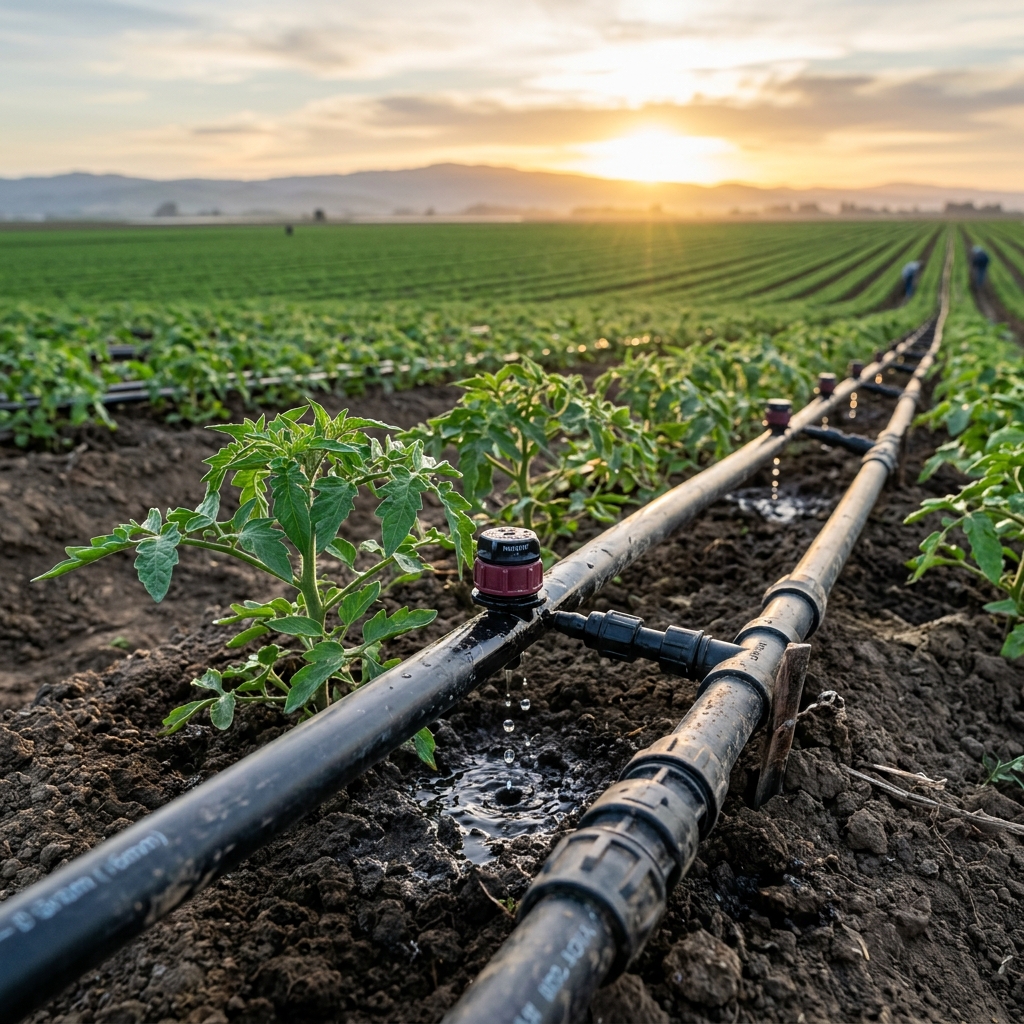
Advanced Irrigation Systems & Drip Technology
Last updated:
Modern agricultural productivity depends on the efficient distribution of water. WorldwideTradeX provides high-performance irrigation solutions designed...
Modern agricultural productivity depends on the efficient distribution of water. WorldwideTradeX provides high-performance irrigation solutions designed for large-scale farming, greenhouse automation, and commercial landscaping.
Table of Contents
- Drip Irrigation & Piping Infrastructure
- Dynamic Sprayer & VAN Nozzle Systems
- Automation, Control & Filtration
- Technical Specifications Table
1. Drip Irrigation & Professional Piping
Maximize water use efficiency (up to 95% savings) with targeted delivery systems.
1.1 Drip Tape & Emitter Technology
Pressure-Compensated (PC) Drippers:
- Operating Pressure Range: 0.5-3.0 bar (consistent flow across pressure variations)
- Flow Rate Options: 0.6 L/h, 1.0 L/h, 1.6 L/h, 2.0 L/h, 4.0 L/h
- Emitters per Meter: 1-4 emitters/m (spaced 20-100 cm)
- Inlet Pressure Tolerance: ±0.3 bar (flow variation <5%)
- Clogging Resistance: Self-cleaning labyrinth design
- Operating Pressure Range: 0.8-1.5 bar
- Flow Variation: ±15-20% across pressure range
- Suitable Applications: Flat terrain, short laterals (<30 m)
- Cost Advantage: 20-30% lower than PC systems
```
Optimal Spacing (cm) = (Emitter Flow L/h × 100) / (Soil Intake Rate mm/h)
```
Example: 1.0 L/h emitter, 10 mm/h intake rate → (1 × 100) / 10 = 10 cm spacing
Soil Type Considerations:
- Sandy Soil: 15-30 mm/h intake → 30-60 cm spacing
- Loam Soil: 8-15 mm/h intake → 20-40 cm spacing
- Clay Soil: 2-8 mm/h intake → 10-20 cm spacing
1.2 PE-100 Kangal Pipes: Main Line Infrastructure
Material Specifications:
- Polymer Grade: PE-100 (minimum 10.0 MPa MRS)
- SDR Rating: SDR 11 (standard dimension ratio)
- Wall Thickness: 1.9-34.0 mm (diameter dependent)
- Pressure Rating: PN6-PN25 (6-25 bar working pressure)
- UV Resistance: 50 years (carbon black 2-3%)
- Temperature Range: -20°C to +40°C (peak), -40°C short-term
```
Pipe Diameter (mm) = 18.8 × √(Flow Rate L/s × Length Factor / Pressure Loss)
```
Length Factor Table:
- Short Lines (<50 m): 0.5
- Medium Lines (50-200 m): 0.7
- Long Lines (200-500 m): 0.9
- Very Long Lines (>500 m): 1.2
- Flow: 50 L/s = 0.05 m³/s
- Length: 300 m (factor 0.7)
- Pressure Loss: 10 m/100m
- Diameter = 18.8 × √(0.05 × 0.7 / 10) = 18.8 × √0.0035 = 18.8 × 0.059 = 1.11 → 110 mm pipe
- Main Lines (Trunk): DN110-DN315, PN16-PN25
- Sub-Mains: DN50-DN110, PN10-PN16
- Lateral Lines: DN20-DN50, PN6-PN10
- Flexible Lines: DN16-DN40, PN6-PN10
- Trench Depth: 60-80 cm (freeze protection, vehicle load)
- Bedding: 10 cm sand垫, compacted to 95% Proctor
- Backfill: Original soil with stones <25 mm
- Marking Tape: 30 cm above pipe (colored, UV-resistant)
1.3 Fittings & Connection Technology
Compression Fittings:
- Material: Brass, stainless steel, or polymer
- Pressure Rating: Up to PN25
- Installation: Insert tube, tighten compression nut
- Reusability: Limited (2-3 times max)
- Principle: Internal heating coil melts pipe/fitting interface
- Advantages: Leak-free, no external tools, ideal for repairs
- Disadvantages: Higher cost, requires power source
- Applications: Main line branch connections, repair sleeves
- Seal Type: EPDM or NBR O-ring
- Locking Mechanism: Stainless steel collet
- Installation: Simple push-on, quick disconnect
- Pressure Rating: Up to PN16
```
Leak Rate (L/min) = (Pressure Drop bar × Volume L) / (Time min × 7 bar)
```
Acceptable: <0.1 L/min per 100 m of pipe
1.4 Drip Tape Installation Guidelines
Burial Depth:
- Surface Installation: 0 cm (temporary, seasonal crops)
- Shallow Burial: 5-10 cm (perennial crops, moderate traffic)
- Deep Burial: 15-30 cm (permanent installations, heavy traffic)
```
Optimal Spacing (cm) = 2 × Root Zone Radius (cm)
```
Examples:
- Tomato: 60-80 cm (deep taproot)
- Strawberry: 30-50 cm (shallow fibrous)
- Corn: 50-75 cm (moderate depth)
- Potato: 40-60 cm (moderate depth)
- Uniformity Target: >90% (Christiansen coefficient)
- Pressure Variation: <0.3 bar along lateral
- Elevation Change: Maximum 5 m (pressure-compensated)
1.5 Filtration System Design
Multi-Stage Filtration:
- Stage 1: Screen Filter (120-130 micron)
- Removes sand, debris, large particles
- Backflush interval: 24-48 hours
- Pressure drop: <0.3 bar (clean), >1.0 bar (requires cleaning)
- Stage 2: Disk Filter (50-100 micron)
- Removes fine particles, algae
- Pressure drop: <0.5 bar (clean), >1.5 bar (cleaning)
- Stage 3: Centrifugal Sand Separator
- Removes sand/grit (heavy particles)
- 95% removal efficiency at recommended flow
- No moving parts, gravity discharge
- Stage 4: Chemical Injection (Optional)
- Acid: Dissolve碳酸盐 (pH 5.5-6.5)
- Chlorine: Control biological growth
- Chelated Metals: Prevent precipitation
```
Filter Capacity (m³/h) = Peak Flow (m³/h) × Safety Factor (1.2-1.5)
```
Example: 50 m³/h peak → 60-75 m³/h filter capacity required
Filter Maintenance Schedule:
- Daily: Check pressure differential
- Weekly: Clean screens/disks
- Monthly: Inspect seals, O-rings
- Annually: Replace filter elements
2. Dynamic Sprayer & VAN Nozzle Systems
Engineered for uniform coverage and significant water conservation.
2.1 Variable Arc Nozzle (VAN) Technology
Arc Adjustment Mechanism:
- Adjustment Range: 0° (full circle) to 360° (full pattern)
- Adjustment Method: Manual screw or automatic actuator
- Precision: ±2° accuracy
- Locking Mechanism: Set screw or cam lock
| Nozzle Size | 1.0 bar | 1.5 bar | 2.0 bar | 2.5 bar |
|---|---|---|---|---|
| Small (3mm) | 1.2 m | 2.0 m | 2.8 m | 3.5 m |
| Medium (5mm) | 2.5 m | 3.5 m | 4.5 m | 5.5 m |
| Large (7mm) | 3.5 m | 4.8 m | 6.0 m | 7.2 m |
Flow Rate Calculator:
```
Flow (m³/s) = K × D² × √(Pressure bar)
```
Where K = nozzle-specific constant (0.0003-0.0005)
Example: 5mm nozzle at 1.5 bar
Flow = 0.0004 × 25 × √1.5 = 0.0004 × 25 × 1.22 = 0.0122 m³/s = 12.2 L/s Send the field layout, the water source and the crop, and we will quote a drip or sprinkler scheme with the components listed: request a quote.
2.2 Spray Pattern Uniformity
Standard Patterns:
- Full Circle (360°): Uniform radial distribution
- Semicircle (180°): Wall-mounted applications
- Rectangle (90°): Linear row crops
- Custom Arc (0-360°): Adjusted to plant row geometry
- Target: >85% (uniform application)
- Measurement: Catch can test (12-24 cans in grid)
- Calculation: DU = (Mean low-quarter catch) / (Mean total catch)
- Arrange 12-24 collection cans in grid pattern
- Run sprinkler for 30-60 minutes
- Measure water depth in each can
- Calculate DU using formula above
- Adjust sprinkler if DU <80%
2.3 Pop-Up Sprinkler Systems
Design Applications:
- Landscape Irrigation: Parks, golf courses, municipal areas
- Sports Fields: Football, soccer, baseball fields
- Commercial Properties: Office parks, shopping centers
- Riser Height: 50-300 mm (adjustable)
- Retraction: Spring return or gravity
- Activation: Water pressure (0.5-3.0 bar)
- Material: UV-resistant polymer
- Grass Areas: 50-100 mm below grade
- Paved Areas: Flush with surface, protective housing
- Sloped Terrain: Depth adjusted for even height
```
Spacing (m) = 0.8 × Throw Distance (m)
```
Example: 4.0 m throw → 3.2 m spacing (30% overlap)
2.4 Rotating Nozzle Systems
Gear-Driven Rotators:
- Rotation Speed: 10-30 minutes per revolution
- Coverage: 360° continuous
- Flow Rate: 0.5-2.0 m³/h
- Pressure Range: 2.0-5.0 bar
- Rotation Speed: 15-45 RPM
- Coverage: 90-360° (adjustable arc)
- Flow Rate: 1.0-5.0 m³/h
- Pressure Range: 3.0-7.0 bar
- Gear-Driven: 10-15 m (large area, uniform coverage)
- Impact: 8-12 m (smaller areas, higher pressure)
2.5 Mini-Spray & Micro-Sprinkler Systems
Micro-Sprinkler Applications:
- Orchard Irrigation: Citrus, vineyards, nut trees
- Nursery Plants: Container-grown plants
- Vegetable Crops: Transplant establishment
- Micro-Sprinkler: 20-100 L/h
- Mini-Sprinkler: 100-400 L/h
- Spray Diameter: 1.0-3.0 m
- Tree Base: 2-4 emitters per tree (120° apart)
- Row Crops: 1-2 emitters per plant
- Spacing: 1.5-3.0 m (depending on canopy size)
3. Automation, Control & Filtration
The "brain" and "heart" of precision irrigation networks.
3.1 Solenoid Valve Technology
Valve Types:
- Diaphragm Valves: 1-4 inch, electric or solenoid actuated
- Pressure Range: 0.5-10 bar
- Flow: 5-100 m³/h
- Actuation: 12-24V DC, 220V AC
- Butterfly Valves: 3-12 inch, electric actuated
- Pressure Range: 1-16 bar
- Flow: 50-500 m³/h
- Actuation: 24V DC, 220V AC
```
Valve Cv = Flow (GPM) × √(SG / ΔP)
```
For metric: Cv = Flow (m³/h) × √(1 / ΔP bar) × 0.86
Typical Cv Values:
- 1" diaphragm: 10-15
- 2" diaphragm: 30-45
- 3" diaphragm: 60-90
- 4" diaphragm: 100-150
3.2 Irrigation Controllers & Automation
Controller Types:
- Basic Timer Controllers: 4-12 stations, mechanical/electronic
- Smart Controllers: Wi-Fi enabled, weather-based scheduling
- PLC Controllers: Industrial grade, complex logic
- Centralized Systems: Networked across multiple sites
- Weather Data Integration: ET₀ calculation, rain delay
- Soil Moisture Input: Sensor-based irrigation triggering
- Mobile App Control: iOS/Android remote operation
- Flow Monitoring: Leak detection, water usage tracking
```
Irrigation Duration (min) = (Water Depth mm × Area m²) / (Flow L/min)
```
Example: 25 mm depth, 100 m², 500 L/min flow
Duration = (25 × 100) / 500 = 5 minutes
3.3 Moisture Sensor Integration
Sensor Types:
- Capacitance Sensors: Measure dielectric constant (volumetric water content)
- Tensiometers: Measure soil water tension (matric potential)
- Neutron Probe: Neutron moderation (research grade)
- Time Domain Reflectometry (TDR): Electromagnetic pulse (high accuracy)
- Shallow Root Crops: 15-30 cm
- Medium Root Crops: 30-60 cm
- Deep Root Crops: 60-90 cm
- Trees: 30 cm, 60 cm, 90 cm (multi-depth)
| Crop | Optimal (% vol) | Warning (%) | Stress (%) |
|---|---|---|---|
| Tomato | 60-80 | 50 | <40 |
| Corn | 65-80 | 55 | <45 |
| Wheat | 60-75 | 50 | <40 |
| Potato | 70-85 | 60 | <50 |
| Grapes | 50-65 | 40 | <30 |
3.4 Fertigation Systems
Fertilizer Injection:
- Venturi Injectors: Simple, no power required
- Efficiency: 60-70%
- Pressure Loss: 1-3 bar
- Pump Injectors: Positive displacement
- Efficiency: 90-95%
- Pressure Loss: <0.5 bar
- Pressure-Injected: Dedicated injection pump
- Efficiency: 95%
- Precise control
- Ammonium Nitrate: Avoid with calcium (precipitation)
- Calcium Nitrate: Avoid with sulfates (precipitation)
- Potassium Sulfate: Generally compatible
- Chelated Micronutrients: Stable over wide pH range
- Nitrogen: 50-200 kg/ha per application
- Phosphorus: 10-50 kg/ha per application
- Potassium: 30-150 kg/ha per application
- Micronutrients: 0.1-2.0 kg/ha per application
3.5 Drainage & Drain Valves
Drain Valve Types:
- Manual Drain: Plug or ball valve
- Automatic Drain: Timer or pressure-activated
- Siphon Drain: Gravity-based, no power required
```
Drain Capacity (m³/h) = 1.2 × System Volume (m³) / Drain Time (h)
```
Typical drain time: 2-4 hours for full system
Winterization Procedure:
- Shut off main water supply
- Open all drain valves
- Activate air compressor (5-10 psi)
- Flush each zone until dry
- Close drain valves, cap open ends
4. Technical Specifications: Irrigation Hub
| Component | Standard / Metric | Primary Application |
|---|---|---|
| PE Fittings | Compression / PN16 | High-pressure line security |
| Nozzle Radius | 0.9m - 4.6m | Precision zone coverage |
| Efficiency | 95% Water Saving | ESG / Arid Zone Agriculture |
| Filtration | 120 Mesh / 130 Micron | Drip emitter longevity |
5. System Design Examples
5.1 50-Hectare Wheat Field Drip Irrigation
Field Layout:
- Total Area: 50 hectares (500,000 m²)
- Field Segments: 10 segments × 5 hectares each
- Main Line: DN200 PE-100 pipe, PN16
- Sub-Mains: DN110 PE-100 pipes, PN16
- Laterals: DN50 PE pipes, PN10
- Drip Lines: 16 mm tubing, 30 cm spacing
- Peak ET₀: 6 mm/day
- Irrigation Efficiency: 90%
- Water Application: 6 mm / 0.9 = 6.7 mm
- Water Volume: 6.7 mm × 500,000 m² = 3,350 m³ per irrigation
- Irrigation Duration: 3,350 m³ / 100 m³/h = 33.5 hours
- Irrigation Period: 3 days × 12 hours/day
- Drip Lines: 500,000 m² / 0.3 m spacing = 1,667,000 m of drip line
- Emitters: 1,667,000 m / 0.3 m spacing = 5,556,667 emitters (30 cm spacing)
- Main Lines: 2 km (ring main)
- Sub-Mains: 10 km (1 km per segment)
- Valves: 10 automated solenoid valves (1 per segment)
- Drip Lines: $0.15/m × 1,667,000 m = $250,000
- Main/Sub-Mains: $20/m × 12,000 m = $240,000
- Valves & Controls: $10,000 × 10 = $100,000
- Filtration System: $40,000
- Pump & Power: $80,000
- Total: $710,000
- Cost per Hectare: $14,200
- Water Savings: 50% vs. flood irrigation
- Flood: 6,000 m³/ha, Drip: 3,000 m³/ha
- Annual savings: 150,000 m³ (assuming 5 irrigations)
- Fertilizer Savings: 30% (100 kg/ha saved)
- Annual savings: 5,000 kg fertilizer
5.2 Greenhouse Tomato Irrigation System
System Design:
- Area: 2,000 m² greenhouse
- Plant Spacing: 30 cm × 40 cm = 12 plants/m²
- Total Plants: 24,000 plants
- Drip Line Spacing: 40 cm (row spacing)
- Emitter Spacing: 20 cm (per plant)
- Drip Lines: 2,000 m² / 0.4 m = 5,000 m
- Emitters: 5,000 m / 0.2 m = 25,000 emitters (1.0 L/h each)
- Main Line: DN50 PE-100, PN16
- Sub-Mains: DN32 PE-100, PN16
- Filters: Screen (120 micron) + Disk (50 micron)
- Nutrient Solution: NPK 15-15-15 + micronutrients
- Concentration: EC 1.8-2.2 dS/m, pH 5.8-6.2
- Application: 0.5-1.0 L per plant per day
- Total Daily Water: 24,000 plants × 0.75 L = 18 m³
- Stations: 4-6 zones (depending on layout)
- Features: Moisture sensors, EC/pH monitoring, automated fertigation
5.3 10-Hectare OrchardsSprinkler System
System Configuration:
- Tree Spacing: 6 m × 6 m = 277 trees/ha
- Total Trees: 2,770 trees (10 ha)
- Sprinkler Spacing: 12 m × 12 m (192 sprinklers/ha)
- Total Sprinklers: 1,920 sprinklers
- Type: Rotating impact or gear-driven
- Flow Rate: 2.0-4.0 m³/h
- Throw Distance: 12-18 m
- Pressure: 3.0-5.0 bar
- Peak ET₀: 6 mm/day
- Orchard Coverage: 70% (tree canopy)
- Effective Area: 10 ha × 0.7 = 7 ha
- Water Depth: 6 mm
- Volume: 7 ha × 6 mm = 420 m³
- Flow Rate: 420 m³ / 8 hours = 52.5 m³/h
- Head: 40 m (elevation + friction)
- Pump Power: 25-30 kW electric motor
6. Implementation Guidelines
6.1 Pre-Design Checklist
Essential Information Required:
- [ ] Field or greenhouse dimensions (precise survey)
- [ ] Crop type and planting density
- [ ] Soil texture and depth profile
- [ ] Water source (well, river, reservoir) with quality analysis
- [ ] Available water quantity (L/s or m³/h)
- [ ] Water pressure (available head)
- [ ] Local climate data (ET₀, rainfall, temperature)
- [ ] Energy availability (electricity, fuel)
- [ ] Budget and ROI expectations
6.2 Design Verification Steps
Hydraulic Design:
- [ ] Flow rates calculated for all zones
- [ ] Pressure drops optimized (target <20% variation)
- [ ] Pipe sizes selected (AV method or Hazen-Williams)
- [ ] Pumps sized (flow + head requirements)
- [ ] Emergency overflow provision
- [ ] Filter capacity ≥ 1.5× peak flow
- [ ] Valve flow coefficients match system requirements
- [ ] emitter spacing appropriate for soil type
- [ ] Nozzle patterns match crop geometry
- [ ] Controller capacity (number of stations)
- [ ] Sensor integration (moisture, flow, pH)
- [ ] Remote access capabilities
- [ ] Data logging requirements
6.3 Installation Standards
Trenching Requirements:
- Depth: 60-80 cm (freeze protection, vehicle load)
- Width: 30-50 cm (work space)
- Bedding: 10 cm sand layer, compacted
- Backfill: Remove stones >25 mm, compact in layers
- Straight Lengths: No joints required >100 m
- Bends: Use 90° or 45° elbows, minimum bend radius 20× pipe diameter
- Joints: Properly fused or compression connected
- Testing: 1.5× working pressure for 2 hours
- Valve Box: 60×60×60 cm concrete pad
- Drainage: Gravity or pump-assisted
- Accessibility: Maintenance access provided
- Marking: Valve identification clearly labeled
6.4 Commissioning Procedure
Pre-Commissioning:
- Verify all components installed per design
- Inspect pipe joints and fittings
- Check electrical connections
- Inspect filtration system
- Hydraulic Test: Pressurize to 1.5× working pressure
- Leak Test: Monitor pressure drop for 2 hours
- Flow Test: Measure flow at design points
- Zone Test: Activate each zone individually
- Control Test: Verify automation functionality
- Distribution Test: Catch can test for uniformity
- Efficiency Test: Compare actual vs. design flow
- Control Test: Verify moisture sensor calibration
- Fertigation Test: Verify injection accuracy
6.5 Maintenance Schedule
Daily Checks:
- [ ] System pressure (main line, zones)
- [ ] Filter pressure differential
- [ ] Pump operation (noise, vibration)
- [ ] Controller status (alarms, time)
- [ ] Clean screen filters
- [ ] Inspect emitters for clogging
- [ ] Check for leaks (visual inspection)
- [ ] Verify valve operation
- [ ] Clean disk filters
- [ ] Inspect pump seals
- [ ] Check electrical connections
- [ ] Calibrate sensors
- [ ] Complete system flush (high-velocity water)
- [ ] Inspect pumps for wear
- [ ] Replace filters and seals
- [ ] Calibrate all sensors
- [ ] Winterization (if applicable)
6.6 Troubleshooting Guide
Problem: Low Pressure in Zone
- Check for leaks (visual inspection, acoustic listening)
- Verify filter is clean (pressure differential high)
- Inspect emitter for clogging (remove and flush)
- Check pump performance (flow rate vs. design)
- Verify valve is fully open (actuator issue)
- Perform catch can test (identify low-flow areas)
- Check emitter flow rates (replace faulty emitters)
- Verify pressure-compensated emitters functioning
- Inspect for air locks (bleed valves)
- Check for pipe collapse (deformation)
- Check pump efficiency (flow vs. head curve)
- Verify system for leaks (increased flow demand)
- Inspect for cavitation (noise, vibration)
- Verify motor winding resistance (electrical issue)
- Check for oversized pump (throttling required)
- Check injector pump calibration
- Verify fertilizer concentration in tank
- Inspect for air in injection line
- Check injection check valve (backflow)
- Verify mixing in main line (static mixer)
7. Economic Analysis
7.1 Cost Comparison Table
| System Type | Cost/Ha | Water Savings | ROI Period | Maintenance Cost |
|---|---|---|---|---|
| Flood Irrigation | $500-1,000 | 0% | N/A | $50-100/yr |
| Sprinkler | $2,000-4,000 | 30-40% | 3-5 years | $200-400/yr |
| Drip (Surface) | $3,000-6,000 | 50-60% | 2-4 years | $300-600/yr |
| Drip (Buried) | $5,000-8,000 | 60-70% | 3-5 years | $400-800/yr |
7.2 ROI Calculation Example
50-Hectare Wheat Field Conversion:
- Current System: Flood irrigation
- Proposed System: Drip irrigation
- Investment: $710,000 (from Section 5.1)
- Water: 150,000 m³ × $0.10/m³ = $15,000
- Fertilizer: 5,000 kg × $0.50/kg = $2,500
- Labor: 200 hours × $10/hour = $2,000
- Yield Increase: 10% × 3,000 kg/ha × $0.20/kg × 50 ha = $30,000
- Total Annual Savings: $49,500
```
Payback Period = Investment / Annual Savings
Payback = $710,000 / $49,500 = 14.3 years
```
With Yield Premium (Organic/High-Quality):
- Yield Premium: 20% increase
- Additional Revenue: $30,000 × 1.2 = $60,000
- Total Savings: $79,500
- Payback: $710,000 / $79,500 = 8.9 years
7.3 Financing Options
Lease vs. Purchase:
- Lease: $5,000-8,000/ha/year, 5-year term
- Purchase: $20,000-40,000/ha (one-time)
- ROI Comparison: Lease 20-30% higher effective cost
- Water Conservation Grants: Up to 30% of system cost
- Energy Efficiency Rebates: $0.05-0.10/kWh saved
- Agricultural Development Funds: Variable by region
8. Future Trends & Innovations
8.1 Smart Irrigation Systems
IoT-Enabled Irrigation:
- Soil Moisture Sensors: Real-time data transmission
- Weather Stations: Local ET₀ calculation
- Automated Control: AI-driven scheduling
- Mobile Monitoring: Remote control and alerts
- Data Aggregation: Combine sensor, weather, crop data
- Predictive Algorithms: Optimize irrigation timing
- Historical Analysis: Long-term water use patterns
- Compliance Reporting: Water usage documentation
8.2 Precision Irrigation Technologies
Variable Rate Irrigation (VRI):
- Technology: GPS-guided, zone-controlled
- Flow Control: 0-100% adjustability per zone
- Benefits: Match water application to soil type, slope, crop
- Savings: 15-25% water vs. uniform application
- Installation: 20-40 cm depth
- Advantages: Protection from UV, animals, machinery
- Disadvantages: Higher installation cost, inspection difficulty
- Lifespan: 15-20 years (vs. 5-10 for surface)
8.3 Water Recycling & Reuse
Treated Effluent Irrigation:
- filtration: Sand, membrane, UV treatment
- Nutrient Content: NPK values analyzed
- Safety Standards: WHO guidelines for crop type
- Cost: $0.10-0.30/m³ treatment
- Collection: Roof catchment (0.5-1.0 mm rain = 1-2 L water)
- Storage: 100-5,000 m³ tanks
- Quality: Filter + UV treatment required
- Sizing: 10-30% of annual water needs
Explore All Agro Commodities | Back to Main Portfolio
Frequently Asked Questions
What is the difference between drip irrigation and sprinkler irrigation?
Drip irrigation delivers water directly to the root zone at low flow rates (1–8 L/hour per emitter), minimizing evaporation and surface runoff. Water use efficiency is 90–95%. Sprinkler irrigation distributes water over a larger area via overhead nozzles, with 75–85% efficiency. Drip is preferred for row crops, orchards, and water-scarce regions.How much water can drip irrigation save compared to flood irrigation?
Drip irrigation typically saves 30–50% water compared to surface/flood irrigation for the same crop yield. In arid regions, savings can reach 60–70%. The combination of water savings and reduced fertilizer leaching (fertigation) makes drip systems economically viable within 2–4 seasons in most crops.What is fertigation and how does it work with drip systems?
Fertigation is the injection of water-soluble fertilizers directly into the irrigation water. Drip systems allow precise, frequent fertigation (daily or multiple times per day), delivering nutrients exactly when and where the plant needs them. This reduces fertilizer use by 20–40% compared to broadcast application while improving crop quality.What maintenance is required for drip irrigation systems?
Key maintenance: regular flushing of lateral lines to remove sediment, filter cleaning (screen/disc filters every 1–4 weeks), emitter inspection for clogging, and annual system pressure testing. Water quality analysis is essential — high iron, calcium, or biological content requires chemical treatment (acid flushing, chlorination) to prevent emitter clogging.More Frequently Asked Questions
What is the typical MOQ for this commodity?Bulk contracts usually start from one vessel or container lot. Exact MOQ depends on product, packing, and destination — send an RFQ for a firm number.
How is quality verified before shipment?
We supply batch COA documents and can arrange SGS/Intertek inspection at the loading port as specified in the SPA.
Which Incoterms do you offer?
FOB, CIF, CFR, and DAP are standard. The right term depends on your logistics capability and risk preference.
Are prices fixed or market-based?
Prices are market-based and benchmarked to relevant indices. Current quotes are issued via RFQ — we do not publish fixed standing prices.
Can you support private label or destination packing?
Where the product allows, yes — packing format, labels, and lot documentation can be aligned to your market requirements.
For project-specific terms, contact WorldwideTradeX via RFQ.