Turkish marble is bought in four formats — blocks, slabs, cut-to-size pieces and finished products — from quarry clusters in Afyon, Muğla, Denizli, Balıkesir, Burdur and Elazığ. This page sets out the export varieties, the EN test standards buyers request, how A/B/C grading works, how stone is packed, and the six steps from a specification sheet to a loaded container.
At a glance
| Format | What you receive | Who buys it | Document to ask for |
|---|---|---|---|
| Block | Raw quarry block, inspected at the face | Processor with its own sawing capacity | Quarry/lot identification, block photos |
| Slab | Sawn or polished panel, typically A-framed | Fabricator, dealer, project buyer | Test report for the stone and lot, packing list |
| Cut-to-size tile | Piece cut to a drawing, calibrated | Contractor, project buyer | Approved shop drawing, thickness tolerance sheet |
| Finished piece | Installable item (table, sink, sill, stair set) | Retailer, hospitality buyer | Assembly drawing with part numbering |
Where the figures stand. In 2025 marble made up 69.8% and travertine 19.5% of Türkiye's natural-stone production, and processed products were 68.38% of natural-stone exports against 31.62% blocks; the USA, China, India, Saudi Arabia and Iraq were the five largest export markets (Ministry of Energy and Natural Resources, page updated 30 June 2026 — infobank: natural stones). The same source gives total reserves as 63.11 billion tonnes, described there as about 40% of world natural-stone reserves. Tell us the product group — blocks, slabs, tiles or cut-to-size — and request a quote with the volume, finish and destination port.
Which Turkish marble varieties are most often specified?
Four colour families cover almost every export enquiry: white and cream, beige, grey and black, and the coloured or translucent stones used for feature work. The names below are the ones that appear in our product pages and sample requests; the same name is not a guarantee of appearance, because a quarry block varies and shade control is a contract question rather than a catalogue fact. Read the variety guide for origin regions, colour ranges and what each stone is normally used for.
White and cream marbles
White marble is the volume category. It is specified for lobby floors, wall cladding, stairs and bathroom work, and it is also the category where buyers most often underestimate shade variation between blocks.
| Variety | What it looks like | Where buyers use it |
|---|---|---|
| Afyon White | White base, minimal veining | Flooring, wall cladding, stairs |
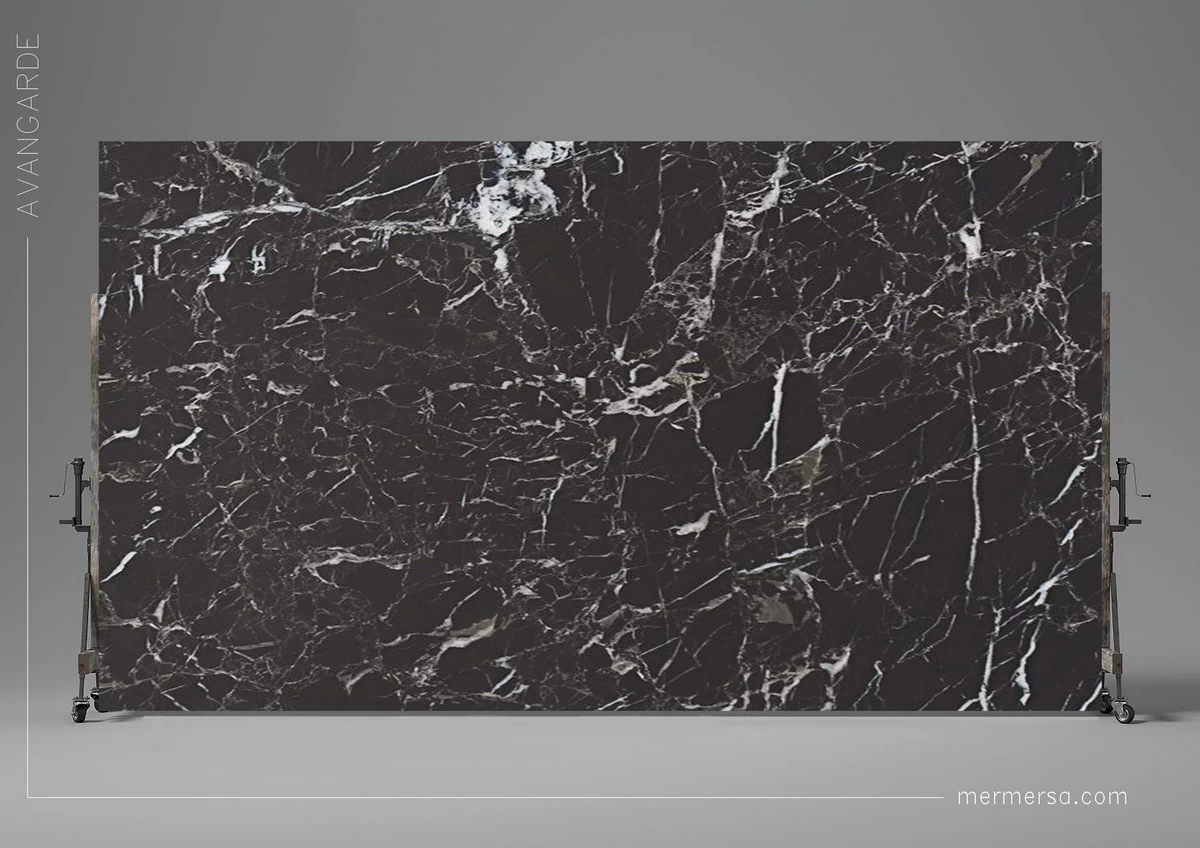
| Avangarde | White base with bold contrast veins | Feature walls, tabletops, counters |
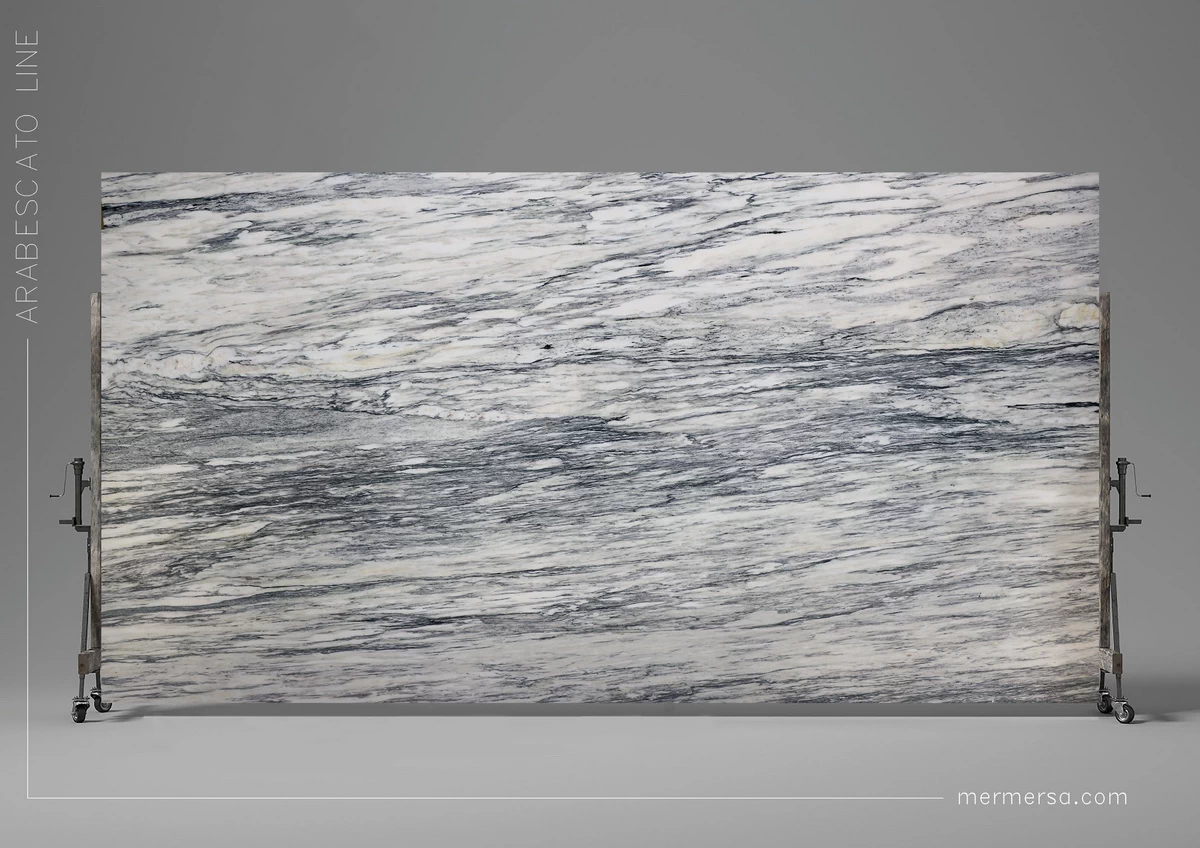
| Arabescato | Grey-blue veins on a cream base | Bookmatched walls, luxury interiors |
| Sugar Marble | Fine-grained, bright white | Sinks, bathroom sets, decorative pieces |
Bright crystalline whites such as Thassos from Greece and Carrara-family whites from Italy appear in the same tender conversation, but they are non-Turkish comparators, not part of this range; use them only to describe the look you are chasing, not as an origin.
Beige and cream marbles
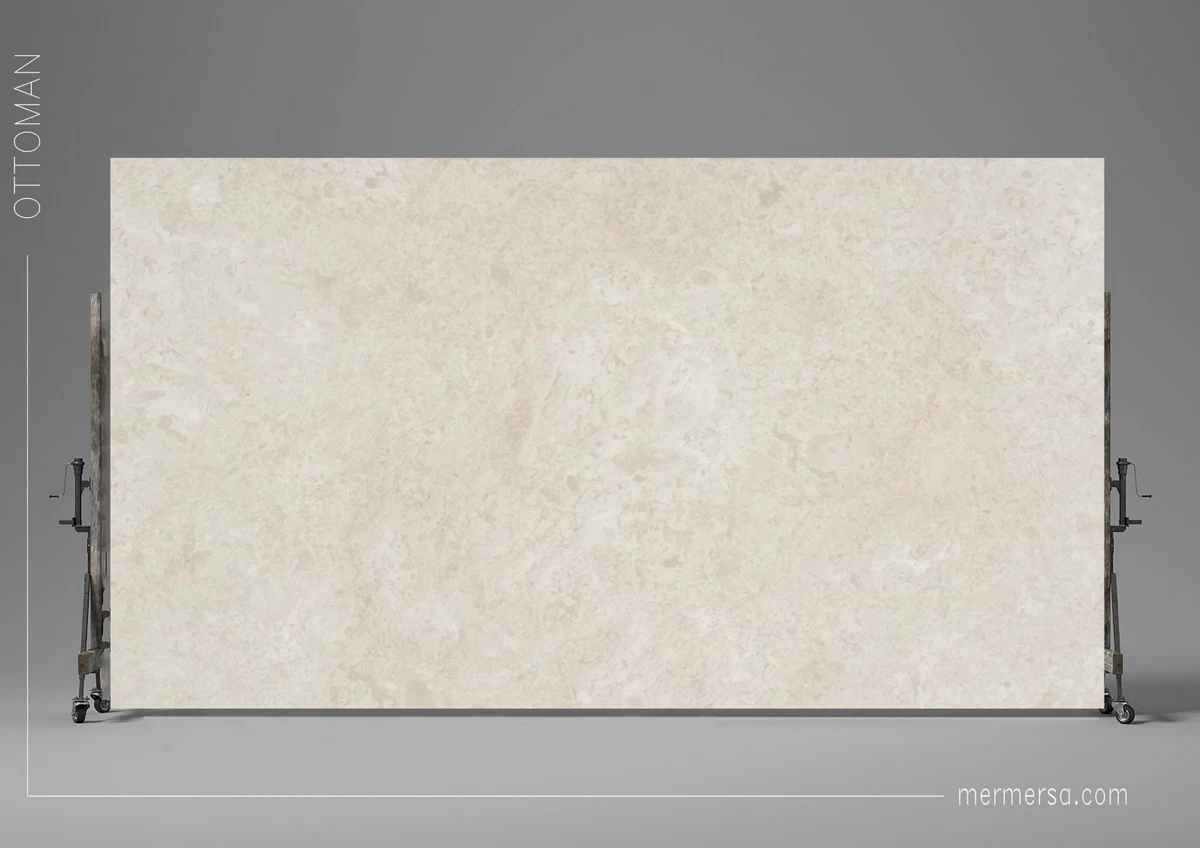
Warm neutrals dominate hotel and hospitality floors because they hide everyday wear better than white and read well under warm lighting. Ottoman Beige, Active Beige and Balıkesir Beige are the names most often quoted; travertine sits in the same commercial slot at a different price logic.
Grey and black marbles
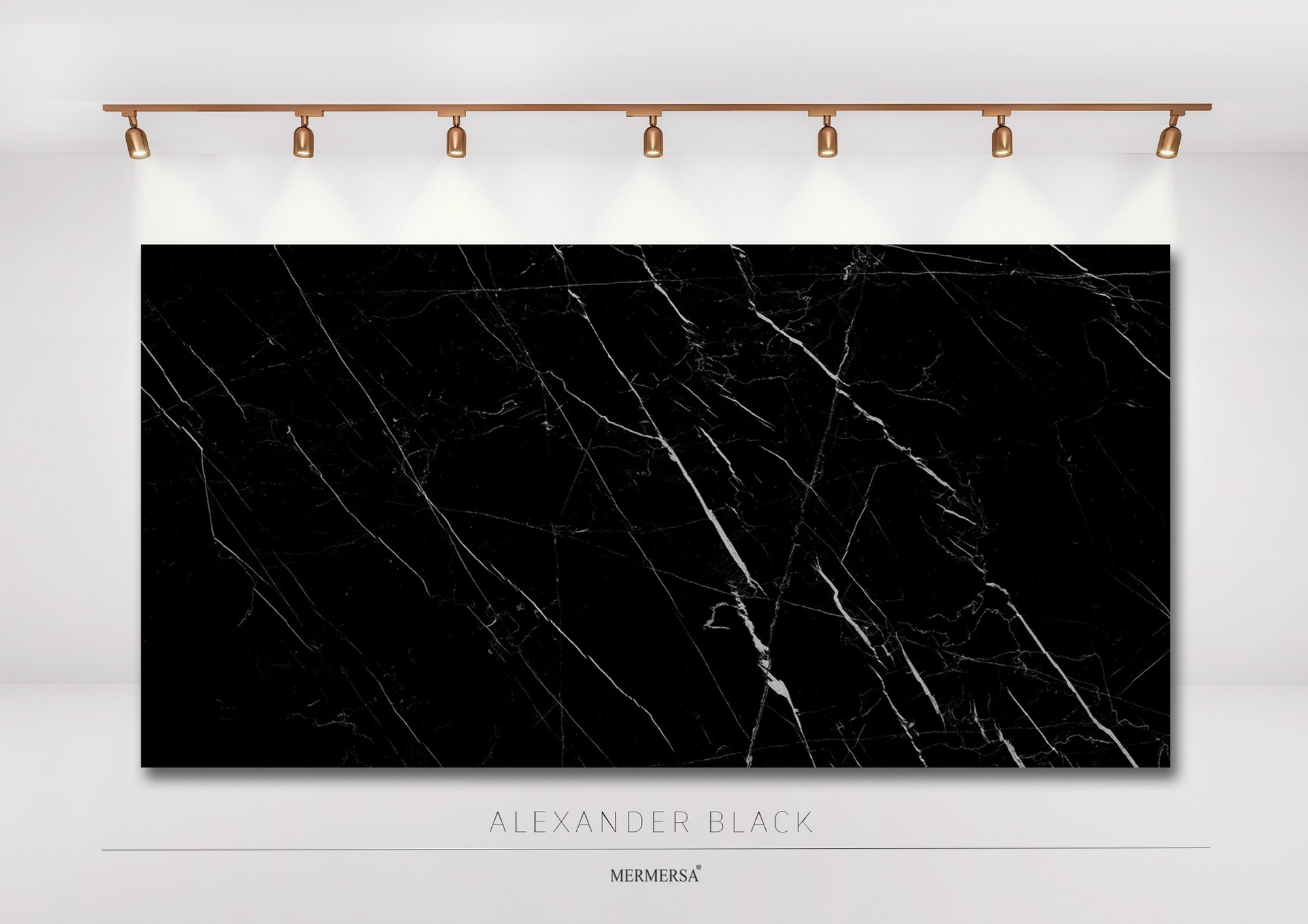
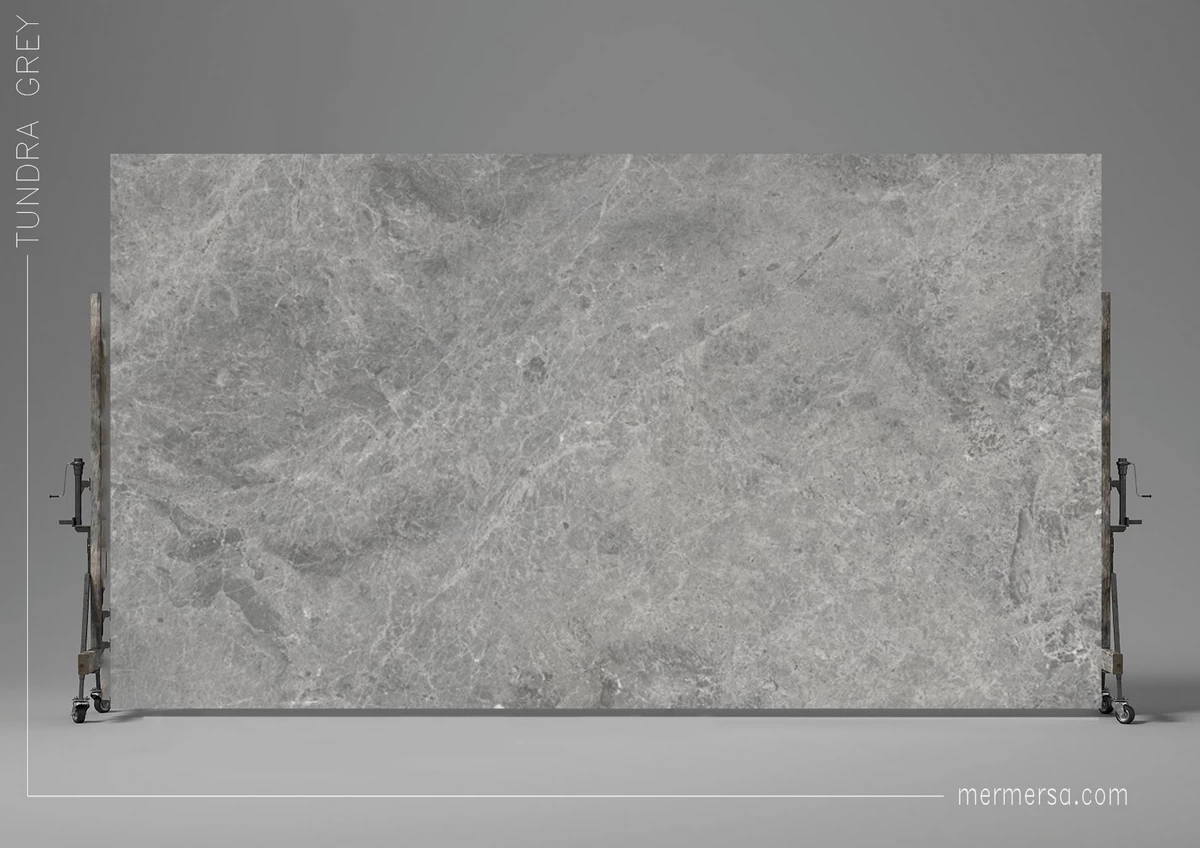
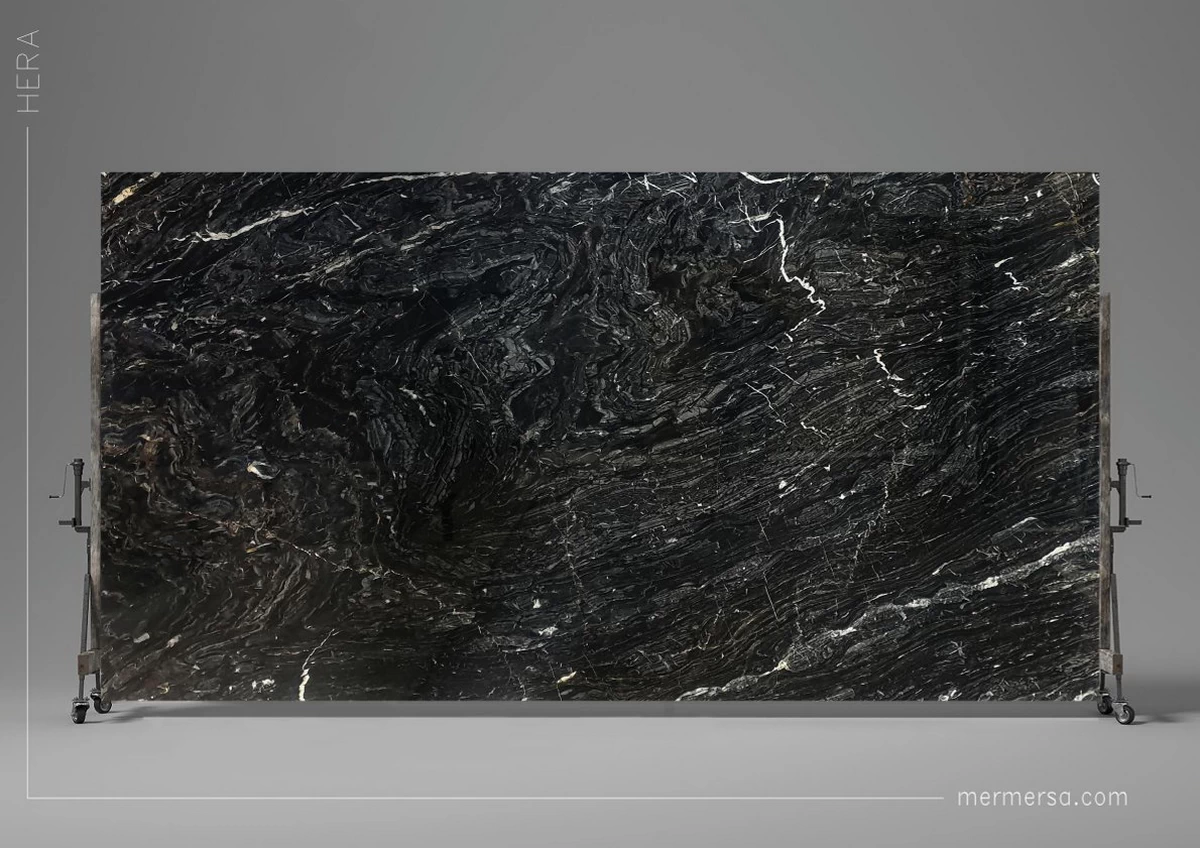
Tundra Grey, Armani Grey, Alexander Black and Hera Black are specified where a project wants contrast: reception desks, bar fronts, fireplace surrounds and feature walls. Dark polished stone shows etching and water marks more clearly than light honed stone, which is a maintenance question worth raising before the order, not after.
Coloured and translucent stones
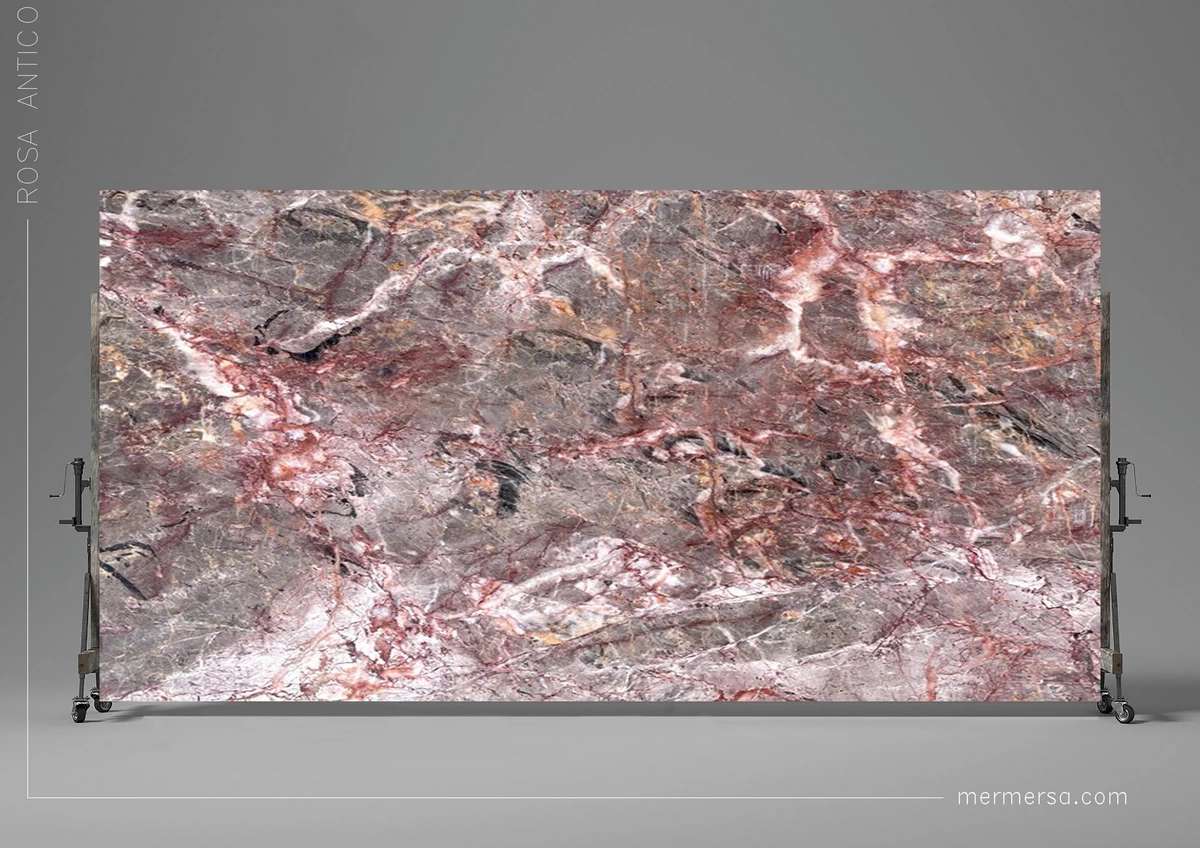
Rosa Antico, Violet, Elazığ Cherry and honey or green onyx cover the statement pieces: fireplace surrounds, backlit bar fronts, decorative panels. Onyx is the one stone in the range that is routinely specified for backlighting, so translucency and slab thickness need to be agreed against a sample rather than a description.
Where does each stone come from?
Quarry region matters more than buyers expect, because it drives colour range, block size, availability over a project's life and the paperwork that follows the stone. A project that needs a second shipment two years later is really asking whether the same quarry and the same layer are still producing.
| Quarry region | Stone family | What the region is known for |
|---|---|---|
| Afyon | White and beige marble | Afyon White, Sugar, beige lines; dense processing cluster |
| Muğla | White and grey marble | Muğla White and grey varieties |
| Denizli | Travertine and grey marble | Classic travertine, Denizli grey |
| Balıkesir (Marmara) | Beige, cream and historic white | Beige lines; Marmara Island as a historic white marble source |
| Burdur | Onyx and travertine | Burdur onyx, honey travertine |
| Elazığ | Cherry, rose and violet | Elazığ Cherry and the rose/violet family |
Two questions settle most of this section in an RFQ: which quarry and layer the offer is based on, and whether matching material for a later phase can be reserved at the same time. The travertine page covers the Denizli and Burdur stones in more detail, and the gallery shows the stones next to each other so that colour families can be compared visually.
Which format should you order: block, slab, tile or finished piece?
The right format depends on who does the next operation. Buying blocks makes sense when you own or control a gangsaw and a polishing line; buying slabs suits fabricators who cut to their own templates; cut-to-size tiles suit contractors working from a drawing; finished pieces suit retailers and project buyers who want something installable.
| Format | Typical buyer | What it is used for | Handling note |
|---|---|---|---|
| Block | Processor with its own cutting capacity | Sawing into slabs or tiles | Inspected at the quarry face; transport is by flatbed to a plant |
| Slab | Fabricator, dealer | Countertops, cladding, big tiles | A-frame or bundled crates; cutting waste is the buyer's calculation |
| Cut-to-size / tile | Contractor, project buyer | Floors, walls, stairs from a drawing | Palletised cartons; calibration and thickness tolerance matter here |
| Finished piece | Retailer, hospitality buyer | Tables, sinks, sills, stair sets | Plywood crates, foam, corner protection; numbering for site assembly |
The trade-off is capital versus control. Blocks are cheaper per square metre of finished stone only if the yield is good and the offcuts have a use; slabs cost more per unit of raw material but transfer the cutting risk to someone who does it every day. Our format comparison sets out the yield arithmetic with symbols rather than promises, because yield depends on block soundness and the cutting plan. Countertops, tables, stairs and marble windowsills each add their own fabrication steps on top of the base format.
Which standards does a marble buyer ask for?
Turkish marble is sold against European test standards more often than against any other reference set, and the standards are the language in which a specification is written. Names only are given here; values belong to the producer's datasheet for the specific stone and lot.
- EN 1469 — slabs for cladding: the document a façade or wall-cladding specification usually cites.
- EN 12058 — slabs for floors and stairs: the floor and stair counterpart.
- EN 12057 — modular tiles: the standard behind cut-to-size tile orders.
- EN 1341 — slabs of natural stone for outdoor paving: the one to name for exterior paving projects.
- EN 1936 for density and porosity, EN 13755 for water absorption.
- EN 1926 — compressive strength; EN 12372 — flexural strength.
- EN 14231 — slip resistance by the pendulum test: the document to ask for when a stone is going into a wet area or a public floor.
- EN 12670 — terminology, useful when a contract has to define what "repair" and "fissure" mean.
- ASTM C503 — the marble dimension stone specification used on US-market projects.
How do you buy Turkish marble: the six-step RFQ path
- Send a specification, not a photo. Product type, acceptable varieties, format, thickness, finish, quantity in square metres or pieces, destination port and the date the site needs the stone. Photos help, but a specification is what a factory can quote against.
- Fix the sample basis. Ask for samples taken from the block or batch that will actually be processed, not from a showroom board. For large projects, request block photos or video and, where practical, a visit.
- Read the quotation on a common basis. Confirm the unit of sale (per square metre, per piece, per tonne), the Incoterm, the packing method, the finish, the thickness tolerance and how long the price stays valid.
- Turn the offer into a contract annex. Attach the agreed specification, the grade definition, the inspection rights and the claim window to the pro-forma or sales contract.
- Inspect before loading. Either your own inspector, a third party such as SGS or Intertek, or a documented photos inspection. Whatever the choice, agree it before production ends, not after the container is closed.
- Load, document, and keep the claim route open. Packing list, commercial invoice, certificate of origin and transport document travel with the shipment; the inspection and claims page explains what to check on arrival and how to document damage.
How is marble packed and loaded for export?
Packing is where a good order and a bad arrival are decided. Slabs travel on A-frames or in bundled crates with separators between faces; tiles travel in cartons on pallets with corner protection; finished pieces travel in plywood crates lined with foam, with each part labelled to match an assembly drawing. Long thin pieces such as stairs and marble sills are the breakage risk in almost every order, so bundle design and lashing points are worth a line in the contract.
Wood packaging used for export normally has to comply with ISPM 15, the international phytosanitary standard for wood packaging material, which is a customs question rather than a quality one. Container type, weight distribution and the split between a 20 ft and a 40 ft box depend on the product mix and the destination; the packing and container loading page sets out the logic, the questions to ask and the supervision options, without pretending that one loading pattern fits every order.
How do grades A, B and C work in practice?
Grading is a description of natural variation and acceptable repair, not a quality label in the marketing sense. Grade A means uniform colour and minimal fissuring; grade B allows minor variation and small repairs; grade C accepts visible veining, colour movement and repairs, and is used where budget matters more than uniformity.
| Grade | What it allows | Where it normally goes |
|---|---|---|
| A | Uniform shade, tight vein control, minimal repair | Lobby floors, showrooms, high-visibility cladding |
| B | Minor shade variation, small filled fissures, standard repair | Commercial floors, corridors, general cladding |
| C | Visible movement, more repairs, wider shade range | Landscaping, budget cladding, cut-down work |
The grade only protects the buyer if it is defined against inspection criteria: colour and vein uniformity, permitted repairs, resin and mesh backing, calibration and thickness tolerance. That definition, and what happens when a lot does not meet it, belongs in the buyer's guide and in the claims procedure.
What does a project supply package look like?
Hospitality and mixed-use projects rarely order one product. A hotel package usually mixes lobby flooring, corridor cladding, bathroom countertops and sinks, staircases, reception desk fronts and some FF&E pieces such as tables, furniture or TV units. The practical difficulty is not any single item; it is keeping shade, finish and batch consistent across items that are produced in different weeks.
The sequence that works is a specification stage with approved samples, a mock-up for the most visible surface, a quantity take-off with an overage allowance, shop drawings with part numbering, and phased deliveries matched to the fit-out programme. Our hotel and project supply page walks through that sequence, and interior fit-out covers the wider contractor coordination. Marble flooring, wall cladding and fireplaces each carry the specification detail for their own scope.
How should buyers compare stone with the alternatives?
Marble is not always the right answer. Engineered quartz and porcelain are more consistent and more chemical-resistant; granite handles acid and wear differently; sintered stone competes on thin large-format panels. The differences that matter in a tender are appearance, hardness, staining and etching behaviour, heat tolerance, weight, repairability and cost logic, and they are laid out on the comparison page. For the marble side of the argument, the finishes page explains how a honed surface hides etching that a polished surface shows on day one.
Care after handover is a budget question as much as a technical one: sealing does not stop etching, and commercial cleaning products are the usual cause of damage in hotels and lobbies. The care and maintenance page gives a cleaning table and a maintenance plan; the price guide explains why a per-square-metre price comparison between quotes is usually meaningless without the same variety, grade, thickness, finish and packing.
What do we need from you to quote?
An enquiry gets a useful answer when it carries: the product and acceptable alternatives, format and thickness, finish, quantity, destination port or delivery address, target date, packing expectations, and any standard or inspection requirement. Add the site constraints that are easy to forget, such as maximum piece weight for manual handling, lift or stair access, and whether pieces will be handled by forklift or gantry. Send the requirement as an RFQ and it will be checked against availability and packing before a number is put on it.
Frequently Asked Questions
Do you supply blocks, slabs, tiles or finished products?
All four formats, depending on the product family. Blocks and slabs suit processors and fabricators; cut-to-size tiles suit contractors working from drawings; finished pieces such as tables, sinks, stair sets and sills are supplied ready to install. Say which format you need in the RFQ, because the price basis, packing and inspection points differ for each.
Can I choose the specific block my order comes from?
For block and slab orders, yes in practice: block photos or video can be shared before cutting, and for larger projects a quarry or plant visit can be arranged. For tile and finished-piece orders the batch is what gets matched, since several blocks may feed one order.
Which finish should I choose for a hotel lobby floor?
It depends on the maintenance regime. Polished shows every etch mark and dust pattern but reads brighter; honed hides etching and glare; brushed and sandblasted add grip for wet areas. Ask for the slip-resistance test result for the exact stone and finish, and confirm the cleaning products the operator will actually use.
What standards do you work to?
European natural stone standards are the normal reference: EN 1469 for cladding slabs, EN 12058 for floor and stair slabs, EN 12057 for modular tiles, EN 1936 for density and porosity, EN 13755 for water absorption, EN 1926 for compressive strength, EN 12372 for flexural strength, and EN 14231 for slip resistance. ASTM C503 is the reference on US-market projects. We name the standards; the numbers belong on the producer's datasheet for your stone.
How is colour consistency controlled across a large order?
By tying the order to a block or a small set of blocks and by agreeing a shade tolerance in the contract. Bookmatching for feature walls is planned from slab pairs, which has to be decided before cutting starts. See the quality inspection page for the criteria an inspector checks.
What are the main causes of damage in transit?
Improperly designed crates, too few lashing points, stone loaded against a container wall without protection, and long thin pieces without intermediate support. Loading supervision photographs solve disputes later; the packing page lists what to look for.
How do payment terms usually work on a first order?
A deposit against the pro-forma with the balance against shipping documents is common on first orders; letters of credit are used where the buyer or the bank requires them. The buyer's guide sets out the options and the risk each one carries for both sides.
Do you provide installation?
For project quantities, installation supervision can be arranged through local contractors, with shop drawings and part numbering supplied so that site teams can assemble stair sets, cladding and pattern floors. Small orders ship with installation notes. Site works outside stone supply are handled with the fit-out contractor, see interior fit-out.
Sources and standards
- İMİB — Istanbul Mineral Exporters' Association — the sector body whose publications are the first place to look for Turkish natural stone figures; quote any reserve or export number with the publication name and year.
- TİM — Türkiye Exporters Assembly — aggregate export data by sector and year, useful for market context.
- CEN-CENELEC — where the EN natural stone standards listed above are published; order the texts before writing them into a tender.
- ASTM International — publisher of ASTM C503, the marble dimension stone specification used on US-market projects.
Related pages
Marble buyer's guide: the ten-step import process · Turkish marble varieties and origins · Blocks, slabs and tiles compared · Travertine from Denizli and Burdur · Marble finishes from polished to flamed · Technical data and test standards · Packing and container loading · Import documents and customs · Price drivers explained · Quality inspection and claims · Hotel and project supply · Care, sealing and maintenance · Marble versus granite, quartz and porcelain · Marble TV units · Project gallery · Request a quote