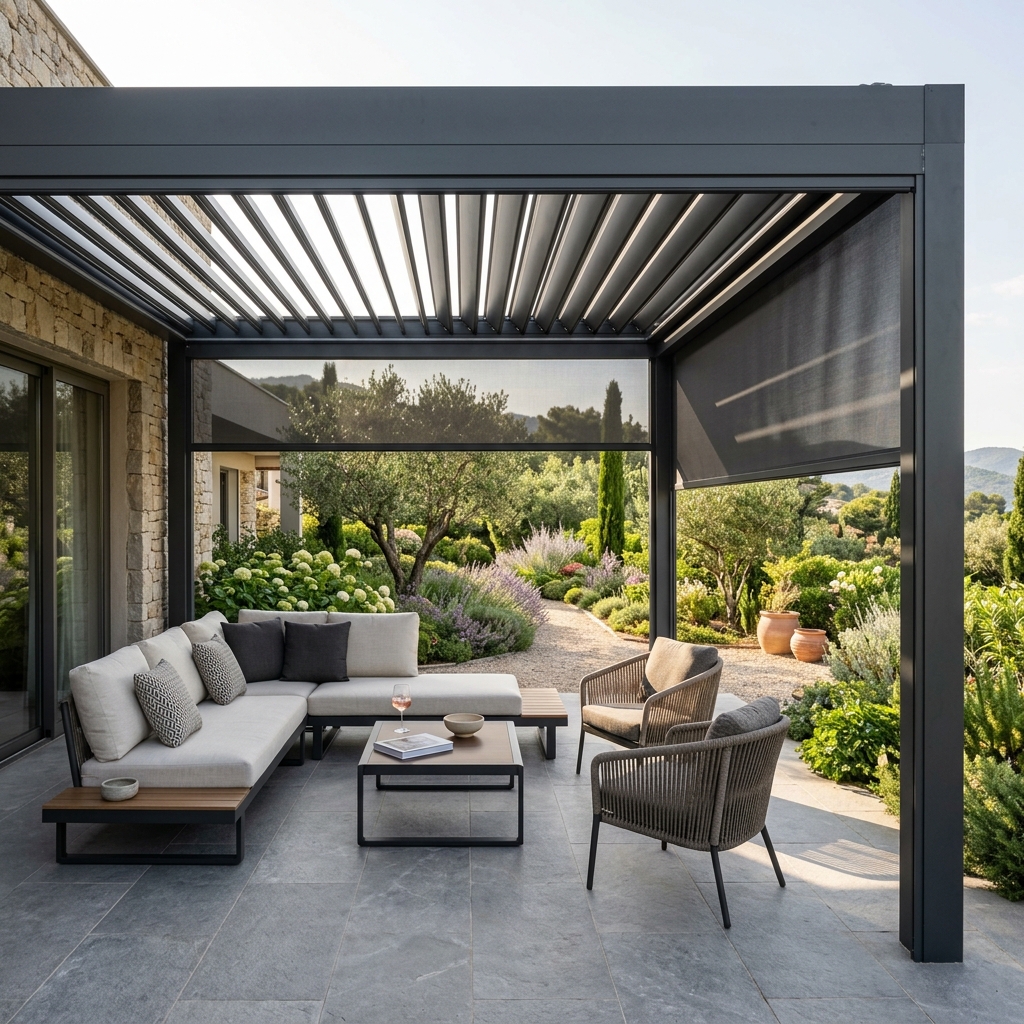
Zip blind systems are the global standard for outdoor shading in commercial environments. Unlike conventional roller blinds or awnings, zip blinds use a patented zipper-track mechanism that locks the fabric edge into aluminum guide rails — creating a sealed perimeter that resists wind, blocks UV radiation, controls temperature, and provides privacy without sacrificing natural light.
WorldwideTradeX supplies zip blind systems for HoReCa (Hotel, Restaurant, Café) projects, commercial buildings, residential complexes, and industrial facilities. We connect project developers, interior designers, and procurement teams with certified Turkish manufacturers offering full project support from specification to installation.
Table of Contents
- What is a Zip Blind System?
- How the Zipper Track Mechanism Works
- System Types & Models
- Fabric Technology & Performance
- Motorization & Smart Control
- Application Areas
- Wind Resistance & Certifications
- Installation & Maintenance
- Technical Specifications
- Frequently Asked Questions
1. What is a Zip Blind System?
A zip blind (also called zip screen, zip shade, or zip roller) is an outdoor shading system where the fabric edges are locked into aluminum guide rails via a continuous zipper track. This creates a hermetically sealed perimeter that:
- Eliminates fabric flutter in wind (unlike standard roller blinds)
- Blocks insects completely when fully deployed
- Controls solar heat gain — reducing cooling loads by 20–40%
- Provides privacy while maintaining outward visibility (3–10% openness factor)
- Protects against rain at low angles when combined with a cassette housing
2. How the Zipper Track Mechanism Works
The zipper channel system is the engineering core of zip blind performance:
Components:
- Aluminum side tracks — extruded 6063-T6 alloy, powder-coated, available in RAL colors
- Zipper tape — high-frequency welded to fabric edges, UV-stabilized PVC
- PVC guide inserts — self-lubricating, replaceable, ensure smooth operation
- Bottom bar — weighted aluminum profile with rubber seal for floor contact
- Roller tube — motor or spring-loaded, housed in cassette or open-roll configuration
- Motor or manual operation unrolls fabric from the roller tube
- Zipper tape on fabric edges engages with PVC inserts in side tracks
- Fabric descends under controlled tension — no flutter, no billowing
- Bottom bar contacts floor seal (optional) for complete enclosure
- Reverse operation retracts fabric into cassette housing
Standard roller blinds without zipper tracks fail in wind above 30–40 km/h. Zip blind systems maintain structural integrity up to 120–140 km/h (Class 4–6 per EN 13561), making them suitable for coastal resorts, rooftop terraces, and high-rise balconies.
3. System Types & Models
Ceiling-Mounted Zip Blind (Tavan Zip Perde)
The most common configuration for pergolas, terraces, and covered outdoor areas. The roller tube is mounted horizontally at ceiling level, with the fabric descending vertically.
Spring-Loaded Ceiling System (Yaylı Tavan):
- Spring mechanism maintains constant fabric tension
- No motor required — manual operation via strap or cord
- Suitable for widths up to 400 cm
- Lower cost, simpler maintenance
- Hydraulic shock absorber controls descent speed
- Prevents fabric damage from rapid deployment
- Suitable for widths up to 600 cm
- Preferred for high-traffic commercial installations
Vertical Zip Blind (Dikey Zip Perde)
Wall-mounted configuration where the roller tube is positioned vertically. The fabric extends horizontally across the opening.
- Ideal for wide openings where ceiling mounting is not possible
- Used for shop fronts, restaurant facades, and large terrace enclosures
- Available in motorized and manual versions
Cassette Zip Blind (Kasetli Zip Perde)
The roller tube and fabric are housed in a protective aluminum cassette when retracted. This protects the fabric from UV degradation and weather when not in use, significantly extending product lifespan.
- Premium option for permanent installations
- Fabric lifespan extended by 30–50% vs open-roll systems
- Available in ceiling and wall-mount configurations
4. Fabric Technology & Performance
Zip blind fabric is a technical textile engineered for outdoor performance. Key parameters:
Openness Factor (OF):
The percentage of the fabric surface that is open (perforated). This determines the balance between solar control, visibility, and ventilation.
| Openness Factor | Solar Rejection | Visibility | Best Use |
|---|---|---|---|
| 1–3% | 95–99% | Limited | Maximum privacy, sun control |
| 3–5% | 90–95% | Good | Standard commercial |
| 5–10% | 80–90% | Excellent | View preservation priority |
| 10–14% | 70–80% | Maximum | Insect protection only |
Fabric Materials:
- PVC-coated polyester — most common, high durability, easy cleaning, 5–15 year lifespan
- Fiberglass (glass fiber) — fire-resistant (Class B1), dimensionally stable, no stretching
- HDPE (High-Density Polyethylene) — lightweight, UV-stabilized, recyclable
- UV Protection: 95–99% UV blockage (UPF 50+)
- Solar Heat Rejection: 70–99% depending on openness factor and color
- Breathability: "Breathing" fabric allows air circulation — no condensation buildup
- Acoustic: Reduces external noise by 3–8 dB
- Fire Rating: Available in Class B1 (DIN 4102) for commercial applications
5. Motorization & Smart Control
Motorized zip blind systems are the standard for commercial installations. Manual operation is only practical for single residential units.
Motor Types:
- Tubular motors (Somfy, Nice, Elero, Cherubini) — integrated into the roller tube, silent operation, 5-year commercial warranty
- External motors — for very large or heavy systems, easier maintenance access
- Wall switch — simple on/off/stop
- Remote control — RF (radio frequency), range 30–100m
- Smartphone app — via Somfy TaHoma, Nice Home, or proprietary systems
- Building Management System (BMS) — KNX, BACnet, Modbus integration for hotel/commercial automation
- Voice control — Amazon Alexa, Google Home compatible (via smart hub)
- Wind sensor — automatic retraction at preset wind speed (typically 40–60 km/h)
- Sun sensor — automatic deployment when solar radiation exceeds threshold
- Rain sensor — automatic retraction to protect fabric
- Timer — scheduled operation by time of day
Automated zip blinds in commercial buildings reduce HVAC energy consumption by 20–40% by preventing solar heat gain in summer and reducing heat loss in winter. ROI on motorization is typically 3–5 years in commercial applications.
6. Application Areas
Zip blind systems are used across a wide range of commercial and residential applications:
HoReCa (Hotel, Restaurant, Café):
- Hotel terrace and pool area enclosures
- Restaurant outdoor dining areas — year-round operation
- Café and bar facade systems
- Resort bungalow and villa shading
- Lobby and atrium solar control
- Shopping mall exterior shading
- Office building facade systems
- Showroom and retail storefront enclosures
- Warehouse and industrial door alternatives
- Balcony and terrace enclosures
- Winter garden (kış bahçesi) systems
- Pergola and gazebo integration
- Garage door alternatives
- Healthcare facility sun control
- Educational institution shading
- Sports facility wind protection
- Rooftop terrace enclosures
| Application | Primary Benefit | Secondary Benefit |
|---|---|---|
| Restaurant terrace | Year-round outdoor dining | Insect protection |
| Hotel pool area | UV protection for guests | Privacy from adjacent buildings |
| Office facade | Solar heat rejection (energy saving) | Glare reduction for screens |
| Residential balcony | Privacy | Wind protection |
| Winter garden | Temperature control | Rain protection |
7. Wind Resistance & Certifications
Zip blind systems are tested and certified according to European standards:
EN 13561 — External Blinds Standard:
| Wind Class | Wind Speed | Application |
|---|---|---|
| Class 1 | Up to 17 km/h | Sheltered indoor |
| Class 2 | Up to 28 km/h | Partially sheltered |
| Class 3 | Up to 46 km/h | Standard outdoor |
| Class 4 | Up to 65 km/h | Exposed outdoor |
| Class 5 | Up to 90 km/h | Coastal/high-rise |
| Class 6 | Up to 130 km/h | Extreme exposure |
Commercial zip blind systems typically achieve Class 4–5 as standard, with reinforced systems reaching Class 6.
Additional Certifications:
- CE Marking — EU product safety compliance
- DIN 4102 Class B1 — fire retardancy (for fabric)
- ISO 9001 — quality management system
- EN 12210 — water tightness classification
- Alloy: 6063-T6 (marine-grade)
- Surface treatment: Thermoset powder coating (60–80 micron)
- Color: Any RAL color, standard anodized finishes
- Corrosion resistance: Salt spray test 1,000+ hours
8. Installation & Maintenance
Installation Process:
- Site survey — measure opening dimensions, assess wall/ceiling structure, identify motor cable routing
- Structural assessment — verify wall/ceiling can support system weight (typically 8–25 kg/m²)
- Bracket installation — anchor brackets into structural substrate (concrete, steel, or timber)
- Track installation — aluminum side tracks plumbed and leveled
- Roller tube installation — with motor pre-installed and cable connected
- Fabric installation — fabric attached to roller tube, zipper edges threaded into tracks
- Bottom bar installation — weighted bar attached to fabric bottom edge
- Motor commissioning — limit settings programmed, group control configured
- Sensor installation — wind/sun/rain sensors positioned and calibrated
- Annual: Clean tracks with mild detergent, inspect zipper tape for wear, lubricate PVC inserts
- Biannual: Check motor limit settings, inspect fabric for UV degradation or tears
- 5-year: Inspect powder coating for chips (touch up immediately to prevent corrosion)
- Motor replacement: Tubular motors last 10–15 years with normal use; replacement is tool-free in most systems
- Brush off loose dirt when dry
- Wash with mild soap and water (pH neutral)
- Do not use solvents, bleach, or pressure washers
- Allow to dry fully before retracting into cassette
9. Technical Specifications
| Parameter | Standard | Premium/Reinforced |
|---|---|---|
| Max single panel width | 400 cm | 600 cm |
| Max drop height | 400 cm | 600 cm |
| Wind resistance | Class 4 (65 km/h) | Class 6 (130 km/h) |
| Aluminum alloy | 6063-T5 | 6063-T6 |
| Powder coating | 60 micron | 80 micron |
| Motor warranty | 3 years | 5 years |
| Fabric warranty | 5 years | 10 years |
| System warranty | 2 years | 5 years |
| Operating temperature | -20°C to +70°C | -30°C to +80°C |
| UV resistance | UPF 50+ | UPF 50+ |
10. Frequently Asked Questions
What is the difference between a zip blind and a standard roller blind?
A standard roller blind has no side guides — the fabric hangs freely and flutters in wind above 20–30 km/h. A zip blind locks the fabric edges into aluminum side tracks via a zipper mechanism, creating a sealed perimeter that resists wind up to 130 km/h, blocks insects completely, and eliminates light gaps at the sides. For outdoor commercial use, zip blinds are the only viable option.
What wind speed can zip blind systems withstand?
Standard commercial zip blind systems are certified to Class 4 (65 km/h steady wind). Reinforced systems with heavier aluminum profiles and stronger zipper tracks achieve Class 5 (90 km/h) or Class 6 (130 km/h). For coastal installations or high-rise buildings, always specify Class 5 or 6 systems.
Can zip blinds be used in winter?
Yes. Zip blind systems operate in temperatures from -20°C to +70°C. In winter, closed zip blinds create a thermal buffer zone that reduces heat loss from the enclosed space. Combined with a pergola or glass roof, zip blinds can extend outdoor dining season year-round in most European climates.
How long does installation take for a commercial project?
A standard restaurant terrace (50–100 m²) typically takes 2–3 days for installation. Larger hotel projects (500+ m²) require 1–2 weeks. Lead time from order to installation is typically 4–8 weeks for custom-manufactured systems.
What is the lifespan of a zip blind system?
With proper maintenance: aluminum frame 20–30 years, fabric 5–15 years (depending on UV exposure and cleaning), motor 10–15 years. The fabric is the most frequently replaced component and can be replaced without removing the frame.
Are zip blinds suitable for automatic litter boxes?
This question is not applicable to zip blinds. For cat litter questions, see our Bentonite Cat Litter section.
Can zip blinds be integrated with building automation systems?
Yes. Motorized zip blinds can be integrated with KNX, BACnet, Modbus, and proprietary hotel management systems. Somfy TaHoma and Nice Home platforms provide cloud-based control with API access for custom integrations. Wind and sun sensors can be connected to building automation for fully automatic operation.
Why Source Zip Blinds Through WorldwideTradeX?
WorldwideTradeX connects project developers, architects, and procurement teams with certified Turkish zip blind manufacturers — the global leaders in zip screen technology.
Turkey: The Global Center for Zip Blind Manufacturing
Turkey produces over 60% of the world's zip blind systems, driven by:
- Advanced aluminum extrusion technology
- Competitive manufacturing costs vs. European producers
- Full vertical integration: aluminum profiles, fabrics, motors, and accessories
- CE-certified production facilities
- Established export infrastructure to 80+ countries
What We Provide
| Service | Details |
|---|---|
| Technical specification | System selection based on project requirements |
| Sample provision | Physical samples of profiles, fabrics, and motors |
| Project quotation | Detailed BOQ with unit prices and installation costs |
| Factory audit | On-site or virtual factory inspection |
| Logistics | FOB, CIF, DDP — door-to-door project delivery |
| After-sales | Spare parts, fabric replacement, motor service |
Certifications Available
- CE marking — European conformity
- Wind resistance class — EN 13561 certified
- Fabric fire rating — EN 13501 (B-s1,d0 available)
- Motor certifications — CE, UL, RoHS
- ISO 9001 — Quality management system
Request a Project Quote
Submit your project requirements through our RFQ form and receive a detailed quotation within 24 hours.
Zip Blind Knowledge Hub
- Zip Blind Technology: Zipper Mechanism & Engineering
- Zip Blind Models: Ceiling, Vertical & Cassette Systems
- Zip Blind Fabrics: Technical Textiles & Performance Data
- Zip Blind Applications: HoReCa & Commercial Projects
- Motorized Zip Blinds: Smart Control & Automation
→ Facade Systems Supplier — Aluminium Profiles, Glass Systems and Exterior Cladding · Construction Services & Building Materials