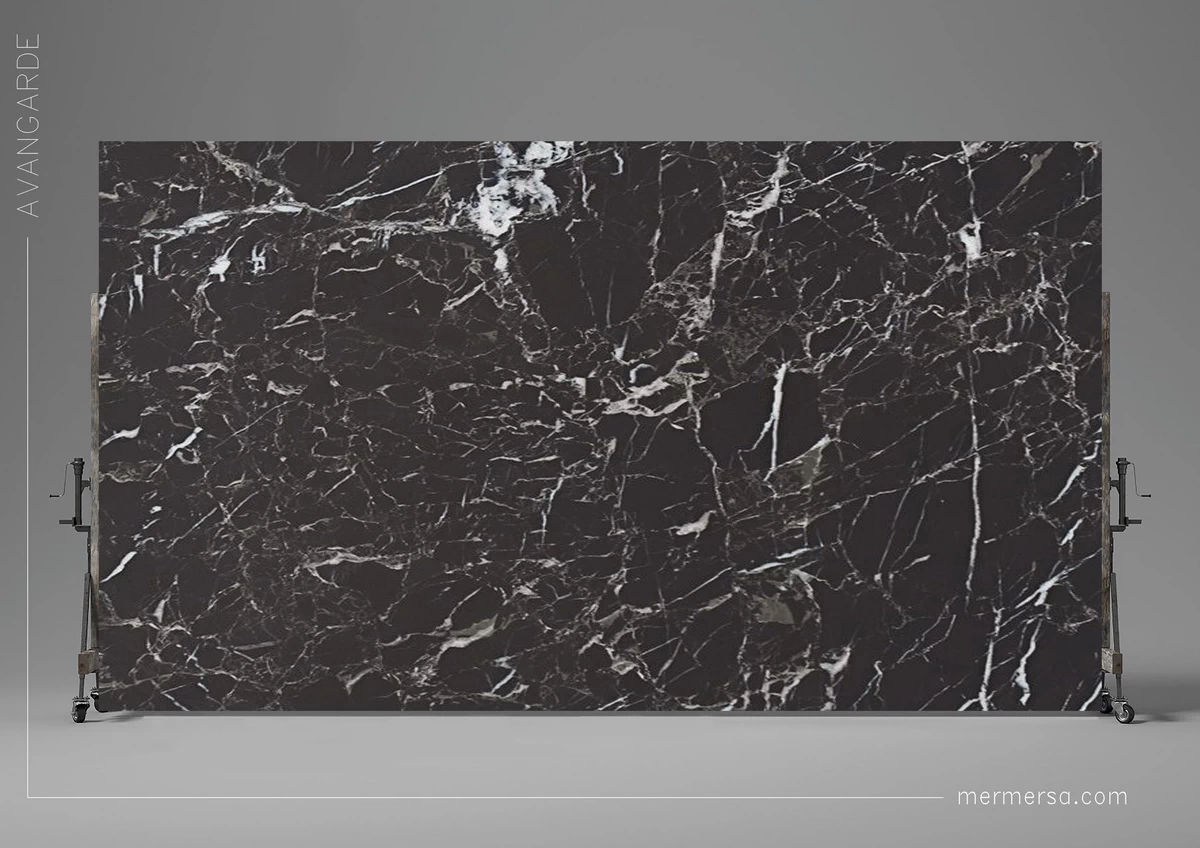
Turkish Travertine Supplier: Types and Export
Turkish travertine is a porous calcareous stone formed at hot springs and quarried in Türkiye mainly around Denizli, with Burdur as a second producing area. Before asking for a price, a buyer settles three choices that shape the whole order: the cut direction (vein-cut or cross-cut), whether the natural holes are filled or left open, and the finish. Everything else — format, thickness, packing — follows from those three.
What is travertine and how does it differ from marble?
Travertine forms where mineral-rich hot water reaches the surface and releases carbon dioxide as it cools; the calcium carbonate it drops builds up in layers, and the gas bubbles that escape leave the holes that define the stone. Marble, by contrast, is limestone that has been recrystallised by heat and pressure, so its structure is interlocking crystals rather than layered precipitation. The practical differences follow from that origin:
- Porosity. Travertine carries visible voids in its natural state. Marble's porosity is a much finer network you do not see with the eye.
- Structure. Travertine has a direction: the layers it was deposited in, which is what vein-cut and cross-cut expose differently. Marble has veining from mineral impurities, not bedding planes.
- Hardness. Travertine is softer than limestone and noticeably softer than marble, so it scratches and edges wear faster under abrasive traffic.
- Reaction to acids. Both are calcium carbonate and both etch on contact with acid, but on an unfilled, textured travertine the mark lands on an uneven face and reads differently than a polish etch on marble.
- Look. Travertine's appeal is its open, banded, slightly weathered appearance; the holes and the banding are the product, not a defect to be polished away.
Where does Turkish travertine come from?
Denizli is the main travertine area in Türkiye, and the wider region around it has a long history of working the stone: Hierapolis, the Roman city built on the thermal terraces near Denizli, is constructed of the travertine deposited by the same hot springs. That continuity matters commercially, because it means the same beds have been quarried for a long time and the trade names attached to them are understood across markets.
Burdur is the other producing area buyers encounter in export offers. In the 2025 natural-stone production figures published by the Ministry of Energy and Natural Resources, travertine accounted for 19.5% of production, which places it second among Turkish stones after marble (infobank, updated 30 June 2026).
The practical question is not which town the stone comes from but which bed: the same trade name can come from different layers with different densities of holes and different banding. Ask for the quarry or bed to be stated on the quotation and repeated on the crate labels.
Which colour families are exported?
Colour names in the travertine trade are trade names, not graded classifications: two suppliers can use the same word for stones that are not identical. Read them as families and confirm against a physical sample or a current photo set.
| Colour family | Look | Typical use |
|---|---|---|
| Ivory and Light | Pale cream to near-white, quiet banding, few strong contrasts | Hotel floors and bathrooms, wall cladding where a bright plane is wanted |
| Classic and Medium | Warm beige with clear horizontal bands | Floors, stairs, cladding — the mainstream commercial look |
| Walnut / Noce | Darker brown with stronger banding contrast | Feature walls, fireplace surrounds, floors that should ground a space |
| Yellow and Red | Warmer, more saturated tones | Exterior paving, decorative bands, mixed-pattern floors |
| Silver | Grey tones with cool banding | Contemporary interiors, floors paired with grey joinery and steel |
Silver deserves a note: it is a grey travertine rather than a separate stone, and it is the family reported as favoured in some Asian markets. Mixing families in one order is where colour consistency complaints start, so name the family in the specification rather than in the covering e-mail.
What do filled, unfilled, vein-cut and cross-cut mean for a buyer?
Quotable definition block: Filling means the natural holes are closed with a coloured cement or resin-type filler before honing; unfilled leaves them open. Vein-cut slices the block across its bedding layers so the bands run across the piece; cross-cut slices along the layers so the look is flowery and rounded. Filling and cut direction are two independent choices — you can buy filled vein-cut, unfilled cross-cut, or any other combination.
| Term | What it means | Typical use | Question to ask the producer |
|---|---|---|---|
| Filled | Holes closed with cement or resin filler, then honed flat | Interior floors, bathroom walls, countertops, anywhere hygiene or cleaning matters | Filler type and colour — cementitious or resin, and whether it is mixed to match the stone |
| Unfilled | Holes left open, texture intact | Exterior paving, pool decks, feature walls, rustic interiors | Whether the stone will be sealed after installation, and with what |
| Vein-cut | Cut across the bedding layers; linear, striped look | Floors and walls that want directional lines; large-format cladding | Whether the blocks offered are consistently suitable for that cut |
| Cross-cut | Cut along the layers; cloudy, rounded look | Floors and cladding wanting a softer, less linear pattern | How much variation is normal within the batch |
The choice follows the use rather than taste alone. An unfilled floor in a hotel corridor collects dirt and cleaning product in the open holes; a filled and honed floor in the same corridor wipes clean. An unfilled exterior paver drains and grips better underfoot. A filled floor that will be wet — a bathroom, a pool surround — is the standard pairing, because open voids hold water and dirt.
Finishes: honed, polished, brushed, tumbled, bush-hammered
- Honed — ground to a smooth matte face. The most common interior finish for travertine, and the one usually combined with filling, because the filler and the stone are cut flush together.
- Polished — ground and buffed to a shine. Less common on travertine: the polish plays over the filled holes and the banding rather than producing a mirror, and the stone loses the matte character most buyers wanted from it.
- Brushed — the surface is abraded with wire brushes so the softer parts wear away slightly, leaving a gentle texture. A middle ground: easier to wipe than unfilled tumbled, with more grip than honed.
- Tumbled — the pieces are worn against each other until the edges soften and the surface opens up. The classic outdoor look for pavers, and normally left unfilled.
- Bush-hammered — a mechanical roughening that leaves an even, coarse grip. Used where slip matters more than appearance: ramps, pool surrounds, exterior steps.
Formats and applications
| Format | Typical application | What to specify alongside it |
|---|---|---|
| Tiles | Interior floors and walls, bathrooms, kitchens | Size, thickness, finish, filled/unfilled, colour family |
| Slabs | Wall cladding, large-format floors, countertops, stair treads | Thickness, cut direction, book-matching requirement if any |
| Pavers | Terraces, pool surrounds, garden paths | Thickness for the load, finish, unfilled or filled, frost behaviour |
| Wall cladding | Interior feature walls, exterior ventilated facades | Panel format, fixing method, weight per square metre |
| Pool coping | The pool edge | Profile of the bullnose, finish for wet bare feet, thickness |
Pool coping is worth separating from ordinary tiles because it is cut to a profile that overhangs the water and is walked on wet and barefoot. The finish there is a slip question before it is a look question, and the thickness must match the edge detail drawn by the pool builder.
Two specifications belong with every outdoor order: EN 1341 for stone slabs and sets for outdoor paving, which is the document to request for exterior pavers, and EN 14231 for slip resistance by the pendulum method. Both are named as documents to ask for; the results belong to a specific lot, as explained in the technical data and test standards article.
Can travertine be used outdoors and around pools?
Yes, and it is one of the more common outdoor stones in export orders — but three properties decide how it behaves, and they should be checked rather than assumed.
Frost behaviour. Travertine's open pores take in water; in a climate with freeze-thaw cycles, water left in the pores expands as it freezes and can open the face of the stone. Water absorption and frost resistance are the pair to read together, and the fill matters too: unfilled exterior stone relies on the stone itself, while a filled exterior piece has a filler that must survive the same cycling.
Slip resistance. Around a pool, the surface is wet, often soapy and walked on barefoot. A honed interior finish is a poor choice there; brushed, tumbled or bush-hammered surfaces give the grip, and the pendulum result is the number to ask for rather than a description like "anti-slip".
Drainage. Unfilled travertine with its open texture drains and dries faster than a closed polished surface, which is one reason tumbled pavers are common around pools.
None of this needs to be taken on trust: put EN 1341 for the pavers and EN 14231 for slip resistance into the request, and ask for the results for the lot you are buying.
Which markets prefer which cut?
Trade press reporting on Turkish travertine exports (litosonline, undated) describes a split in demand: Chinese buying has favoured vein-cut stones in the medium, classic and light colour ranges; the United States is described as preferring light and noce tones with cross-cut growing; southern European buyers are reported as favouring vein-cut; and silver is reported as favoured in India.
Treat that as background, not as a specification. Market preferences move, the article carries no date, and none of it tells you what your own buyers want. What it is useful for is reading a producer's export orientation: a quarry that ships mostly to one market may have a block selection, a band of colour and a default cut that suit you well — or not at all. Ask which direction the current blocks run before you judge the sample.
Packing and shipping notes
Travertine travels as tiles and pavers in bundles inside crates or on pallets, and slabs in A-frame crates, with the pieces separated so faces do not rub in transit. Weight is the constant constraint: stone is heavy, so container load is planned by weight before it is planned by volume, and an order that fills a container by volume may reach the weight limit first. Crates need banding, corner protection and, for slabs, timber that suits the destination's plant-health rules.
The full checklist — block and slab crating, moisture protection, labelling, loading sequence and weight distribution — sits in the packing and container loading article, and the paperwork that accompanies the shipment in export documents and customs.
RFQ fields for travertine: format and dimensions · thickness · finish · cut direction (vein or cross) · filled or unfilled · colour family · quantity in square metres or tonnes · destination port · packing requirement. Sending all nine in the first message removes two or three rounds of e-mail and gets you a quotation that can actually be compared with another.
Frequently Asked Questions
Is travertine cheaper than marble?
Price depends on the variety, the grade, the finish and the volume, and it moves with the market — there is no fixed rule that one is cheaper than the other for the same specification. Send the specification in an RFQ and compare quotations on the same format, finish and quantity.
Should travertine be filled or unfilled?
For interiors that are cleaned regularly — floors, bathrooms, countertops — filled, because the open holes hold dirt and cleaning water. For exteriors, pool surrounds and rustic feature walls, unfilled is common and is part of the look; it drains well and takes grip better. Specify it explicitly either way, since it changes both the price and the cleaning regime.
What is the difference between vein-cut and cross-cut?
Vein-cut slices across the bedding layers, so the piece shows linear bands running in one direction. Cross-cut slices along the layers, giving a cloudy, rounded pattern. They are cut from the same blocks, so the choice changes the look, not the stone's properties.
Can travertine be used for pool surrounds?
Yes, provided the finish and the test results fit the use. Ask for slip resistance to EN 14231 and, where pavers are involved, the outdoor paving document EN 1341, and prefer brushed, tumbled or bush-hammered surfaces over honed ones for wet barefoot areas.
Does travertine need sealing?
Interior filled and honed travertine is normally sealed after installation, and unfilled exterior stone is commonly sealed as well; the care, sealing and maintenance page covers the intervals and the tests. What to ask the producer is whether the stone was treated before shipment, because pre-sealing and site sealing are different claims.
How is colour consistency handled across a large order?
By naming the colour family in the specification, asking for the quarry or bed to be stated, and approving a sample from the current production rather than from an old display. Natural stone varies between beds, so the honest way to control it is to fix the reference, not to demand zero variation.
What do I send in an RFQ for travertine?
Format and dimensions, thickness, finish, cut direction, filled or unfilled, colour family, quantity, destination port and packing requirement. A photograph of the intended use helps the producer propose the right grade; a sample request can follow once the specification is settled.
Sources and standards
- Ministry of Energy and Natural Resources — natural stones infobank — 2025 production share of travertine (19.5%), updated 30 June 2026.
- litosonline — Travertine in Turkey — trade-press description of travertine varieties and market preferences; article undated, so preferences are reported as background only.
- CEN-CENELEC — publisher of EN 1341 (outdoor paving slabs and sets) and EN 14231 (slip resistance, pendulum); confirm the current edition before writing either into a specification.
Related pages
Marble overview · Marble buyer's guide · Turkish marble varieties · Marble gallery · Finishes · Flooring · Wall cladding · Packing and container loading · Request a quote