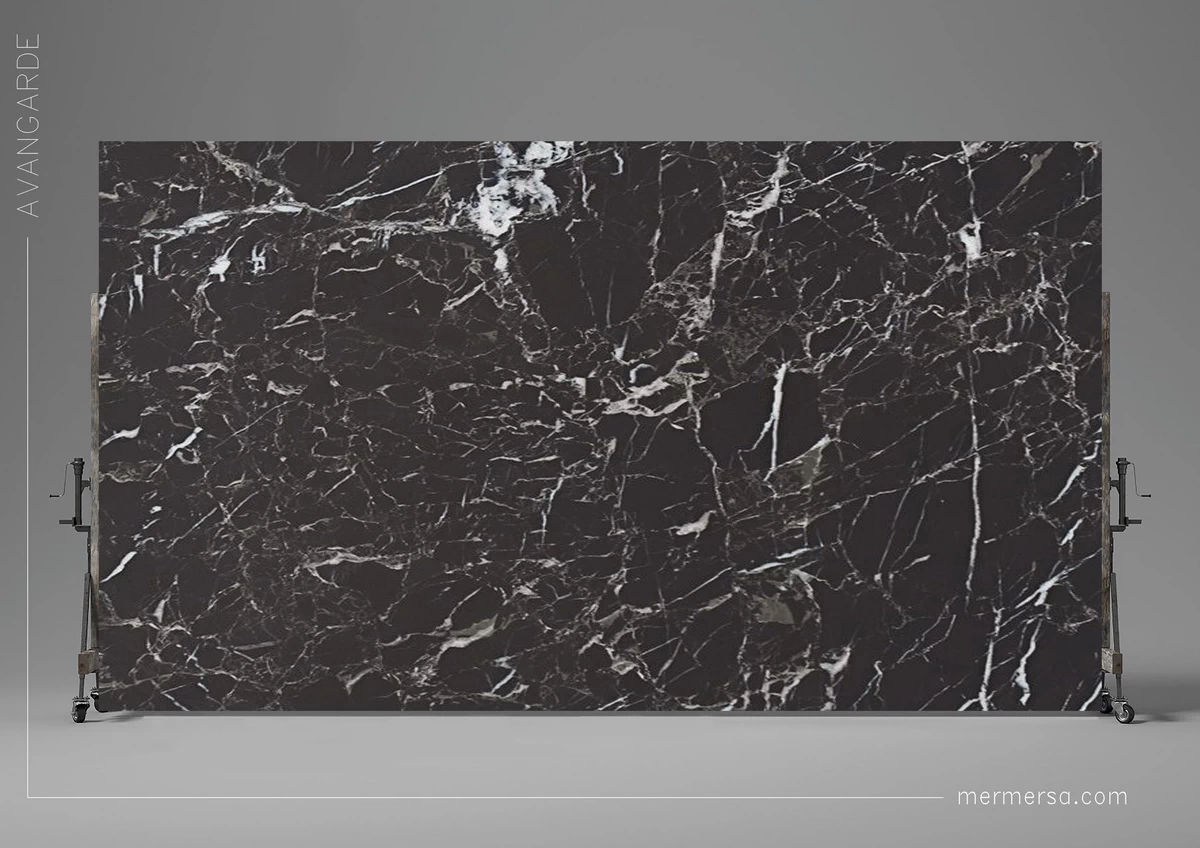
Marble Finishes Compared: Polished to Flamed
The finish decides how much light the surface throws, how it behaves underfoot and how visible everyday damage becomes. Polished suits walls and dry, low-traffic areas; honed takes the wear out of a floor's sightline; brushed and antique textures break up the look of etching; flamed and bush-hammered textures are outdoor and rough-stone work.
What marble finishes exist?
A finish is the last operation performed on the face of the stone, and it changes only the surface — not the material underneath. The names below are the ones a buyer will meet on a specification sheet, a proforma or a factory's finish board:
- Polished. Ground and buffed to a reflective gloss. The deepest colour and the sharpest veining of any finish, and the one buyers picture first.
- Honed. Ground to a smooth matte with no gloss. The same stone reads softer and slightly paler than its polished version, because the surface scatters light instead of reflecting it.
- Brushed. Run under abrasive brushes after honing so the softer veins sit fractionally lower than the harder ones, leaving a gently worked texture you can feel with a hand.
- Antique (antiqued). A more pronounced version of the brushed effect, usually combined with a softening of edges and arrises so the piece looks handled rather than machined. Trade language also calls this a lapped or worn face, and some producers pair it with a leathered texture — a fine directional grain with a low sheen.
- Flamed. A torch passed over the surface, spalling the top layer into a rough, open texture. On marble this is not a routine catalogue item: the stone's composition and colour decide whether it survives the thermal shock with its face intact, so flamed marble is possible on some stones rather than a standard offering — ask the producer before specifying it.
- Bush-hammered. A rotating pointed tool peppering the face with small, regular craters. Common on harder exterior stones and on travertine where a non-reflective, grip-textured face is wanted; again, confirm on marble.
- Sandblasted. Abrasive grit blown onto the face for a uniform dull texture. Quieter visually than bush-hammering and often used where a matte exterior surface is needed without deep relief.
Finish comparison
Table A: finish, look, slip behaviour, visibility, use, maintenance
| Finish | Look | Slip behaviour (qualitative) | Etch / stain visibility | Typical use | Maintenance note |
|---|---|---|---|---|---|
| Polished | Reflective, deepest colour, sharpest veins | Smoothest face; least natural grip when wet | Highest — etching reads as a dull mark on a bright field | Walls, low-traffic floors, dry areas, vanity tops | Shows every mark; needs the most frequent cleaning and the most careful sealing regime |
| Honed | Matte, softer colour, no glare | Rougher than polished at the same grit | Moderate — a dull spot on a dull field draws less attention | Floors, stairs, high-traffic lobbies, kitchen worktops where gloss is unwanted | Practical workhorse; refreshes by re-honing rather than re-polishing |
| Brushed | Gently undulating texture, low sheen | More texture underfoot than honed | Low — the texture breaks up the outline of a mark | Floors in retail and hospitality, wall features, furniture | Dust sits in the relief; cleaning needs a brush, not just a mop |
| Antique / leathered | Pronounced worked texture, soft edges, worn look | Most textured of the machined finishes | Low to very low — camouflage by relief | Bar tops, tables, islands, feature walls, heritage-style work | Texture holds residue in the grain; wipe-downs matter more than polish |
| Flamed | Rough, open, non-reflective | Strong texture; foot feel is markedly broken | Very low visually, but the face is disrupted | Exterior paving and cladding where the stone suits thermal treatment | No gloss to lose; watch for loose grains on soft stones |
| Bush-hammered | Evenly cratered, flat matte | Strong texture; consistent underfoot | Very low visually | Exterior steps, pool decks, travertine paving | Rugged and honest; can trap soil in the craters |
| Sandblasted | Uniform dull grain, no relief | Moderate texture, flatter than bush-hammered | Low visually | Exterior wall surfaces, signage faces, matte feature panels | Even surface; pressure washing behaves predictably |
The slip column is deliberately qualitative. Numbers come from a laboratory test on the actual finish — see the application table below for the document to request — and no honest supplier assigns a value to a finish name in the abstract.
Polished marble
Polishing is what people mean when they say "marble" in a domestic conversation: colour at its deepest, veining at its sharpest, a surface that bounces daylight around a room. It is also the finish with the clearest failure mode. Etching — the dull spot an acid leaves on calcite — shows against a mirror field the way a fingerprint shows on glass. The same drop that would be invisible on a honed floor advertises itself on a polished one.
That does not make polished wrong. It makes it a placement decision:
- Where it works. Feature walls, cladding, low-traffic floors, bathroom vanity tops, dining and meeting tables — anywhere the surface is seen but not walked on hard, and where spills are wiped by someone paying attention.
- Where it works against you. Entrances, corridors, kitchen floors, stair treads with real traffic, outdoor paving. In these positions the polish is a maintenance obligation: every grit particle dragged in on a shoe is a scratch, and polish retention becomes a question about how often the floor is buffed, not about the factory's work.
- What to ask for. Gloss level as a contract term where consistency matters across a batch, a sample at final polish approved under the light the space will actually have, and the sealing regime on the care, sealing and maintenance page before the first delivery.
Honed marble
Honed is the default answer for floors and for anyone who wants stone without the shine. Ground to a matte at a chosen hone grit, it reads as soft, contemporary and slightly powdery, and its practical advantage is behavioural rather than aesthetic: a dull field tolerates the small abrasions a floor inevitably collects far better than a reflective one.
Buyers specify honed for three connected reasons:
- Traffic. A honed lobby floor does not develop the traffic-polish map that a polished one does in the same year, so the floor at month twelve resembles the floor at handover.
- Glare. Under skylights, shop lighting or low winter sun, a polished floor throws light back at the eye; honed does not. This matters in retail and hospitality where signage and displays compete for attention.
- Honesty about wetness. A honed surface does not make claims about grip — but it also does not present a wet area as a mirror. Whether it is suitable for a specific wet location is a question for the test result on the actual finish, not for the finish name.
Brushed and antique finishes
Brushed and antique are the family of finishes that do with texture what honing does with gloss: they lower the contrast between the stone's daily life and its first day. A brushed face has been run under abrasive brushes after honing, so the softer veins recede fractionally and the harder ridges stand — a relief you read with a hand as much as with an eye.
Antique goes further: deeper relief, softened edges, a face that looks as though it has been walked on for a century when it left the factory last week. Some producers pair it with a leathered texture — a fine directional grain under a low sheen — and if a project uses that term, it should appear in the specification verbatim rather than being translated into "textured".
Practical notes for buyers:
- Etching practically disappears as a visual complaint. Not because the stone stops reacting with acid, but because a mark on a worked surface has no clean field to contrast against. This is the honest version of "hides damage": the damage still happens; nobody sees it.
- Cleaning changes character. Relief holds dust and residue. A mop glides over the peaks and leaves the valleys; hospitality floors with brushed finishes are cleaned with brushes or scrubbers on a schedule that suits the texture.
- Samples matter more than for polished work. Texture depth is the one parameter that genuinely varies between production runs, so a lot sample — not a show-board piece — is what should be approved.
- Best fit: bar tops, tables, islands, retail floors, feature walls and heritage-style fit-outs. See countertops for how the finish interacts with edging and sink cut-outs.
Flamed, bush-hammered and sandblasted
These three are the texture end of the scale, and the first rule is accuracy about marble itself. Flaming works by thermal shock: the torch spalls a thin layer of the surface. Stones with the right composition and colour take it cleanly; others crack, lighten or lose face. So flamed marble exists but is not a default catalogue line — it is possible on some stones, and the correct next sentence in any enquiry is a question to the producer about that specific block or batch.
Bush-hammering and sandblasting are mechanical rather than thermal, which makes them applicable to a wider range of surfaces, and both are most at home outdoors or in deliberately rugged interiors:
- Bush-hammered gives an evenly cratered face with real foot relief. It is the natural choice for exterior steps, pool surrounds and paving where a broken surface is wanted underfoot, and it is a common request on travertine — see travertine, where the stone's own porosity combines with the tooling to produce a very particular face.
- Sandblasted is calmer: a uniform dull grain without deep relief, good for exterior wall surfaces and any panel that must not reflect.
- Flamed sits between them visually — open, rough, non-reflective — with the caveat above about suitability per stone.
Which finish for floors, walls, countertops, stairs and bathrooms?
Table B: application, preferred finishes, what to avoid, document to ask for
| Application | Preferred finishes | Avoid | Document to ask for |
|---|---|---|---|
| Hotel lobby / high-traffic floor | Honed, brushed | Polished in heavy-traffic routes; deep relief in dust-prone zones without a cleaning plan | Slip-resistance test result per EN 14231 on the actual finish; approved lot sample |
| Stairs and treads | Honed, brushed; polished only in low-traffic ceremonial runs | Polished treads in exterior or wet approaches without a test result | EN 14231 result on the specified finish; tread/riser piece schedule |
| Kitchen countertop | Honed, brushed, antique | Polished where etching visibility is a known complaint; textured surfaces without a cleaning brief | Sealing regime from care and sealing; sample at final finish |
| Bathroom wall / vanity | Polished, honed | Open textures behind taps where residue builds | Sealing and cleaning instructions for the chosen finish |
| Feature wall / cladding | Polished, honed, brushed, antique | Highly textured finishes where lighting is flat and will not read them | Finish sample viewed under the specified lighting |
| Exterior paving | Bush-hammered, sandblasted; flamed where the producer confirms suitableness | Polished, and any finish assumed suitable without a test | EN 14231 slip result on the textured finish; producer's confirmation for flamed |
| Exterior cladding | Sandblasted, brushed, honed | Flamed unless confirmed on that stone | Fixing and thickness design documentation for the cladding system |
The document column is the differentiator. "Slip-resistant" is a claim; a pendulum slip-resistance test result for the finish actually being bought is a document — EN 14231 is the natural-stone test to name in a specification for floors and stairs, and the result belongs to the tested surface, not to the stone's name. If a supplier cannot produce it for the finish in question, the specification should say what is being accepted instead. For everything else about the material itself, keep the flooring, stairs and wall cladding pages beside this one.
How do you keep finish consistent across lots?
Finish is produced by machines, abrasives and operators, which means it drifts. A polished batch from March and a polished batch from September can differ in gloss and colour response even when the blocks are the same variety. Four controls keep a project out of that trap:
- Approve a reference sample at the final finish. Not a small showroom chip under showroom light — a piece large enough to read the veining, viewed under the light the space will have, and marked as the contractual reference. Store it; compare every delivery against it.
- Require a lot sample per production run. For long programmes, agree that each batch ships with a sample or photographs of that batch before loading. This is cheap at the factory and expensive to discover on site.
- Write the tolerance into the wording, not the expectation. "Gloss level consistent with the approved sample" is negotiable; "no visible difference under site lighting" is not. Name what is measured, how it is compared and who decides — this is the same discipline the quality, inspection and claims page applies to shade and dimension.
- Fix the light before judging anything. Finish is judged under lighting, and a sample approved under one lamp fails under another. Put the lighting condition in the approval note itself.
Frequently Asked Questions
Is honed marble more slip-resistant than polished?
Generally, a rougher surface grips better than a smoother one, and honed is rougher than polished at equivalent preparation. But that is a tendency, not a result: slip behaviour depends on the exact finish, the stone and the conditions of use. Ask for the pendulum slip-resistance test result per EN 14231 on the actual finish being supplied, especially for floors, stairs and any wet or exterior location.
Does honed marble stain more?
It hides etching better and shows staining less dramatically than a mirror-polished field in some lights, but a smooth matte face gives a stain a clean area to sit in, so prompt wiping and an appropriate sealing regime still matter. The practical difference is visibility, not resistance: no finish makes stone stain-proof, and the sealing guidance on the care and sealing page applies to honed exactly as it does to polished.
Which finish hides scratches best?
Textured finishes — brushed, antique, leathered — hide scratches best because the existing relief breaks up the outline of a new mark, and honed hides them better than polished. Polished shows every scratch because the surrounding surface is a continuous reflective field. If scratch camouflage is the priority, specify a texture and approve a lot sample of it, since texture depth is what varies between runs.
Can the finish be changed after installation?
Sometimes, but not cheaply or predictably. A honed floor can be re-honed and a polished one re-polished in place, which is a significant on-site operation with dust, noise and access implications; a textured finish generally cannot be recreated in place because the tooling needs the factory setup and a flat, unobstructed face. The sensible approach is to choose the finish for the room's real life before installation rather than planning to fix it afterwards.
Which finish suits outdoor travertine?
For outdoor travertine, buyers usually choose a textured face — bush-hammered or sandblasted — because the application wants a non-reflective, broken surface, and the stone's natural porosity combines well with tooling. Whatever texture is chosen, ask for the slip test result on that exact finished surface for paving, and see the travertine page for how the stone's open structure affects both appearance and maintenance.
What must I state in an RFQ about finish?
Name the finish exactly as the producer names it, the reference sample it is to match, the light it will be judged under, whether a lot sample is required per batch, and — for floors and stairs — the slip test document you expect. Add the quantity, format, thickness and destination alongside, and use the RFQ form; a finish written as "standard finish" leaves gloss, texture depth and colour response all undefined, which is where two different deliveries start to disagree.
Sources and standards
- CEN — publisher of EN 14231, the pendulum slip-resistance test for natural stone surfaces, named here as the test a specification should request for floors and stairs; the result belongs to the tested finish, not to a finish name in the abstract.
- Calcite-based marble reacting with acids (etching) is a general property of the material, stated without figures: this page gives no slip values, ratings or hardness numbers, because those belong to a test report on the specific batch and finish.
- Finish terminology follows the names used across this site's marble pages — polished, honed, brushed, antique/leathered, flamed, bush-hammered, sandblasted — so a specification written against these pages reads the same way in a factory.
- No finish is claimed as stain-proof, slip-rated or universally suitable; suitability is per application and per test.
Related pages
Marble · Buyers guide · Technical data and standards · Care, sealing and maintenance · Travertine · Flooring · Countertops · Stairs · Wall cladding · Request a quote