Marble Blocks, Slabs and Tiles: Which to Buy
Blocks suit processors who will do their own cutting, slabs suit dealers and fabricators selling cut surfaces, and tiles or cut-to-size suit contractors and developers buying to a drawing. The right format depends on who does the cutting, how much waste you can absorb and how the delivery schedule has to work.
Blocks, slabs, tiles, cut-to-size: what is each format?
Four formats leave a marble supply chain, and each is a different point on the same axis: how much of the processing has already been done when the material reaches you.
- Quarry block. A rough-sawn mass straight from the quarry, nominally cubic but never exactly so, with saw marks and chipped edges. Nothing about the inside is visible; the buyer is buying an expectation. Blocks are the format with the least processing and the most risk concentrated in one place.
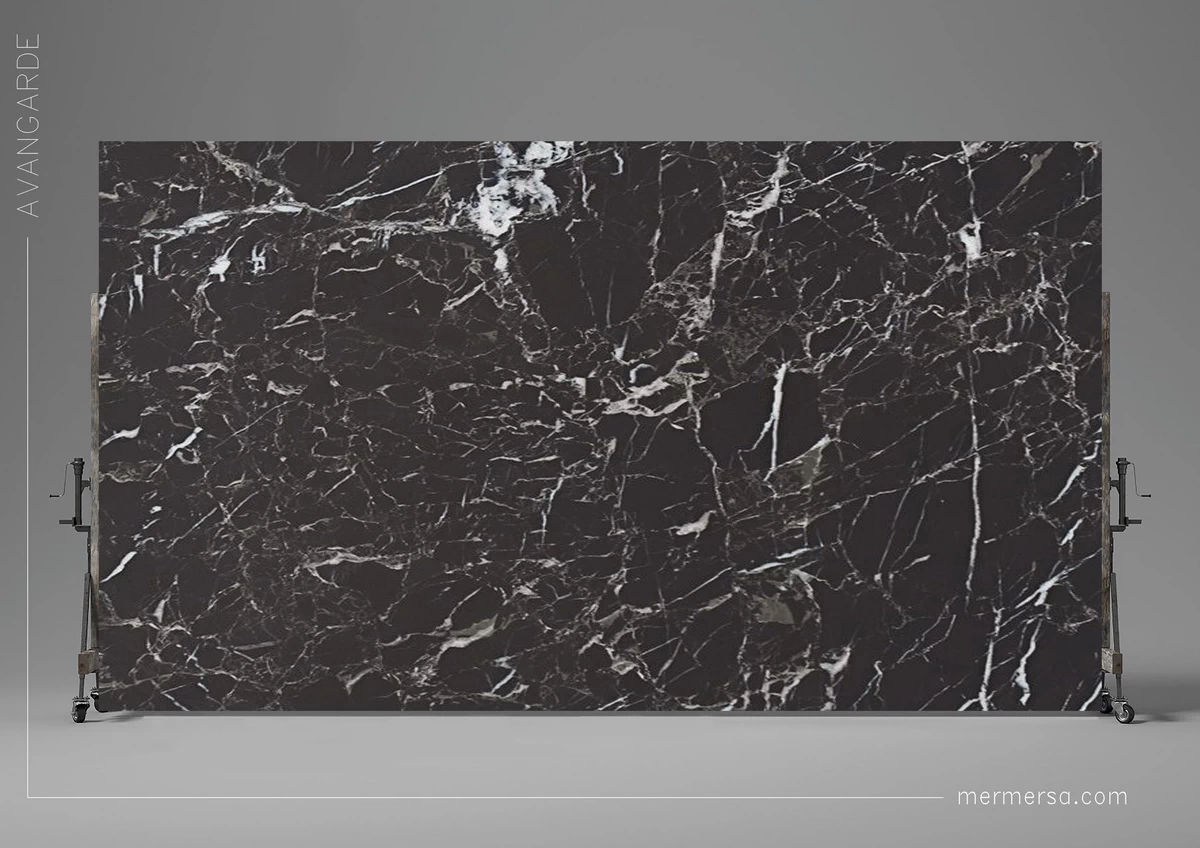
- Slab. A block that has been resawn — typically on a gangsaw or frame saw — into continuous sheets, polished or honed on one face, and sized for display and sale. The surface is visible, the pattern is visible, and a slab order can be traced to the block it came from.
- Modular tile. A slab or block cut further into standard-size pieces with calibrated thickness, packed in cartons. This is the format of floor and wall contracts with drawings, repeat quantities and installation tolerances.
- Cut-to-size (CTS). Pieces cut to the project's own dimensions — stair treads, risers, skirting, window sills, lobby layouts — often to a template or a shop drawing rather than to a catalogue size.
Who buys which format?
Table A: buyer, typical format, why, main risk
| Buyer | Typical format | Why | Main risk |
|---|---|---|---|
| Processor or fabricator | Block | Owns the sawing, controls yield, converts capacity into finished goods | Hidden defects discovered inside the block; yield below plan |
| Dealer or distributor | Slab | Shows customers real surfaces; sells by the sheet or by the project | Slow-moving stock; slabs that do not match the sample the customer approved |
| Kitchen or vanity fabricator | Slab, cut-to-size | Needs continuous surfaces for large tops and exact site measurements | Templating errors; bookmatch pairs that cannot be repeated |
| Contractor | Modular tile, cut-to-size | Buys to a drawing and an installation schedule; wants predictable coverage | Thickness variation across cartons; delivery phased behind other trades |
| Developer or hotel project | Cut-to-size, modular tile with a slab allowance | One spec across many rooms; wants consistency from floor to lobby | Batch variation across a long programme; a re-order that opens a new vein |
The trade's own export figures describe this split. Ministry of Trade data for 2025 natural-stone exports is reported at 68.38% processed and 31.62% blocks, and trade press quotes from the Aegean exporters' union put most block shipments towards the large processing hubs in Asia. In other words, most Turkish material that reaches a European dealer has already been sawn somewhere — which is exactly why the format question is really a question about where you want the processing to happen.
What does a buyer inspect on a block?
A block inspection is a short list of questions asked under time pressure at the yard, and the honest framing is that it is a sampling exercise, not a guarantee. What to ask:
- Is the colour representative of the block? One sawn face shows one plane; ask whether the face offered is typical and, where possible, request photographs of a second face.
- Are the veining and pattern direction consistent with the intended use? If the block is destined for matched floors or feature walls, vein direction decides whether the yield plan is realistic.
- Where are the cracks and defects? Surface fissures, repair lines, iron staining and soft seams are visible questions; ask what is visible on all sides and what was cut away already.
- What are the actual dimensions, and what is the usable volume? Measure or verify against the scale ticket; corners and edge damage are lost volume before the first slab is cut.
- Are there hidden fissure indications? Ask about drilling marks, water lines or previous inspection notes — the absence of a visible crack on one face is not the absence of one inside.
- Who else has inspected it, and may you see the report? A prior third-party inspection with a written report is worth more than a verbal assurance, and it is the natural bridge to the quality and inspection page.
Slab formats and thickness bands
Slabs are ordered in bands rather than exact figures, because a sawn sheet varies across its length and the contract works with a tolerance. The two thickness bands already standard in this trade are 20 mm and 30 mm, and they carry different jobs: 20 mm is the common band for wall cladding, furniture and lighter applications where weight matters; 30 mm is the common band for stairs, countertops and floor work where edges are exposed and strength is visible in the detail.
Beyond thickness, a slab specification needs:
- Finish — polished, honed, brushed, or a split face for exterior work; the finish changes both the appearance and the maintenance story.
- Size range — the length and height envelope the fabricator can work within, stated as a range because a gangsaw's output follows the block, not the order form.
- Selection level — whether slabs are commercial, standard or premium, and what each label is defined to mean in the contract, since every supplier's ladder differs.
- Matching requirements — bookmatch or veincut where the design calls for it, stated before cutting, because it can only be produced if it is planned at the saw.
Cut-to-size and modular tiles; calibration
Two terms do most of the work in this section. Calibration means the tile's thickness has been ground to a narrow tolerance so pieces lay flat together; modular means the pieces follow a defined size series. Both matter because installation tolerance is where a floor either succeeds or becomes a dispute.
A calibrated tile matters for three reasons:
- Flatness. Pieces outside the thickness tolerance rock under the trowel, and the installer compensates with more adhesive — which is cost, on somebody's account.
- Edge details. Recessed joints, flush transitions between rooms and the meeting of tile with a door profile all assume the thicknesses match.
- Repeat orders. A second batch that is not calibrated to the first re-opens a finished floor; the tolerance is part of the product, not a factory detail.
Yield, waste and cost logic
Yield is where the format choice becomes money. The relationship can be written with symbols only — the values belong to your block, your saw and your specification:
> Usable area = (block volume × yield factor) ÷ thickness
Where the yield factor is whatever fraction of the volume survives sawing, trimming and rejection, and thickness is the band you ordered. Raise the yield factor and the same block covers more floor; add a trim requirement or a stricter selection and it covers less. Nobody can quote that factor honestly before seeing the block, which is why block buying is a skilled trade rather than a catalogue exercise.
Table B: cost line, who bears it, direction by format
| Cost line | Who bears it | Direction by format |
|---|---|---|
| Quarry and block extraction | Block seller, inside the block price | Fixed at the block stage; disappears from the buyer's view in slabs |
| Sawing into slabs or tiles | Whoever owns the cutting step | Buyer's cost in blocks; seller's cost in tiles and cut-to-size |
| Kerf and trimming waste | Whoever owns the cutting step | Largest visible line for block buyers; absorbed in slab pricing |
| Selection and matching | Dealer or fabricator | Adds cost in slabs; nearly invisible in commercial-grade tiles |
| Packaging by format | Seller, in the price; sometimes split at the Incoterm | Blocks heavy and simple; slabs crated and braced; tiles cartoned and palletised |
| Freight per unit of usable stone | Buyer | Improves as the format carries more finished surface per kilogram |
The logic without numbers: processing closer to the buyer moves the waste, the labour and the schedule risk onto the buyer's side of the ledger, and processing closer to the source moves them onto the seller's, where they are priced in. A price comparison between a block and a slab that ignores this is comparing two different amounts of work. The price guide explains how the trade structures the discussion.
Packing by format
Each format ships the way its failure mode demands:
- Blocks travel break-bulk or in containers on timber bearers, lashed and chocked; the risk is point loading and shifting, and the inspection question is the securing, not the wrapper.
- Slabs move in bundles on A-frames or in crates, polished faces interleaved and protected; a crate opened at the yard tells you whether the packing was designed for the journey or for the warehouse.
- Tiles and cut-to-size go in cartons on pallets, with piece counts, finish and batch marked on each carton — which is also what makes a phased installation possible without mixing batches.
Which format for which project?
Table C: project type, recommended format, notes
| Project type | Recommended format | Notes |
|---|---|---|
| Continuous production, own sawing capacity | Block | Requires inspection discipline and a yield plan; the buyers guide covers the wider process |
| Showroom and retail trade | Slab | Displays sell stone; stock turns by surface, not by tonnage |
| Apartment or hotel room programme | Modular tile, calibrated | Consistency and repeat ordering decide the outcome |
| Lobby, stairs and feature walls | Cut-to-size from selected slabs | Matching is planned before cutting; allowances set on the drawing |
| Large-area flooring contract | Modular tile with a slab allowance | Batch control across deliveries; see flooring |
| Facade or rainscreen cladding | Cut-to-size slabs to the cladding standard | Fixing system and slab thickness designed together; see wall cladding |
| Mixed fit-out with tight phasing | Tiles plus a slab reserve | Keeps trade continuity while leaving room for selection |
Frequently Asked Questions
Is it cheaper to buy blocks or slabs?
It depends on who does the cutting and what the waste costs you, not on the price per unit of raw material. A buyer with idle saw capacity and the discipline to plan yield can do well on blocks; a buyer without those is comparing a cheap material against an expensive mistake. Put both formats through the same scope comparison before deciding — the price guide shows how the trade frames it.
What thickness should I order for floors?
The two bands in common trade use are 20 mm and 30 mm, with 30 mm the usual choice for floors and stairs where edges show and loads are carried, and 20 mm common for cladding, furniture and lighter work. The final figure is the designer's and the substrate's decision; state it in the RFQ with the finish and the tolerance.
What is cut-to-size marble?
Stone cut to the project's own dimensions from slabs or blocks — treads, risers, sills, skirting, floor layouts — to a drawing or template rather than a catalogue size. It is priced and scheduled as a drawing-driven package, which is why the document revision matters as much as the stone.
What is a calibrated marble tile?
A tile whose thickness has been ground to a narrow tolerance so pieces lie flat together during installation. Calibration is what lets an installer keep joints flush and adhesive even; ask for the tolerance in the specification rather than assuming it, and name the standard your specification follows — EN 12057 for modular tiles is the relevant European reference.
How are blocks sold: by tonne or by cubic metre?
By either, depending on the contract, and sometimes by a nominal block count with scale weights attached. What matters is that the contract states the unit, the weighing or measuring method, and how the figure is verified — do not accept a unit that is not defined in the offer you are comparing.
Can I choose slabs from a block?
Often yes: buyers visit the yard or review sawn-face photographs and reserve specific blocks or slab sequences, usually for a project where matching matters. State it in the enquiry — selection rights are a commercial term, and they affect the price because they narrow the seller's options.
How do I specify a slab order in an RFQ?
Give the material and finish, the thickness band, the size range or the application, the selection level, the matching requirement if any, the quantity with a tolerance, packing expectations, destination and Incoterm. The RFQ form lists what we need; the fewer assumptions left open, the closer two quotes are to being comparable.
Sources and standards
- İMİB — Istanbul Mineral Exporters Association; export statistics and sector reports for Turkish natural stone.
- TİM — Turkish Exporters Assembly; aggregate export data. The 2025 processed-versus-block split (68.38% / 31.62%) is cited from the Ministry of Trade infobank updated 30 June 2026, as reported in the trade press.
- CEN-CENELEC — publisher of EN 12057, EN 12058 and EN 1469, named in this article as specification references; confirm the current edition before citing a clause.
- No block sizes, yields, prices, stock or minimum quantities are stated as facts on this page; values are agreed per specification and per quotation.
Related pages
Marble · Buyers guide · Technical data and standards · Price guide · Packing and container loading · Quality, inspection and claims · Flooring · Wall cladding · Request a quote