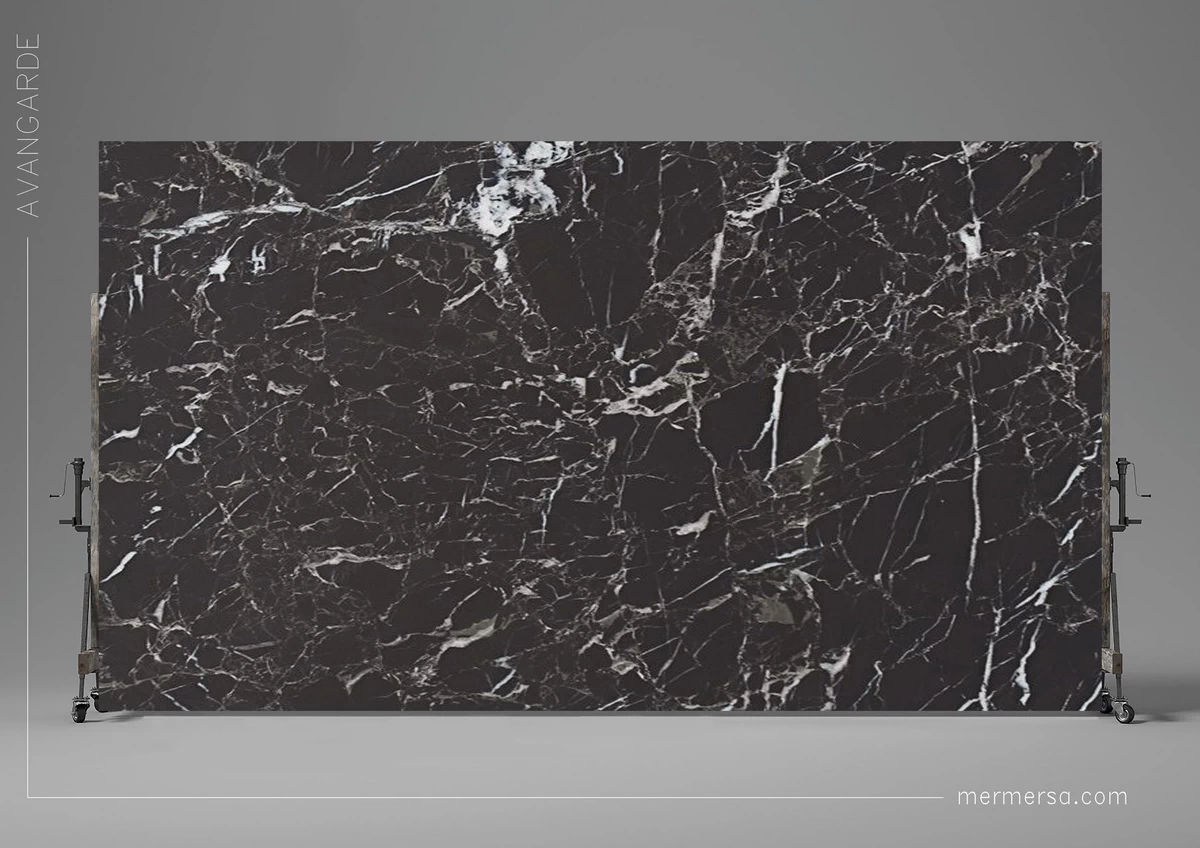
Turkish Marble Price: What Drives the Cost
There is no single price per square metre for Turkish marble. The number follows variety, grade, thickness, finish, format, packing, Incoterm and order size, and two quotations can only be compared when those are held constant — a price quoted per m² without them describes nothing you can buy.
Why is there no single price per m² for Turkish marble?
Marble is not manufactured to a catalogue; it is extracted from a quarry, sawn into slabs or tiles and finished to order. Every step between the face of the quarry and your site adds a cost that depends on the job rather than on the stone alone. A thick slab for a staircase is not the same product as a thin tile from the same block, even if both carry the same variety name.
Three structural reasons keep a single figure impossible:
- The material varies inside the name. A trade name covers a range of colours, vein patterns and soundness. The producer sorts blocks and slabs into grades, and the grade is priced.
- Almost every parameter is a choice. Thickness, finish, dimensions, tolerance, calibration, packing: each one can be specified up or down, and each changes the cost of the piece and the work around it.
- The quote is a delivered-or-not question. The same piece of stone quoted ex-works, FOB and CIF are three different numbers, and none of them is wrong.
Cost drivers at a glance
| Driver | Direction | How it appears in a quote | What to hold constant when comparing |
|---|---|---|---|
| Variety and rarity | Up for scarce colours and tight supply | Named as the stone, sometimes with a grade suffix | The exact variety name and origin |
| Grade / selection | Up with tighter selection | "Grade A", "first choice", "selected" — words, not numbers | The grade definition and the approved sample |
| Thickness | Up with thickness | Stated in mm per item | The same thickness for every quote |
| Format and cut-to-size waste | Up as pieces get larger or less regular | Piece size and quantity, or m² plus a waste allowance | Identical dimensions and the same waste assumption |
| Finish | Up with the work put into it | "Polished", "honed", "tumbled" — and who performs it | The same finish, and the same party doing it |
| Tolerance and calibration | Up for tighter tolerances | Tolerance class or "calibrated" | The same tolerance wording |
| Book-matching / slab selection | Up when slabs must be paired | Often a separate line or "on request" | Whether pairing is required at all |
| Packing | Up with heavier or more protective packing | Crate, pallet, bundle — in or excluded | Packing type and whether it is in the price |
| Incoterm and port | Moves the number a lot | EXW, FOB, CIF, DAP and the named place | One Incoterm for every quote |
| Payment terms | Up where risk is higher for the seller | Deposit, documents, credit | The same terms across quotes |
| Order size and mix | Down per unit with volume; mix can push it up | m² or tonnage, and the item list | Similar quantities and the same item list |
| Test reports and documents | Up where extra documentation is required | Usually a note, sometimes a line | Which documents each quote includes |
Reading the table left to right answers the question buyers actually ask: two quotes differ because one of these rows differs, and the way to find out which is to normalize them rather than to choose the smaller number.
Variety and rarity
The variety sets the base because it reflects what the quarry has to give and how much sorting the blocks need. A homogeneous beige that comes out of a working bed consistently costs less to produce than a stone whose blocks are frequently downgraded or rejected. Scarcity is part of it as well: a colour that is available this quarter may be from a part of the quarry that will not be reached again for a long time, and the producer prices what is in front of them.
The honest caution: rarity claims are easy to make and hard to verify. A quotation that leans on "limited availability" should be checked against the actual parameter that drives the price — the grade, the thickness or the packing — rather than accepted on the story.
Grade, selection and the approved sample
Grades (usually expressed as A, B, C or as "first, second, third choice") sort material by how much defect, colour movement and vein variation each piece shows. The higher the selection, the more stone is set aside on the way to filling an order, so the price per accepted piece rises.
Two things make grade the most misused word in a quotation. It is defined differently in every workshop, and it is not attached to a document. The way to pin it down is to make the grade reference the approved sample: write the sample reference into the order, state that acceptance is assessed against it, and ask what proportion of the delivery will be outside that reference. The buyer's guide covers the ten-step process this sits inside.
Grade also explains why a "cheaper" offer can cost more: if a larger share of the crate falls outside the approved look, the yield on site drops and the replacement order eats the saving.
Thickness, format and finish
Thickness is the most straightforward driver — more material costs more, and the offcut has value — but it also changes what the stone can do. A thin tile cannot span a void; a thick slab carries a stair tread or a cantilevered piece. Specify thickness per item and hold it constant across quotes, because a comparison that mixes 20 mm and 30 mm is not a comparison.
Format works through yield. Large slabs are cut from blocks with fewer saw passes but more risk; small tiles use the block more completely but add handling. Cut-to-size work — stair treads, window sills, custom panels — carries waste that has to be absorbed somewhere, and a quote that pretends waste is zero is hiding it in the rate. The blocks, slabs and tiles page shows where in the chain each format comes from.
Finish costs follow the work performed: honing, polishing, brushing, tumbling and bush-hammering are each a separate operation, sometimes by a third party, and the finer the required surface the more passes it takes. Ask who performs the finish and at which stage, because a finish applied before final sizing and one applied after are not the same offer. The full range is on the finishes page.
Packing, freight and Incoterms
Packing is quoted separately from stone for good reason: crates, pallets and bundles are built to survive the route, and heavier protection costs more but reduces breakage. Whether packing sits inside or outside the unit price changes the number even when it does not change the goods.
Incoterms decide whose costs and risks are in the number, in one sentence each:
- EXW (ex works) — the buyer collects at the seller's premises; the quote covers the goods at that gate and nothing after it.
- FOB (free on board) — the seller delivers and clears the goods onto the vessel at the named port; sea freight and everything after loading is the buyer's.
- CIF (cost, insurance and freight) — the seller pays freight and insurance to the destination port, but risk transfers once the goods are on board at origin.
- DAP (delivered at place) — the seller bears cost and risk to a named destination, excluding import clearance.
Order size, mix and yield from blocks
Volume improves the unit rate up to a point: sawing and handling are spread over more square metres, and a full container loads more efficiently than a part one. Below a workable quantity, fixed costs — setup, cutting plan, packing build — land on fewer units.
Mix cuts the other way. An order of one variety in one format runs continuously; an order of six varieties in four formats creates short runs, more setups and more residual material. That does not make mixed orders bad, but they should be priced as mixed orders, and a single blended rate per m² hides where the cost came from.
For block purchases, yield is the whole question: how much usable slab the block produces after the sawing plan, how much is downgraded, and how much is waste. Two blocks at the same price per tonne can give very different costs per usable square metre.
How do you compare quotes like for like?
Twelve checks, in order. Send them with the request and most of the ambiguity disappears before a number is even produced.
- Variety — same trade name, same stated origin.
- Grade — same grade definition, tied to the approved sample reference.
- Thickness — same millimetres for every item, stated per item.
- Finish — same finish, and the same party performing it.
- Dimensions and tolerance — same sizes, same tolerance class.
- Calibration — same answer to whether thickness calibration is included.
- Book-matching — same answer to whether slabs must be paired.
- Packing — same packing type, and the same answer to whether it is inside the price.
- Incoterm and port — one Incoterm, one named place, one currency.
- Payment terms — deposit, documents and balance identical across quotes.
- Quote validity — the date each number expires, in writing.
- Test reports — which reports are included, per lot, and to which standard edition.
Is the price stable?
No, and a quotation should be read as a snapshot with a date on it rather than as a standing rate. Three things move it between one order and the next, and none of them is a prediction of the future:
- Energy — sawing, grinding and polishing are energy-intensive steps, so power costs pass into processing rates.
- Freight — container rates and availability move with shipping conditions, and they land on the packing-and-loading side of the number.
- Currency — quotes are usually issued in a foreign currency while part of the cost is local, so the rate at which a producer can buy inputs affects what they can hold.
What do official statistics show?
Context only. Türkiye's natural-stone exports were about US$1,936 million in 2023, down 7.63% on 2022, with an average of US$307.04 per tonne — up 5.2% year on year (StoneNews, 29 April 2024, citing İMİB and Confindustria Marmomacchine).
Read that figure carefully: it is an average across all natural stone exports, from raw blocks to finished tiles, and averages mix cheap bulk material with expensive processed work. It is therefore not a price list, not a marble price, and not a number you can apply to a specification. Its only honest use is as background when you are reading a quotation that looks unusually high or low — the mix of what a country ships explains part of any difference, and processing level explains more.
Frequently Asked Questions
How much does Turkish marble cost per square metre?
It depends on parameters that no generic figure can carry. For an accurate quotation, send eight things: variety and origin, grade or approved sample, thickness per item, finish, dimensions and tolerance, quantity, Incoterm with destination port, and packing requirement. With those, a quote is comparable; without them, any per-m² number you are given describes an imaginary product.
Is Turkish marble cheaper than Italian?
Prices reflect what it costs to quarry, process and deliver in each country, plus the mix of material each country exports — not a ranking of quality. What can be said with sources is that average export values per tonne differ between countries because one ships more raw blocks and the other more finished and worked stone, so a headline average compares product mixes as much as it compares stone. Compare like-for-like specifications instead of country averages.
Why do two quotes for the same stone differ?
Because at least one row of the cost-driver table differs: grade, thickness, finish, tolerance, packing, Incoterm, payment terms, validity or order size. Normalize them with the twelve-point checklist and the difference either shrinks or becomes explicable — usually one specific line.
Does thicker marble cost more per m²?
Generally yes, because there is more material and the offcut has value, and because a thicker piece can be used where a thinner one cannot. The right comparison holds thickness constant: if the thicknesses differ, the prices are not comparable until you either convert or re-request them at the same thickness.
How long is a quote valid?
Whatever period the quote states — validity is set in the document and should be in writing. Ask for it explicitly, and if your award date sits beyond it, agree in advance what happens on expiry rather than assuming the figure stands.
Do I pay more for polished than honed?
Finish processing differs — polishing, honing, brushing and tumbling are separate operations with different numbers of passes — so confirm the finish cost per quote rather than assuming a direction. What matters more is matching the finish to the use: a honed floor and a polished floor from the same block are different products in service.
What do I send for an accurate quote?
Variety and origin, grade or approved sample reference, thickness per item, finish, dimensions and tolerance, quantity and item list, Incoterm with destination port, packing requirement, and any required test reports. Add a photograph or drawing of the intended use; it removes more ambiguity than any amount of follow-up e-mail.
Sources and standards
- StoneNews — 29 April 2024 report on 2023 Turkish natural-stone export value and average unit value, citing İMİB and Confindustria Marmomacchine.
- İMİB — Istanbul Mineral and Metals Exporters' Association — sector export statistics for Turkish natural stone.
- CEN-CENELEC — publisher of the EN standards referenced for reports and specifications.
Related pages
Marble overview · Marble buyer's guide · Blocks, slabs and tiles compared · Finishes · Export documents and customs · Packing and container loading · Request a quote