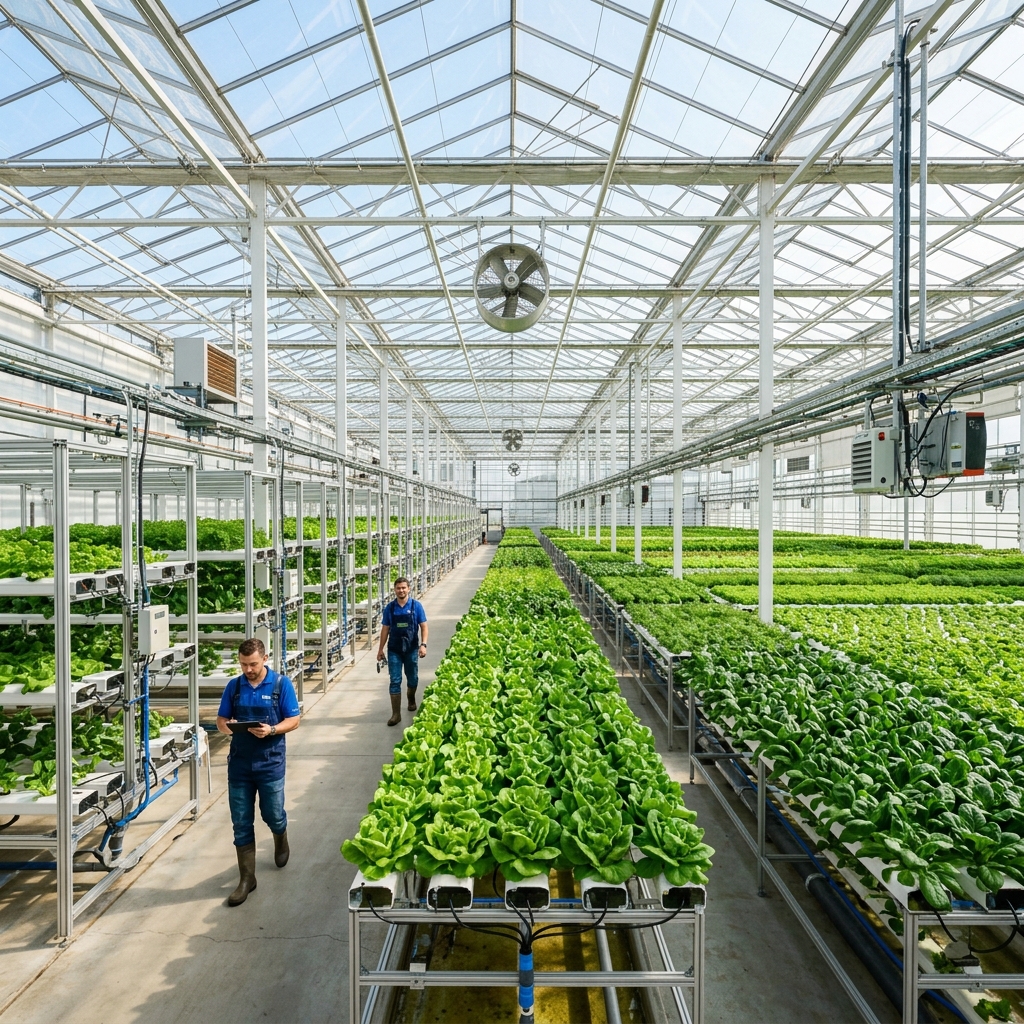
Greenhouse Climate Engineering & Thermal Systems
Last updated:
Agricultural yield is fundamentally limited by environmental control. WorldwideTradeX provides advanced climate engineering solutions from Green Climate...
Agricultural yield is fundamentally limited by environmental control. WorldwideTradeX provides advanced climate engineering solutions from Green Climate, specializing in industrial-scale heating, cooling, and atmospheric management for modern greenhouse complexes and industrial facilities.
Table of Contents
- Industrial Heat Pumps: COP Efficiency
- Advanced Heating & Boiler Systems
- Atmospheric Management: FOG & CO2
- Energy Co-Generation (CHP & Trigeneration)
- Technical Specifications Table
1. Industrial Heat Pumps: Thermal Efficiency Leaders
Our heat pump systems represent the pinnacle of energy efficiency, delivering significantly more thermal energy than electrical input.
- Operational Efficiency (COP):
- Cooling Mode: 300% - 610% efficiency.
- Heating Mode: 320% - 516% efficiency.
- Versatility: Capable of producing hot water from +30 °C to 150 °C.
2. Advanced Heating & Boiler Infrastructure
Custom-engineered thermal plants manufactured in ISO-certified European facilities.
2.1 Boiler System Types & Configurations
Gas-Fired Boilers:
- Condensing Boilers: 95-98% efficiency (flue gas condensation)
- Low-NOx Boilers: <30 mg/m³ emissions (compliance with EU 2015/1188)
- Modulating Capacity: 5:1 turndown ratio (10-100% load)
- Standard Capacity Range: 50-2,000 kW per unit
- Multi-Boiler Arrays: 2-8 units with master controller
- Pellet Boilers: 90-94% efficiency, automated feeding
- Chip Boilers: 85-90% efficiency, larger fuel storage
- Combined Cycle: Gas + biomass hybrid (70% gas, 30% biomass)
- Ash Handling: Automatic ash removal (every 4-8 hours)
- Closed-Loop: 40-60% efficiency (ground temperature 10-15°C)
- Open-Loop: 60-70% efficiency (groundwater 10-18°C)
- Vertical Boreholes: 100-150m depth, 12-15m spacing
- Horizontal Trenches: 1-1.5m depth, 0.5-1m spacing
- Capacity: 15-25 kW per borehole (depending on soil type)
2.2 Greenhouse Heating Load Calculations
Heat Loss Formula:
```
Q = U × A × ΔT × 1.2( infiltration factor )
```
Where:
- Q = Heat loss (Watts)
- U = Overall heat transfer coefficient (W/m²K)
- A = Surface area (m²)
- ΔT = Temperature difference (°C)
- 1.2 = Infiltration factor (10-30% air changes/hour)
- Single Glazing: 5.5-6.5 W/m²K (energy inefficient)
- Double Glazing: 2.8-3.2 W/m²K (standard)
- Double Glazing + Thermal Screen: 1.8-2.2 W/m²K (optimal)
- Insulated Panels: 0.8-1.2 W/m²K (high-end)
- Greenhouse: 1,000 m², 5 m peak height
- Climate: Outdoor min -5°C, target 18°C (greenhouse)
- Construction: Double glazing with thermal screen
- Calculation: Q = 2.0 × 1,000 × 23 × 1.2 = 55,200 W = 55.2 kW
- Boiler Sizing: 60-70 kW (20% safety factor)
- Winter (Dec-Feb): 150-200 degree-days (heating degree days)
- Spring/Fall: 50-80 degree-days
- Summer: 0-10 degree-days (cooling required)
```
Annual Energy (kWh) = Q × HDD × 24 × 0.9( boiler efficiency )
```
Example: 55.2 kW × 180 HDD × 24h × 0.9 = 215,232 kWh/year
2.3 radiant Tube Heating Systems
Installation Configuration:
- Mounting Height: 4-6 meters (greenhouse)
- Spacing: 2-3 meters between tubes
- Tube Material: Incoloy 800 (heat-resistant alloy)
- Surface Temperature: 200-300°C
- Radiant Efficiency: 90-95% (direct crop heating)
- Direct Heating: Warms plants/structures, not air
- Reduced Stratification: Uniform vertical temperature
- Lower Air Temperature: 2-3°C lower setpoint possible
- Energy Savings: 15-25% vs. forced air systems
```
MRT (Mean Radiant Temperature) = ((T_air + T_surface) / 2) + (0.3 × (T_surface - T_air))
```
For uniform comfort: MRT variation < 2°C across growing area
2.4 Underfloor Heating Systems
Hydronic Heating Layout:
- Pipe Spacing: 10-20 cm (closer spacing = more uniform)
- Pipe Material: PEX-AL-PEX (oxygen barrier)
- Flow Temperature: 35-50°C (low temp = higher efficiency)
- Flow Rate: 0.5-1.5 L/min per meter of pipe
- Pressure Drop: <20 kPa per circuit
```
Q = k × (T_flow - T_floor) × L
```
Where:
- Q = Heat output (W/m)
- k = Heat transfer coefficient (1.5-2.5 W/K·m)
- T_flow = Flow temperature (°C)
- T_floor = Floor temperature (°C)
- L = Pipe length (m)
2.5 Emergency Backup Heating
Redundancy Requirements:
- N+1 Configuration: One backup boiler for every N primary boilers
- Backup Capacity: 25-50% of total heating capacity
- Fuel Independence: Separate gas and diesel backup
- Detection: Temperature sensor alarm (setpoint +2°C)
- Alarm: 30-second delay before backup activation
- Backup: Automatic transfer to secondary system
- Alert: Text message to operator within 60 seconds
2.6 Sera Isıtma (Greenhouse Heating) Specialized Solutions
Rail-Based Heating:
- Movement System: Automatic trolley along greenhouse length
- Coverage: 100% uniformity (no hot/cold spots)
- Temperature Control: Zoned (1-2°C variation)
- Fuel: Natural gas or propane
- Maintenance: Annual inspection of moving parts
- Application: Door areas, side walls
- Method: Inline heating pipes in structural frames
- Purpose: Prevent cold air infiltration effects
- Temperature: Maintained at 2-3°C above ambient
2.7 Boiler Plant Control Systems
PLC Control Features:
- Modulating Burners: 5-20% turndown (exact load matching)
- Outdoor Reset: Water temp varies with outdoor temperature
- Cascade Control: Multiple boilers synchronized
- Load Shedding: Prioritize critical zones during peak demand
- Return Water Temperature: Keep below 55°C (condensing mode)
- O₂ Control: 3-5% flue gas O₂ (optimal combustion)
- Draft Control: -2 to -5 Pa (negative pressure operation)
2.8 Maintenance & Safety Systems
Weekly Maintenance:
- Inspect burner flames (blue = good, yellow = dirty)
- Check pressure relief valves
- Verify control settings
- Clean heat exchangers
- Check fuel filters
- Test emergency shutdown
- Full combustion analysis
- Safety valve testing (certified technician)
3. Atmospheric & Humidity Management
Precision control over humidity and CO2 concentrations for optimized photosynthesis.
3.1 Fog Cooling Systems Design
High-Pressure Fog Equipment:
- Pressure Range: 70-150 bar (higher = finer droplets)
- Nozzle Types: Orifice (10-50 micron), swirl (5-30 micron)
- Flow Rates: 1-10 L/h per nozzle
- Filter Requirements: 5-10 micron pre-filter, 1 micron final
- Water Quality: TDS < 200 ppm (prevent nozzle fouling)
- Main Line: 25-50 mm stainless steel
- Distribution: 6-16 mmpolyamide tubing
- Nozzle Spacing: 1-2 meters (greenhouse), 2-3 meters (poultry)
- Zoning: Separate valves per zone (10-50 nozzles each)
```
Water Flow (L/h) = Q_evap × 2.45 / h_fg
```
Where:
- Q_evap = Evaporation rate (kW)
- h_fg = Latent heat of vaporization (2.45 kJ/g)
Real system: 12-15 L/h (80-90% efficiency)
3.2 Fog Cooling Performance Data
Cooling Capacity by Climate:
| Dry Bulb (°C) | Wet Bulb (°C) | ΔT (°C) | Cooling Effect (°C) |
|---|---|---|---|
| 35 | 20 | 15 | 10-12 |
| 30 | 18 | 12 | 8-10 |
| 28 | 16 | 12 | 7-9 |
| 25 | 14 | 11 | 5-7 |
Energy Consumption:
- High-Pressure Pump: 3-5 kW per 100 nozzles
- Control System: 0.5-1 kW
- Total: 3.5-6 kW per 100 nozzles
```
Cooling Effect (°C) = 0.7 × (T_dry - T_wet)
```
Real-world efficiency: 60-80% of theoretical maximum
3.3 Humidification Requirements by Crop
Tomato Greenhouses:
- Relative Humidity: 60-75% (day), 70-85% (night)
- Fog System: 2-4 nozzles per m²
- Water Quality: TDS < 150 ppm (prevent leaf spotting)
- Relative Humidity: 70-85% (continuous)
- Fog Application: Continuous low-rate雾
- Problem Area: High humidity = botrytis risk
- Relative Humidity: 60-70% (day), 70-80% (night)
- Critical Period: Flowering (humidity spikes = poor pollination)
- Relative Humidity: 70-90% (variable)
- Precision Control: ±2% variation
- Drying Cycles: 2-4 hours daily (prevent disease)
3.4 Dehumidification Systems
Refrigerant Dehumidifiers:
- Capacity: 50-200 L/day
- Energy: 2-5 kW (per 100 L/day removed)
- Best For: Small greenhouses (<1,000 m²)
- Capacity: 100-500 L/day
- Energy: 5-15 kW (regeneration required)
- Best For: High-precision environments
- Energy Recovery: 50-70% heat recovery
- Dual Function: Cooling + dehumidification
- Efficiency: 2-3× refrigerant-only systems
3.5 CO2 Enrichment Systems
CO2 Sources:
- Cylinder Gas: 99.9% pure, precise control
- Burner Systems: Combustion byproduct (90-95% pure)
- Fermentation: Wine/beer industry waste stream
- Direct Air Capture: Emerging technology
- Standard Enrichment: 800-1,200 ppm (ambient = 400 ppm)
- High-Peak Enrichment: 1,500-2,000 ppm (short bursts)
- Nighttime: 0 ppm (no photosynthesis)
- Pipe Distribution: 10-25 mm polyethylene
- Emitter Spacing: 2-4 meters
- Control: PLC with CO2 sensor feedback
- Response Time: <30 seconds to setpoint
```
CO2 Required (kg/h) = (Light Intensity × Area × 0.058) / 1000
```
Example: 500 μmol/m²/s light, 1,000 m² → (500 × 1,000 × 0.058) / 1,000 = 29 kg/h
Economic Value:
- Yield Increase: 20-40% (Tomato, Cucumber, Pepper)
- ROI Period: 1-2 years (high-value crops)
- Cost: $0.50-1.50 per kg CO2 (source dependent)
3.6 Atmospheric Control Algorithm
Humidity Control Loop:
```
If RH > setpoint + 5%: Activate fog/dehumidifier
If RH < setpoint - 5%: Reduce fog/increase ventilation
If RH within ±5%: Maintain current state
```
CO2 Control Loop:
```
If CO2 < setpoint - 50 ppm AND light > 200 μmol: Activate CO2
If CO2 > setpoint + 50 ppm: Stop CO2
If light < 200 μmol: Stop CO2 (night mode)
```
Integrated Control Strategy:
- Priority 1: Temperature (heating/cooling)
- Priority 2: CO2 (light-dependent)
- Priority 3: Humidity (fog/dehumidification)
- Priority 4: Ventilation (passive climate control)
4. Energy Co-Generation (CHP & Trigeneration)
Trigeneration systems allow facilities to produce electricity, heating, and cooling simultaneously from a single fuel source.
4.1 Combined Heat and Power (CHP) Systems
CHP System Types:
- Reciprocating Engine: 200-5,000 kW, 80-90% total efficiency
- Gas Turbine: 1,000-50,000 kW, 75-85% efficiency
- Microturbine: 25-250 kW, 70-80% efficiency
- Fuel Cell: 100-10,000 kW, 85-95% efficiency
| System Type | Electrical Efficiency | Thermal Efficiency | Total Efficiency |
|---|---|---|---|
| CHP Engine | 35-45% | 40-50% | 80-90% |
| Grid + Boiler | 35-40% | 85-90% | 70-80% |
| Heat Pump | 200-400% | N/A | 300-500% |
Trigeneration Configuration:
- CHP Unit: Produces electricity + waste heat
- Absorption Chiller: Uses waste heat for cooling (LiBr-H2O)
- Heat Recovery: Additional heat extraction from exhaust
4.2 Absorption Chiller Systems
Lithium Bromide (LiBr) Chillers:
- Driving Heat: 70-150°C hot water/steam
- Cooling Capacity: 50-2,000 kW
- COP: 0.6-1.2 (thermal COP, electrical = pump only)
- Energy Source: CHP waste heat, boiler steam, solar thermal
```
Fuel Input (100%) → CHP → Electricity (35-45%) + Waste Heat (55-65%)
↓
Absorption Chiller → Cooling (60-80% of waste heat)
↓
Heating Loop → Space heating (remaining heat)
```
4.3 System Sizing & Optimization
Load Profile Analysis:
- Hourly Load: Electricity, heating, cooling (24/7)
- Seasonal Variation: Winter (high heating, low cooling), Summer (high cooling)
- Peak Demand: 15-minute maximum (utility demand charge)
- Match Heat Load: CHP thermal output = base heating load
- Electricity Surplus: Sell to grid (net metering)
- Self-Consumption: >70% (avoid export tariffs)
```
Annual Savings = (Electricity Cost × CHP Output) + (Heat Cost × Thermal Output)
Payback Years = Capital Cost / Annual Savings
```
Typical CHP Payback: 4-7 years (high-energy facilities)
4.4 Biomass CHP Systems
Gasifier-Based CHP:
- Fuel: Wood chips, agricultural residues
- Output: 100-2,000 kW electrical
- Efficiency: 70-80% total (lower than gas CHP)
- Emissions: Require scrubber (particulates, CO)
- Fuel: Manure, organic waste
- Gas Output: 20-30 m³ CH4 per tonne substrate
- CHP Size: Match biogas production
- Digestate: Sold as organic fertilizer
4.5 Energy Storage Integration
Thermal Storage Tanks:
- Size: 50-500 m³ (1-4 hours storage)
- Temperature: 80-90°C (hot water), 5-7°C (chilled water)
- Insulation: 100-150 mm polyurethane (0.02 W/mK)
- Stratification: Maintain temperature layers (critical for efficiency)
- Purpose: Peak shaving, backup power
- Size: 20-200 kWh (CHP auxiliary)
- Cycle Life: 5,000-10,000 cycles (LFP chemistry)
5. Technical Specifications: Climate Control
| System Type | Efficiency Grade | Application | Key Component |
|---|---|---|---|
| Heat Pump | Ultra High (COP 6+) | Sustainable Thermal | Screw Compressor |
| Boiler | Industrial Grade | Peak Load Heating | Steam/Water Tubes |
| FOG Cooling | PN100 Precision | Humidity Management | Micronize Nozzles |
| CHP Units | Hybrid Integration | Remote Facilities | Gas/Bio-Engine |
6. Engineering Design Examples
6.1 Case Study: 5-Hectare Tomato Greenhouse Complex
Requirements:
- Area: 50,000 m² (5 hectares)
- Location: Mediterranean climate (winter min -5°C, summer max 40°C)
- Crop: High-wire tomato (year-round production)
- Target Yield: 60 kg/m²/year
Heating System:
- Heat Loss: Q = 2.0 × 50,000 × 23 × 1.2 = 2,760,000 W = 2,760 kW
- Boilers: 3 × 1,000 kW condensing gas boilers (2+1 redundancy)
- Alternative: 2 × 1,500 kW or biomass hybrid
- Peak Load: 3,000-4,000 kW (solar radiation based)
- Fog System: 1,000 nozzles, 70-bar pumps, 30-50 kW
- Ventilation: 40,000 m³/h fans (natural + forced)
- Daily Demand: 200-300 kg/day (1,000 ppm × 50,000 m²)
- Storage: 2 × 2,000 kg liquid CO2 tanks
- Distribution: Pipe network + emitter strips
- Heating (Winter): 5,000-8,000 kWh/day
- Cooling (Summer): 3,000-5,000 kWh/day
- CO2 Production: 20-30 kWh/kg (cylinder filling)
- Total Daily: 8,000-13,000 kWh
- Boilers: $150,000-200,000
- Fog System: $50,000-80,000
- CO2 System: $30,000-50,000
- Controls: $20,000-30,000
- Total: $250,000-360,000
- Payback: 3-5 years (yield increase + quality premium)
6.2 Case Study: Poultry House Climate Control
Requirements:
- Capacity: 30,000 broilers per cycle
- House Dimensions: 12 m × 150 m = 1,800 m²
- Brooding (0-14 days): 33-35°C
- Grow-Out (15-42 days): 22-28°C (gradual decrease)
- Brooder Zone: 300 m², radiant tube heaters (20 kW each)
- Total Heating: 3 × 20 kW = 60 kW (peak)
- Backup: Propane portable heaters (2 × 30 kW)
- Summer Load: 1,000-1,500 kW (bird metabolic heat + solar)
- Evaporative Cooling: 40 fog nozzles, 20-30 kW pump
- Ventilation: 20,000 m³/h fans (2-4 fans, 5-10 kW each)
- Ammonia: <10 ppm (health standard)
- CO2: <3,000 ppm (optimal)
- Particulates: <5 mg/m³ (dust control)
- Ventilation Rate: 5-10 m³/h per bird (variable by age)
- Heating (Winter): 50-100 kWh/day
- Cooling (Summer): 200-400 kWh/day
- Ventilation: 100-200 kWh/day
- Total Daily: 350-700 kWh
- Heaters: $15,000-20,000
- Fog System: $5,000-8,000
- Fans/Ventilation: $10,000-15,000
- Controls: $5,000-8,000
- Total: $35,000-51,000
- ROI: 1-2 years (feed conversion ratio improvement)
6.3 Case Study: Greenhouse Potato Seedling Facility
Requirements:
- Production: 500,000 seedlings per week
- Greenhouse: 2,000 m², multi-tier rack system
- Temperature: 18-22°C (uniform ±1°C critical)
- Humidity: 70-80% (prevent potato virus spread)
- Vertical Temperature Uniformity: Must be <2°C difference floor-to-ceiling
- Root Zone Temperature: 16-18°C (thermoelectric cooling required)
- Air Velocity: <0.2 m/s (prevent seedling stress)
- Under-Rack Heating: 150 kW electric resistance (tube heaters)
- Cooling: 200 kW heat pump (chilled water to racks)
- Humidification: 100 nozzles fog system (precision control)
- CO2: 200 ppm enrichment (photosynthesis boost)
Payback: 2-3 years (seedling premium pricing)
7. Technical Specifications & Performance Data
7.1 Heat Pump Performance Curves
COP vs. Temperature Difference:
| ΔT (°C) | Heating COP | Cooling COP |
|---|---|---|
| 0 | 6.5 | 6.0 |
| 5 | 5.8 | 5.4 |
| 10 | 5.2 | 4.8 |
| 15 | 4.6 | 4.3 |
| 20 | 4.0 | 3.8 |
Heat Pump Sizing Formula:
```
Heating Load (kW) = (ΔT × A × U × 1.2) / COP
```
Example: ΔT=20, A=1,000 m², U=1.5, COP=5 → (20 × 1,000 × 1.5 × 1.2) / 5 = 7,200 W = 7.2 kW
7.2 Fog Cooling Performance Tables
Nozzle Flow Rates:
| Orifice Size | Pressure (bar) | Flow Rate (L/h) |
|---|---|---|
| 10 micron | 70 | 1.5 |
| 10 micron | 100 | 2.2 |
| 20 micron | 70 | 3.0 |
| 30 micron | 70 | 4.5 |
| 50 micron | 70 | 7.5 |
Cooling Capacity by Nozzle:
- 10 micron: 0.2-0.3 kW
- 20 micron: 0.4-0.5 kW
- 30 micron: 0.6-0.8 kW
- 50 micron: 1.0-1.5 kW
7.3 CO2 Requirements by Crop
| Crop | Optimal CO2 (ppm) | Daily Consumption (kg/100 m²) |
|---|---|---|
| Tomato | 1,000-1,200 | 8-12 |
| Cucumber | 800-1,000 | 6-10 |
| Pepper | 1,000-1,200 | 7-11 |
| Lettuce | 600-800 | 3-5 |
| Strawberry | 800-1,000 | 5-8 |
| Rose | 1,000-1,500 | 10-15 |
7.4 Boiler Efficiency Standards
EU ErP Directive 2015/1188:
- Minimum Efficiency (90°C/70°C): 92% (condensing)
- NOx Emissions: <56 mg/kWh (typical 30-40 mg/kWh)
- CO Emissions: <100 mg/kWh (typical 20-50 mg/kWh)
- Pressure Testing: 1.5× working pressure
- Safety Valves: Required for all pressure vessels
- Inspection: Annual certified inspection
8. Implementation Guidelines & Best Practices
8.1 System Design Checklist
Pre-Design Information Required:
- [ ] Greenhouse dimensions (length, width, height)
- [ ] Glazing type and coverage (%)
- [ ] Geographic location (climate data: min/max temp, humidity)
- [ ] Crop type and growing cycle
- [ ] Target yield and production schedule
- [ ] Energy costs (electricity, gas, biomass)
- [ ] Available utilities (gas supply, electrical capacity)
- [ ] Budget constraints
- [ ] Sustainability targets
- [ ] Heating load calculation (winter min temp scenario)
- [ ] Cooling load calculation (summer max temp scenario)
- [ ] Humidity requirements (crop-specific)
- [ ] CO2 requirements (if enrichment planned)
- [ ] Redundancy design (N+1 for critical components)
- [ ] Control system architecture (PLC vs. building management)
8.2 Installation Standards
Piping Installation:
- Support Spacing: 1-1.5 m (horizontal), 2-3 m (vertical)
- Slope: 1-2% (drain to low point)
- Insulation: Minimum R-6 (0.85 m²K/W) for hot pipes
- Expansion Joints: Every 30 m (thermal expansion)
- Motor Control Centers: NEMA 4X for greenhouse environments
- Wiring: UV-resistant conduit (outdoor sections)
- Grounding: Separate ground for control systems
- Surge Protection: All power and signal lines
8.3 Commissioning Procedure
Pre-Commissioning Checks:
- Verify all equipment installed per drawings
- Check electrical connections (tightness, phasing)
- Test safety devices (pressure relief, high-temp cutoff)
- Inspect piping (clean, no debris)
- Leak Test: Pressure test at 1.5× operating pressure
- System Flush: Circulate water to remove debris
- Control Calibration: Sensor verification and tuning
- Functional Test: Full cycle operation (heating, cooling, fog)
- Performance Test: Measure actual output vs. design
- Heating: Temperature rise rate (target: 1-2°C/hour)
- Cooling: Temperature drop rate (target: 2-3°C/hour)
- Fog: Droplet size measurement (target: 5-50 microns)
- CO2: Response time <60 seconds to setpoint change
8.4 Operation & Maintenance
Daily Checks:
- [ ] System pressures (heating, cooling, fog)
- [ ] Temperatures (return, flow, ambient)
- [ ] Water levels (boiler, fog tanks)
- [ ] CO2 levels (sensors reading correctly)
- [ ] Alarm status (no active alarms)
- [ ] Filter inspection/cleaning (fog filters, air filters)
- [ ] Nozzle inspection (clean or replace if clogged)
- [ ] Pump inspection (noise, vibration, flow)
- [ ] Sensor calibration check
- [ ] Burner inspection (combustion, flame color)
- [ ] Heat exchanger inspection (temperature approach)
- [ ] Belt tension and alignment (pumps, fans)
- [ ] Lubrication (bearings, moving parts)
- [ ] Full boiler inspection (certified technician)
- [ ] Safety valve testing (certified technician)
- [ ] Electrical inspection (thermography, torque)
- [ ] Control system backup and firmware update
8.5 Troubleshooting Guide
Problem: Heating System Cannot Reach Setpoint
- Check boiler output (flame, temperature)
- Verify pump flow rate
- Inspect heat exchanger for fouling
- Check insulation (air leaks, thermal bridges)
- Verify sensor calibration
- Check fog nozzle pressure (70-150 bar required)
- Verify water quality (clogged nozzles)
- Inspect pump performance
- Check ambient humidity (limited cooling potential at high humidity)
- Verify fan operation
- Check COP of heat pumps (low COP = refrigerant issue)
- Verify control system tuning (overheating/overcooling)
- Inspect for air leaks (greenhouse seal integrity)
- Check for equipment sizing mismatch (oversized equipment cycles)
- Review maintenance records (dirty filters, fouled heat exchangers)
9. Economic Analysis & ROI Calculations
9.1 Cost Breakdown Example
5-Hectare Greenhouse Climate System:
| Component | Cost Range | Typical Cost |
|---|---|---|
| Boilers (3×1000 kW) | $150,000-200,000 | $175,000 |
| Fog Cooling System | $50,000-80,000 | $65,000 |
| CO2 Enrichment System | $30,000-50,000 | $40,000 |
| PLC Control System | $20,000-30,000 | $25,000 |
| Installation & Commissioning | $30,000-50,000 | $40,000 |
| Total System Cost | $280,000-410,000 | $345,000 |
9.2 Operational Cost Analysis
Annual Energy Costs (Mediterranean Climate):
| Season | Hours | Heating (kWh) | Cooling (kWh) | CO2 (kWh) | Total Cost |
|---|---|---|---|---|---|
| Winter (3 months) | 2,160 | 10,800 kWh/day × 90 days = 972,000 | 0 | 0 | $97,200 |
| Summer (3 months) | 2,160 | 0 | 4,000 kWh/day × 90 days = 360,000 | 30,000 | $72,000 |
| Spring/Fall (6 months) | 4,320 | 5,000 kWh/day × 180 days = 900,000 | 1,000 kWh/day × 180 days = 180,000 | 15,000 | $109,800 |
| Annual Total | 2,232,000 kWh | $279,000 |
Energy Cost Assumptions:
- Electricity: $0.10/kWh
- Natural Gas: $0.03/kWh (1 kWh gas ≈ 0.1 m³)
- CO2 (cylinder): $0.50/kg (200 kg/month = $100/month = $1,200/year)
9.3 Revenue Impact
Yield Increase from Climate Control:
- Tomato: 40-60 kg/m² (uncontrolled) → 80-100 kg/m² (controlled) = 40-60% increase
- Cucumber: 30-40 kg/m² → 60-80 kg/m² = 50-75% increase
- Pepper: 20-30 kg/m² → 40-60 kg/m² = 50-70% increase
- Controlled Environment Produce: 10-30% price premium
- Year-Round Availability: Premium during off-season
- Consistent Quality: Reduced grading losses
```
Annual Revenue Increase = Yield Increase × Price per kg × Area
Payback Years = Total Investment / Annual Revenue Increase
```
Example: 50,000 m² tomato greenhouse
- Yield increase: 40 kg/m² × $2/kg = $80,000/ha
- Total increase: $80,000/ha × 5 ha = $400,000/year
- Payback: $345,000 / $400,000 = 0.86 years (10.3 months)
9.4 Sensitivity Analysis
Key Variables Affecting ROI:
- Energy Prices: ±20% change → ±15% ROI change
- Crop Prices: ±20% change → ±20% ROI change
- Yield Increase: ±10% change → ±10% ROI change
- Investment Cost: ±20% change → ±20% ROI change
| Yield Increase | Breakeven Energy Price | Breakeven Crop Price |
|---|---|---|
| 20% | $0.08/kWh | $1.50/kg |
| 30% | $0.10/kWh | $1.33/kg |
| 40% | $0.12/kWh | $1.25/kg |
| 50% | $0.15/kWh | $1.20/kg |
10. Future Trends & Innovations
10.1 Smart Greenhouse Automation
AI-Based Climate Control:
- Predictive Modeling: Weather forecast integration
- Machine Learning: Learn crop response patterns
- Optimization Algorithms: Minimize energy while maintaining yield
- Parameters: Temperature, humidity, CO2, light, nutrient
- Transmission: LoRaWAN, Wi-Fi, or cellular
- Power: Solar + battery (5-year life)
- Maintenance-Free: 3-5 years without replacement
10.2 Renewable Integration
Solar-Thermal Hybrid:
- Collectors: 200-400 m² for 5,000 m² greenhouse
- Storage: 100-200 m³ thermal tank
- Contribution: 30-50% of heating load (summer), 10-20% (winter)
- Depth: 100-150 m per borehole
- Spacing: 5-8 m between boreholes
- Heat Extraction: 40-60 W per meter depth
- Capacity: 10-15 kW per borehole
10.3 Greenhouse Gas Reduction
Carbon Footprint Targets:
- Current: 5-8 kg CO2e per kg tomato
- Target (2030): 2-3 kg CO2e per kg tomato
- Heat Pumps: Replace gas boilers (60-70% reduction)
- Renewable Energy: Solar PV + CHP (20-30% reduction)
- Energy Efficiency: LED lighting + optimized climate control (10-15% reduction)
- CO2 Capture: Direct air capture (experimental, long-term)
3. Atmospheric & Humidity Management
Precision control over humidity and CO2 concentrations for optimized photosynthesis.
- FOG Humidification: High-pressure (PN100) micronized water injection for adiabatic cooling.
- CO2 Fertilization: Precise atmospheric enrichment to maximize plant metabolism and yield.
4. Energy Co-Generation (CHP)
Trigeneration systems allow facilities to produce electricity, heating, and cooling simultaneously from a single fuel source.
- Automation: Fully integrated PLC systems syncing thermal loads with real-time electrical demand.
5. Technical Specifications: Climate Control
| System Type | Efficiency Grade | Application | Key Component |
|---|---|---|---|
| Heat Pump | Ultra High (COP 6+) | Sustainable Thermal | Screw Compressor |
| Boiler | Industrial Grade | Peak Load Heating | Steam/Water Tubes |
| FOG Cooling | PN100 Precision | Humidity Management | Micronize Nozzles |
| CHP Units | Hybrid Integration | Remote Facilities | Gas/Bio-Engine |
Agro Knowledge Hub
- Precision Irrigation & Water Distribution
- Milling Wheat: Nutrient Density Guide
- Frozen Chicken Paws: GACC Logistics
Frequently Asked Questions
What is climate engineering in agriculture and what technologies does it include?
Agricultural climate engineering encompasses controlled environment technologies: greenhouse heating/cooling systems, fog cooling, thermal screens, CO2 enrichment, and HVAC systems for livestock facilities. The goal is to optimize growing conditions regardless of external climate, extending growing seasons and improving yields.How does fog cooling work in greenhouse and poultry applications?
Fog cooling systems atomize water into ultra-fine droplets (5–50 microns) that evaporate instantly, absorbing heat from the air. This can reduce air temperature by 8–15°C in greenhouses and poultry houses. High-pressure fog systems (70–100 bar) produce finer droplets that evaporate before reaching plants or animals, preventing wetting.What is the ROI of greenhouse climate control systems?
ROI depends on crop type and climate. For high-value crops (tomatoes, peppers, cucumbers) in hot climates, climate control systems typically pay back in 2–4 years through yield increases (20–40%), quality improvement, and year-round production capability. Energy costs are the primary operating expense.What heating systems are used in commercial greenhouses?
Hot water heating via gas or biomass boilers with underfloor or overhead pipe systems is the most common. Heat pumps (air-source or ground-source) are increasingly used for energy efficiency. Geothermal heating is cost-effective where available. CO2 from gas boiler exhaust is often recovered for plant enrichment.More Frequently Asked Questions
What is the typical MOQ for this commodity?Bulk contracts usually start from one vessel or container lot. Exact MOQ depends on product, packing, and destination — send an RFQ for a firm number.
How is quality verified before shipment?
We supply batch COA documents and can arrange SGS/Intertek inspection at the loading port as specified in the SPA.
Which Incoterms do you offer?
FOB, CIF, CFR, and DAP are standard. The right term depends on your logistics capability and risk preference.
Are prices fixed or market-based?
Prices are market-based and benchmarked to relevant indices. Current quotes are issued via RFQ — we do not publish fixed standing prices.
Can you support private label or destination packing?
Where the product allows, yes — packing format, labels, and lot documentation can be aligned to your market requirements.
For project-specific terms, contact WorldwideTradeX via RFQ.