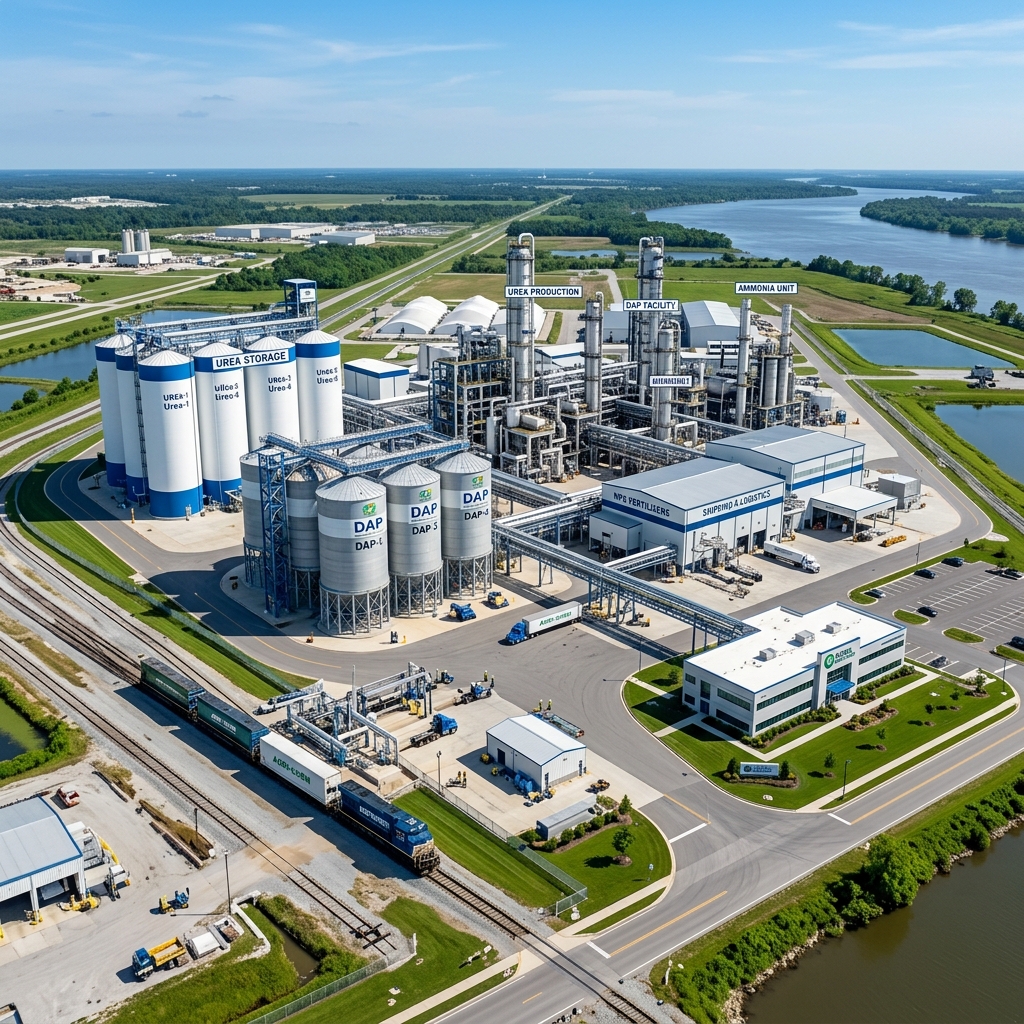
DAP (Diammonium Phosphate) Guide
Last updated:
In global broadacre agriculture, DAP (Diammonium Phosphate) is the gold standard for high-phosphorus nutrition. Delivering a powerful 18-46-0 nutrient...
In global broadacre agriculture, DAP (Diammonium Phosphate) is the gold standard for high-phosphorus nutrition. Delivering a powerful 18-46-0 nutrient profile, it provides the essential ATP energy required for root development and crop establishment. WorldwideTradeX manages the global supply of fully water-soluble DAP for industrial agriculture and bulk blending plants.
Table of Contents
- Nutrient Profile: 18-46-0 Efficiency
- Solubility: The P2O5 Availability Metric
- Application: Soil pH and Ammonia Risk
- Technical Specifications Table
1. Nutrient Profile: 18-46-0 Performance
DAP is a chemically stable, complex fertilizer.
- Nitrogen (18%): Immediate ammoniacal nitrogen for early vegetative growth.
- Phosphorus (46%): Concentrated P2O5 for root establishment and energy transfer.
- Granulometry: Standard 2.0 - 4.0mm granules, perfectly matched for precision spreading and blending with Urea and MOP.
2. Critical Performance: Water Solubility
Plants can only uptake phosphorus that is dissolved in soil solution.
- Minimum Threshold: We guarantee a minimum 90-95% water solubility of the total P2O5 content.
- Direct Impact: High solubility ensures that applied phosphorus is available to seedlings immediately upon rains/irrigation, rather than remaining locked in the soil.
3. Agricultural Application: Soil Interaction
Strategic use of DAP requires understanding soil chemistry.
- pH Interaction: DAP temporarily increases the pH around the granule. In acidic soils, this aids P availability; in highly alkaline soils, MAP may be preferred to avoid ammonia toxicity.
- Hardness: Our DAP is engineered for a crushing strength > 3.0 kgf, preventing dust creation and ensuring even distribution via mechanical spreaders.
4. Technical Specifications: DAP Hub
| Nutrient / Property | Specification (DAP) | Typical WTX Analysis |
|---|---|---|
| Total Nitrogen (N) | 18.0% Min | 18.1% |
| Total P2O5 | 46.0% Min | 46.3% |
| Water Soluble P | 90% of Total P Min | 94.5% |
| Moisture | 1.5% Max | 1.0% |
| Size (2-4mm) | 90% Min | 96% |
Chemicals Knowledge Hub
- Urea N46: Prilled vs. Granular Specs
- Rock Phosphate: The Raw P2O5 Source
- Agro: Climate Engineering & Soil Health
Frequently Asked Questions
What is DAP fertilizer and how does it differ from MAP?
DAP (Diammonium Phosphate) contains 18% nitrogen and 46% P2O5 (phosphate). MAP (Monoammonium Phosphate) contains 11% nitrogen and 52% P2O5. DAP is more widely traded globally; MAP has higher phosphate content and is preferred in high-phosphate-demand crops. Both are granular and water-soluble.What BPL grade is required for DAP/MAP production?
DAP and MAP production requires rock phosphate with minimum 68–72% BPL (Bone Phosphate of Lime, equivalent to ~30–33% P2O5). Lower BPL grades require more acid per unit of product, increasing production costs. High-BPL rock from Morocco (OCP) and Jordan is the global benchmark.How is DAP priced in international markets?
DAP is priced against the Tampa CFR (USA) and India CFR benchmarks, published by Argus and Platts. Prices are influenced by ammonia and sulphuric acid input costs, Chinese export volumes, and seasonal agricultural demand. India is the world's largest DAP importer.What are standard Incoterms and payment terms for DAP bulk shipments?
CFR (Cost and Freight) to destination port is standard for large volumes. Payment is typically irrevocable LC for first transactions. Minimum bulk vessel quantities are 5,000–25,000 MT. SGS inspection at loading port for weight and quality is mandatory.More Frequently Asked Questions
What MOQ applies to chemical products?Often container-scale (big bags, 50 kg sacks or bulk). Confirm per product in your RFQ.
Do you provide analysis certificates?
Yes — CoA per lot is standard; third-party inspection available on request.
How is moisture/fouling controlled in transit?
Proper packing, dry holds/containers and handling guidelines are specified per product.
Are private label packs available?
Retail and distributor branding is possible on selected lines subject to MOQ.
How is pricing determined?
Market-based with volume, packing and Incoterm factors — issued via RFQ.
DAP vs. MAP: A Quick Selection Guide
Buyers blending NPK formulations should choose between the two phosphates on four axes:
| Factor | DAP (18-46-0) | MAP (11-52-0) |
|---|---|---|
| P2O5 concentration | 46% | 52% — more P per freight dollar |
| Nitrogen contribution | 18% | 11% — less N to balance in blends |
| Reaction zone pH | Alkaline (~7.8) | Slightly acidic (~4.5) |
| Fit | Broadacre cereals, alkaline-tolerant crops | P-dense blends, acidic-soil programs |
For long-distance freight, MAP often wins on nutrient-per-tonne economics; for single-pass basal application in South and East Asia, DAP remains the reference product buyers request in the RFQ.
Storage & Handling: Caking Control
DAP absorbs moisture above roughly 60% relative humidity and cakes hard when bagged product sweats in transit.
- Vessel holds must be dry and salt-free; request hold inspection photos before loading.
- Big bags (1-1.25 MT) need UV-stabilized fabric for open-yard storage beyond 30 days.
- Warehouse stacking: 50 kg bags maximum 10 pallets high in tropical climates; poly-lined bags extend safe stacking height.
- Reconditioning: caked stock can be re-screened, but crushing strength is permanently reduced — prevention is cheaper than recovery.
Bulk Blending Compatibility
DAP's 2-4 mm granulometry is deliberately matched to granular urea N46 and MOP so blended product stays homogeneous during transport and spreading. Segregation occurs when components differ by more than ~10% in particle diameter — always request the size guide number (SGN) of each blend component and keep all within 240-300 SGN.
Broadcast blends are unaffected by the DAP-urea pH interaction that concerns banded applications; for compound NPK granulation rather than physical blending, MAP is usually preferred for its reaction chemistry.
For project-specific terms, contact WorldwideTradeX via RFQ.