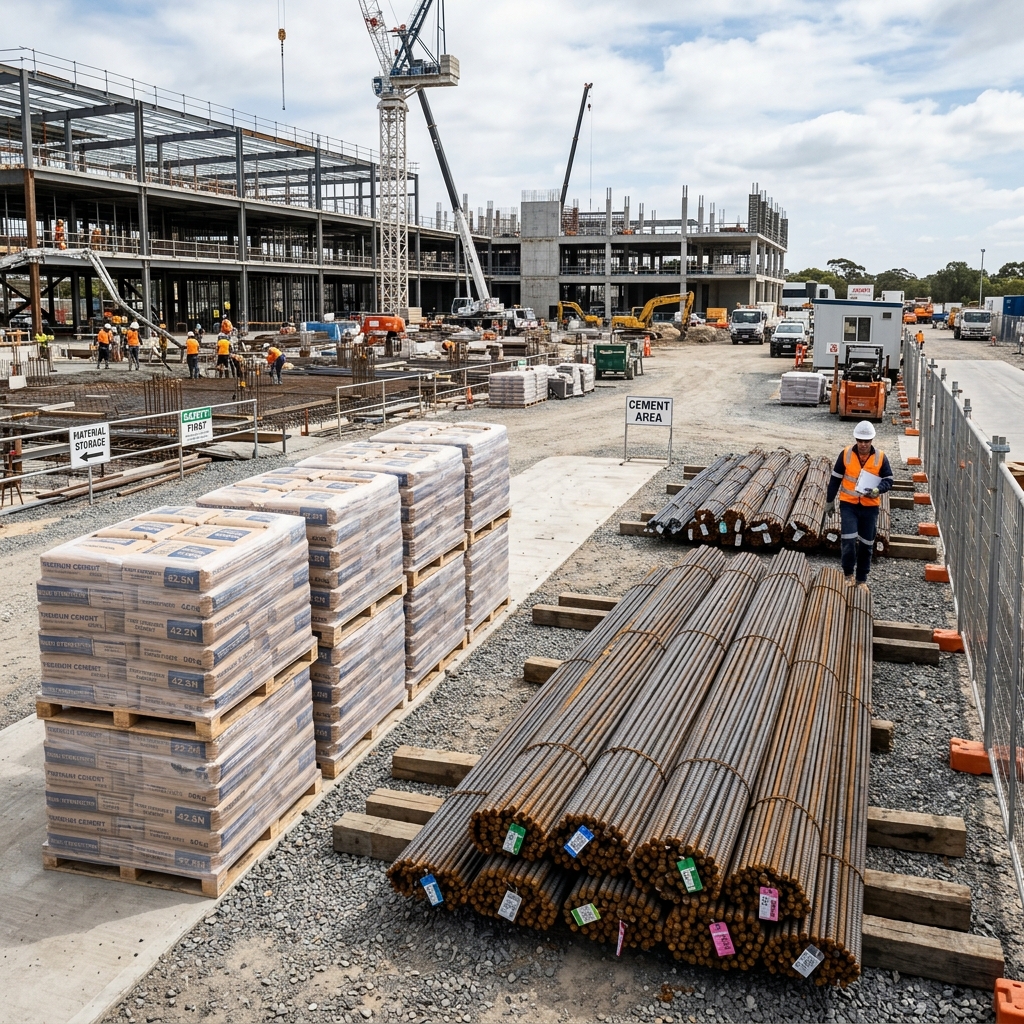
Seismic Steel Rebar (B500C)
Last updated:
When a building sways during an earthquake, its 'bones' must bend without breaking. This property is called ductility, and it is the single most important...
When a building sways during an earthquake, its "bones" must bend without breaking. This property is called ductility, and it is the single most important factor in the BS 4449 (2005) B500C standard we supply. Send the bar diameters, the tonnage and the standard the project specifies, and we will quote ribbed reinforcement through request a quote.
Table of Contents
- Seismic Grade Importance (B500C vs. B500A)
- Technical Specifications (ASTM A615)
- Ductility & Performance Metrics
- Sizing & Sourcing Hub
1. Why Seismic Grade Matters (B500C vs. B500A)
- B500A (Cold Worked): Common, cheaper, but brittle. Snaps under heavy seismic loads.
- B500C (Quenched & Tempered): The "Gold Standard". It has high yield strength (500 MPa) but maintains an elongation at break of >7.5%. This allows the structure to absorb energy rather than catastrophically failing.
2. Technical Specifications (ASTM A615 Grade 60)
We supply deformed bars (ribbed) compliant with both UK/EU and US standards.
| Property | Specification (B500C) | Standard |
|---|---|---|
| Yield Strength (Re) | ≥ 500 N/mm² | BS 4449:2005 |
| Tensile Strength (Rm) | ≥ 1.15 x Re | Min 575 N/mm² |
| Elongation (Agt) | ≥ 7.5% | High Ductility |
| Carbon Equivalent (Ceq) | ≤ 0.50% | Weldability |
| Bar Length | 6m, 12m | Container or Bulk |
3. Sizing & Sourcing Logistics
- Diameters: 8mm, 10mm, 12mm, 16mm, 20mm, 25mm, 32mm.
- Bundling: 2MT Standard Crane Bundles.
- Origin: Turkey (Iskenderun), China (Hebei), Vietnam.
Construction Knowledge Hub
- Portland Cement: CEM I 42.5/52.5 Grades
- Bitumen: 60/70 & 80/100 Penetration Logistics
- Energy: EN590 Diesel 10PPM Standards
Frequently Asked Questions
What is rebar and what steel grade is standard for construction export?
Rebar (reinforcing bar) is deformed steel bar used to reinforce concrete structures. The most traded export grade is B500B (500 MPa yield strength) per EN 10080 standard, or Grade 60 (420 MPa) per ASTM A615. B500B is the European and Middle East standard; Grade 60 is used in the Americas.What is the difference between billets and finished rebar in steel trade?
Steel billets are semi-finished square cross-section bars (100×100mm to 150×150mm) that are rolled into rebar, wire rod, or sections. Finished rebar is the end product. Billets are traded by countries with rolling mill capacity; finished rebar is for direct construction use. Billets are cheaper per MT but require further processing.How is rebar priced in international markets?
Rebar is priced against the Turkish export FOB (Iskenderun) benchmark, published by Platts and SteelOrbis. It is also influenced by Chinese export prices (CFR Southeast Asia) and scrap input costs. Prices are quoted in USD/MT and fluctuate with global construction demand and raw material costs.What are standard quality certifications required for rebar export?
Mill Test Certificate (MTC) per EN 10204 3.1 is mandatory, showing chemical composition and mechanical properties. Third-party inspection (SGS/Bureau Veritas) at mill or port is required by most buyers. Some markets (Saudi Arabia, UAE) require additional local standards compliance (SASO, ESMA).More Frequently Asked Questions
Do you supply materials only or full packages?Both — pure material supply and coordinated packages (stone, bitumen, fit-out, PMC/EPC scopes) depending on the project.
Which documents accompany shipments?
Invoice, packing list, mill/CoA certificates, origin documents and project-specific compliance files as required.
Can you support site delivery (DAP/DDP)?
Yes where the destination and scope allow; otherwise FOB/CIF to your nominated port is standard.
How is quality controlled?
Factory certificates plus optional third-party inspection (SGS/Intertek) before loading.
How do we request a project quote?
Share drawings/specs, quantities, location and target completion via RFQ.
Shipping: Container vs. Break-Bulk
Bar length decides the shipping economics. Standard 6 m bars fit 20ft containers, while 12 m bars require 40ft line containers or break-bulk stowage.
- 40ft containers: 12 m bars in lots around 27 MT; fastest port turnaround and no rust exposure during handling.
- Break-bulk vessel holds: best cost per tonne above roughly 3,000-5,000 MT; bars bundled in 2 MT crane lifts and loaded by hold.
- Stowage quality: sea freight on open decks adds surface rust; light atmospheric rust is acceptable under most standards, but specify holds-not-deck stowage for epoxy-coated or galvanized product.
Weldability & Site Verification
B500C with a carbon equivalent at or below 0.50% welds without preheat in normal bar sizes under EN ISO 17660 procedures; above 0.50% Ceq, preheating and controlled cooling become mandatory. Always match the welding procedure specification to the mill certificate Ceq, not the brochure value.
Site acceptance testing typically covers tensile strength, yield strength, elongation and a 180° bend test per lot (one sample per 30 tonnes is common tender practice). WorldwideTradeX supplies EN 10204 3.1 mill test certificates with every bundle; third-party witnessed tensile tests can be arranged at destination laboratories for project documentation.
What to Specify in Your RFQ
Rebar quotations diverge mostly on missing information. A complete request includes:
- Standard and grade (BS 4449 B500C, ASTM A615 Grade 60, or local equivalent).
- Diameter list with tonnage per size — mill rolling schedules mix diameters per campaign.
- Bar length (6 m / 12 m / cut-and-bend schedules).
- Bundle weight and marking (each bundle needs mill, grade and heat number tags).
- Destination port and required documents (legalization, chamber certification).
- Inspection scope: mill 3.1 certificate only, or third-party sampling at load.
For project-specific terms, contact WorldwideTradeX via RFQ.