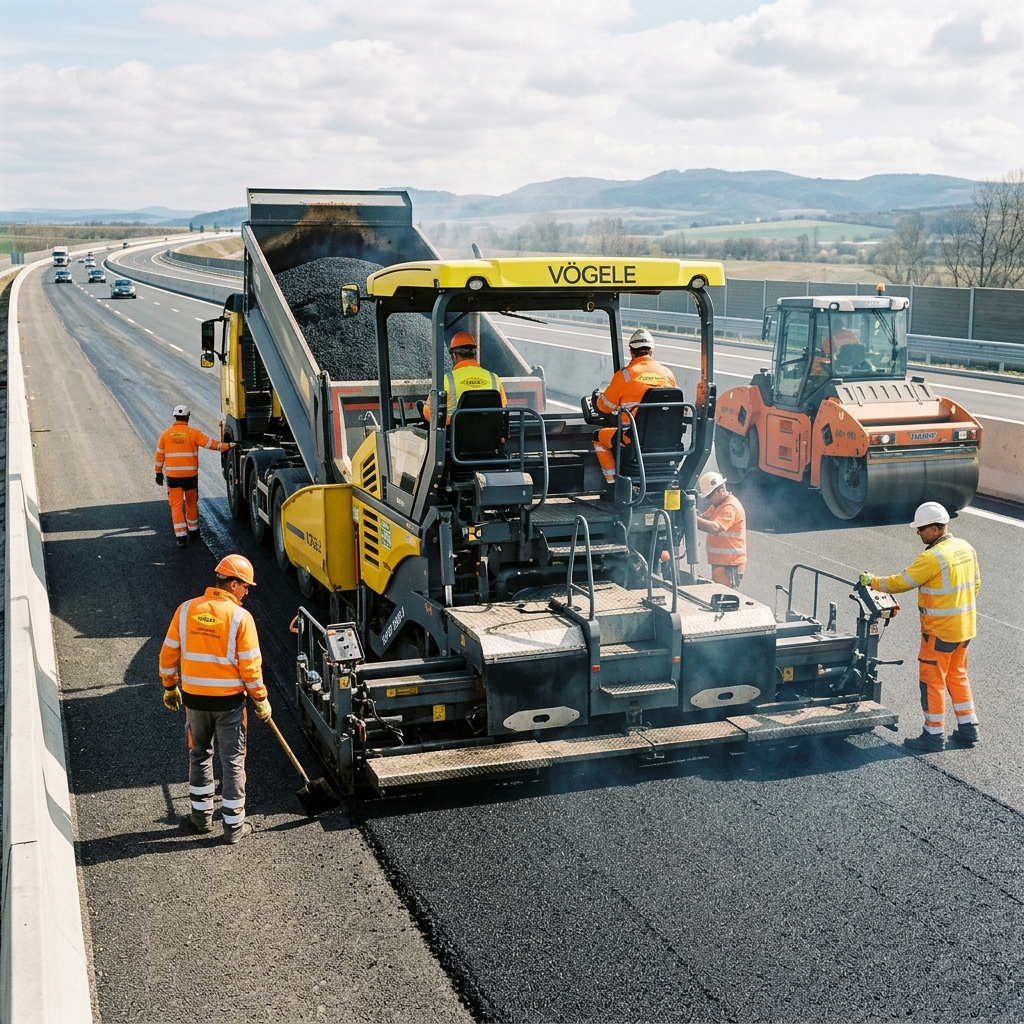
Road Construction & Bitumen Supply
Last updated:
Bulk and drum bitumen for road paving: penetration grades, PMB, packaging, ports, and RFQ guidance.
Bitumen is the binder that holds asphalt together. WorldwideTradeX supplies penetration-grade and polymer-modified bitumen for contractors, national road programs, and asphalt plants. Send the road programme, the binder grade and the delivery schedule, and we will quote bitumen supply for the paving season: request a quote.
Common Grades
| Grade | Penetration (0.1 mm) | Typical use |
|---|---|---|
| 40/50 | 40–50 | Hot climates, heavy traffic |
| 60/70 | 60–70 | General paving standard |
| 80/100 | 80–100 | Cooler climates, surface courses |
| PMB 45/80-65 | Spec-dependent | High-performance / high-stress roads |
Key tests: penetration, softening point (R&B), ductility, flash point, ductility after RTFOT/TFOT.
Packaging Options
| Format | Capacity | Best for |
|---|---|---|
| Steel drums | 150 / 180 / 220 kg | Flexible markets, smaller sites |
| Jumbo / Bitutainer | 20 MT + heating | Large plants, re-export |
| Bulk vessel | 1,000 MT+ | Mega road programs |
Heated Bitutainers reduce unloading time vs drums — often cheaper per MT at scale.
Quality Assurance
- Batch CoA (penetration, softening, flash)
- Optional SGS/Intertek at loading
- Origin documentation (Turkey / MENA / other by contract)
Logistics
- Ports: Mersin, Izmir, Ambarli, Jebel Ali (route-dependent)
- Incoterms: FOB, CIF, CFR, DAP
- Handling: Bitumen must stay within temperature windows; site tanks recommended for bulk
Procurement Tips
- Confirm grade against project specification (authority standards often differ)
- Choose packaging vs bulk based on plant unloading capability
- Plan heating equipment and storage tanks before first shipment
- Align inspection protocol in the SPA
Penetration and Viscosity Grades in Detail
| Grade | Softening point (approx.) | Climate / application |
|---|---|---|
| 30/40 | 55–63 °C | Very hot climates, heavy axle loads, base and binder courses |
| 60/70 | 49–56 °C | Standard binder for wearing courses in warm regions |
| 80/100 | 45–52 °C | Temperate to cool climates, surface dressing, maintenance mixes |
| VG-10 | 40+ °C | Cold regions and low-traffic roads under viscosity grading |
| VG-30 | 47+ °C | Hot climates and high traffic — the common VG equivalent of 60/70 |
| VG-40 | 50+ °C | Extreme heat and heavy-load corridors |
Viscosity-graded (VG) binders are increasingly specified by highway authorities because the test method correlates better with field performance at service temperature than penetration testing alone. Always match the grade to the project specification rather than substituting between grading systems in the bid.
Hot Bitumen vs Emulsion vs Cutback
| Type | Carrier | Typical use | Notes |
|---|---|---|---|
| Hot bitumen | None — heated to 150–170 °C | Hot-mix asphalt structural layers | Highest performance; requires heated logistics end to end |
| Emulsion | Water plus emulsifier | Tack coat, surface dressing, cold mix, slurry seal | Applied at ambient temperature; breaks on contact with aggregate |
| Cutback | Petroleum solvent | Prime coat, remote patching | Declining use — VOC restrictions in many markets |
Emulsions dominate routine maintenance because crews can apply them without heating plants, and they comply with tightening environmental rules. Hot bitumen remains the standard for structural asphalt layers where mix temperature control is available at the plant.
Road Layer Structure
A flexible pavement typically builds up in five layers:
- Subgrade — compacted natural ground, CBR-tested to confirm bearing capacity
- Sub-base — granular or cement-stabilized layer that spreads load
- Base course — crushed aggregate, typically 150–300 mm compacted
- Binder course — coarser asphalt mix, 50–80 mm, carrying most of the structural load
- Wearing course — finer asphalt mix, 40–60 mm, often with harder-grade or polymer-modified binder for rut resistance
Transport Temperature and Handling
- Loading temperature: typically 140–160 °C at refinery; the grade's maximum safe handling temperature must not be exceeded
- Drums: ambient storage is acceptable; reheat in drum heaters or decanters before use
- Bitutainers / jumbo: maintain roughly 130–150 °C in transit; heated unloading saves 2–3 days per parcel versus cold drums
- Bulk vessel: ships with heating coils; the receiver needs insulated tanks at 150 °C or above plus adequate pump capacity
- Storage limits: prolonged holding above 160 °C ages the binder — penetration falls and softening point rises — so plan discharge promptly on arrival and avoid repeated reheating cycles
See adjacent construction materials and services or request a parcel price with grade, tonnage, and destination via the RFQ page.
FAQ
60/70 vs 80/100 — which do I need?
Hotter climates and heavy loads → harder (60/70 or lower penetration). Cooler regions → softer grades.
Do you supply polymer-modified bitumen?
Yes — PMB grades available subject to project spec and volume.
What is MOQ?
Drums from container quantities; bulk contracts typically vessel-scale.
How is quality verified?
CoA standard; third-party inspection optional at loading port.
How do I get a quote?
RFQ with grade, tonnage, packing, and destination.
How many drums fit in a 20-ft container?
Around 110 drums of 180 kg — roughly 20 MT net, subject to shipping-line weight limits on the route.
Can you deliver to cold ports in winter?
Yes, but bulk parcels require receiver tanks with heating; drums are the safer option in freezing conditions where heated storage is unavailable.
What documents come with each shipment?
Batch CoA, certificate of origin, packing list, bill of lading, and third-party inspection report where contracted.
Do you supply PMB for airfields?
Yes — PMB 45/80-65 and similar airfield-grade binders are available to project specification and volume.
WorldwideTradeX — road bitumen RFQ.