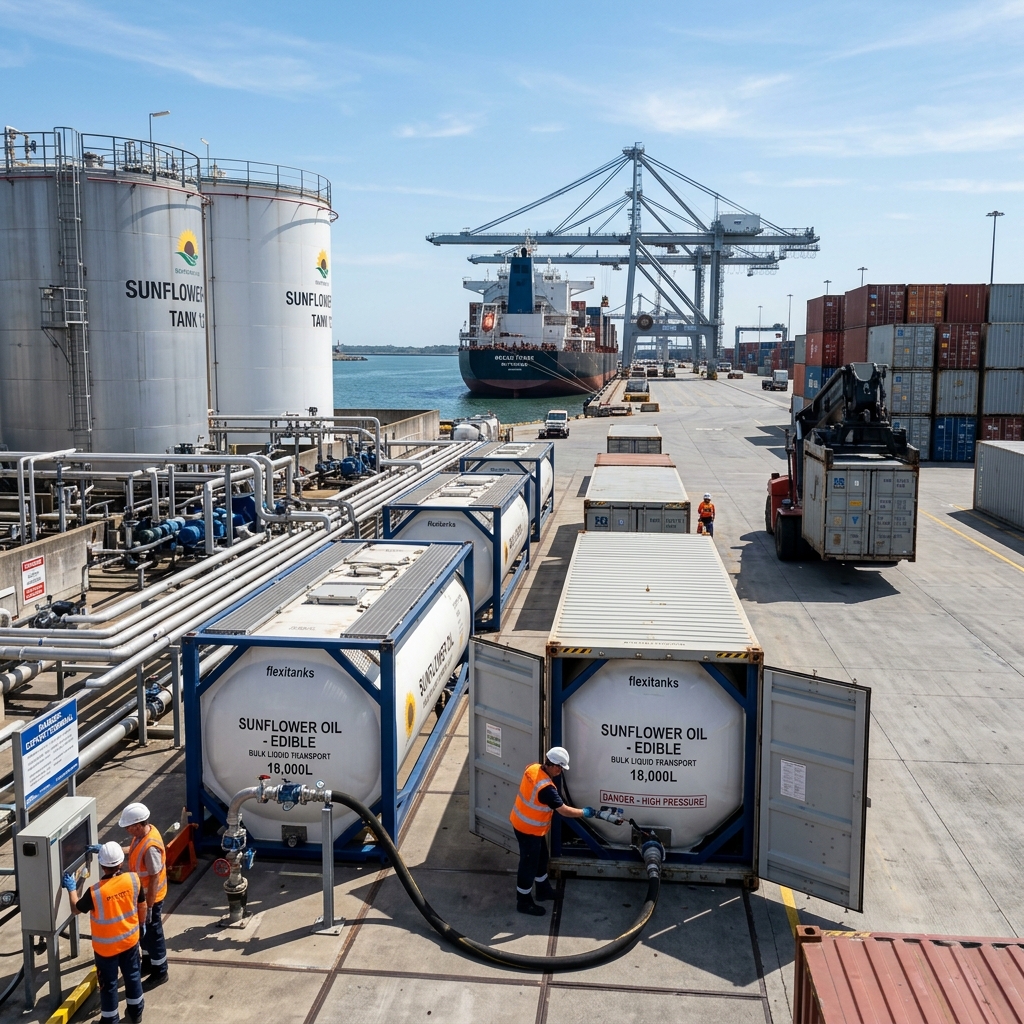
Bulk Sunflower Oil: Russia & Africa Direct Factory
Last updated:
Sunflower Oil (Ayçiçek Yağı) is a premium vegetable oil produced in Turkey from high-quality sunflower seeds. Turkish sunflower oil is renowned for its...
Executive Summary
Sunflower Oil (Ayçiçek Yağı) is a premium vegetable oil produced in Turkey from high-quality sunflower seeds. Turkish sunflower oil is renowned for its light color, neutral flavor, and excellent nutritional profile. This technical specification covers all sunflower oil types including crude, refined, bleached, deodorized (RBD), and high-oleic variants produced in Turkey. Send the grade, the packing and the destination and we will quote Turkish sunflower oil with the analysis and inspection terms attached: request a quote.
Key Features:
- Turkish Production: 1.8-2.2 million MT annual processing capacity
- Processing Regions: Marmara (Tekirdağ, Balıkesir), Aegean (İzmir, Aydın), Central Anatolia (Konya, Kırıkkale)
- Processing Capacity: 5,000-15,000 MT/day per major facility
- Export Markets: EU, GCC, Balkans, North Africa, Central Asia
- Oil Types & Specifications: Crude, RBD, high-oleic, palm-blended variants
- Fatty Acid Profile: Comprehensive composition analysis
- Processing & Refining: Extraction, refining, bleaching, deodorization
- Quality Parameters: Peroxide value, free fatty acid, anisidine value
- Packaging & Storage: Drums, bulk tanks, container loading specifications
- Logistics & Transportation: Temperature control, contamination prevention
- Market Analysis: Regional pricing, demand trends, export opportunities
- Compliance & Certifications: TSE, EU, GCC, ISO, Halal standards
1. Technical Specifications
1.1 Oil Type Classifications
| Parameter | Crude Oil | RBD Oil | High-Oleic | Palm-Blended |
|---|---|---|---|---|
| Color (RBM) | 80-120 | ≤10 | ≤8 | ≤15 |
| Free Fatty Acid | 2.0-4.0% | ≤0.15% | ≤0.10% | ≤0.15% |
| Peroxide Value | 5-15 meq/kg | ≤5 meq/kg | ≤6 meq/kg | ≤6 meq/kg |
| Anisidine Value | - | ≤10 | ≤8 | ≤12 |
| TOTOX Value | - | ≤20 | ≤18 | ≤24 |
| Iodine Value | 90-105 | 90-105 | 110-135 | 85-100 |
| Saponification Value | 188-196 | 188-196 | 185-195 | 188-194 |
| Melting Point | -15 to -10°C | -12 to -8°C | -10 to -6°C | 20-25°C |
| Trans Fats | <0.5% | <0.5% | <0.5% | <1.0% |
| Stearic Acid | 3-5% | 3-5% | 2-4% | 4-6% |
| Oleic Acid | 20-35% | 20-35% | 75-85% | 35-45% |
| Linoleic Acid | 55-70% | 55-70% | 10-20% | 40-55% |
| Saturated Fat | 13-15% | 13-15% | 12-14% | 25-30% |
1.2 Mandatory Quality Parameters (TSE 498/1995)
| Parameter | Requirement | Test Method | Units | Tolerance |
|---|---|---|---|---|
| Moisture & Impurities | ≤0.20% | TSE 2184 | % | ±0.05 |
| Free Fatty Acid (as oleic) | ≤0.15% | TSE 2185 | % | ±0.03 |
| Peroxide Value | ≤5 meq/kg | TSE 2186 | meq/kg | ±1.0 |
| Anisidine Value | ≤10 | TSE 2187 | - | ±2.0 |
| TOTOX Value | ≤20 | TSE 2186 + 2187 | - | ±4.0 |
| Saponification Value | 188-196 | TSE 2188 | - | ±3.0 |
| Iodine Value | 90-105 | TSE 2189 | g I₂/100g | ±3.0 |
| Unsaponifiable Matter | ≤1.5% | TSE 2190 | % | ±0.3 |
| Phosphorus | ≤20 ppm | TSE 2191 | ppm | ±5 |
| Iron | ≤0.30 ppm | TSE 2191 | ppm | ±0.10 |
| Copper | ≤0.05 ppm | TSE 2191 | ppm | ±0.02 |
| Arsenic | ≤0.10 ppm | TSE 2192 | ppm | ±0.05 |
| Lead | ≤0.10 ppm | TSE 2192 | ppm | ±0.05 |
| Cadmium | ≤0.05 ppm | TSE 2192 | ppm | ±0.02 |
1.3 Fatty Acid Composition (RBD Sunflower Oil)
Standard Linoleic Type:
| Fatty Acid | Range | Units | Test Method |
|---|---|---|---|
| Palmitic (C16:0) | 5.0-8.0% | % | TSE 2193 |
| Stearic (C18:0) | 3.0-5.0% | % | TSE 2193 |
| Oleic (C18:1) | 20-35% | % | TSE 2193 |
| Linoleic (C18:2) | 55-70% | % | TSE 2193 |
| Linolenic (C18:3) | <1.0% | % | TSE 2193 |
| Other | <1.0% | % | TSE 2193 |
High-Oleic Type:
| Fatty Acid | Range | Units | Test Method |
|---|---|---|---|
| Palmitic (C16:0) | 4.0-6.0% | % | TSE 2193 |
| Stearic (C18:0) | 2.0-4.0% | % | TSE 2193 |
| Oleic (C18:1) | 75-85% | % | TSE 2193 |
| Linoleic (C18:2) | 10-20% | % | TSE 2193 |
| Linolenic (C18:3) | <0.5% | % | TSE 2193 |
| Other | <1.0% | % | TSE 2193 |
1.4 Nutritional Values (Per 100g)
Standard Linoleic Type:
- Energy: 3,700 kJ / 884 kcal
- Fat: 100g
- Saturated: 13-15g
- Monounsaturated: 20-35g
- Polyunsaturated: 55-70g
- Carbohydrates: 0g
- Protein: 0g
- Salt: 0g
- Vitamin E: 40-60 mg α-tocopherol
- Energy: 3,700 kJ / 884 kcal
- Fat: 100g
- Saturated: 12-14g
- Monounsaturated: 75-85g
- Polyunsaturated: 10-20g
- Carbohydrates: 0g
- Protein: 0g
- Salt: 0g
- Vitamin E: 40-60 mg α-tocopherol
2. Processing & Refining
2.1 Raw Material: Sunflower Seeds
Seed Specifications:
- Moisture: ≤8.0%
- Oil Content: 38-44%
- Impurities: ≤2.0%
- Cracked Seed %: ≥85%
- Fatty Acid Value: ≤30 mg KOH/10g
- Purity: ≥98% (same variety)
- Moisture: ≤8.0% (prevent mold during storage)
- Foreign Matter: ≤2.0% (straw, stones, metal)
- Rancidity: No rancid odor or taste
- Mycotoxins: Aflatoxin ≤10 μg/kg
2.2 Extraction Process
Step 1: Cleaning & Preparation
```
Seed Reception → Cleaning (sieves, magnets) → Hulling → Flaking → Cooking
```
- Hulling: 12-15% hull removed
- Flake Thickness: 0.25-0.35 mm
- Cooking: 100-110°C, 15-20 minutes
- Moisture: 8-10% after cooking
- Expeller Extraction: 18-22% oil remaining in cake
- Solvent Extraction: 99%+ oil recovery
- Cake Moisture: 7-9%
- Cake Oil Content: 10-12%
```
Crude Oil → Degumming → Neutralization → Bleaching → Deodorization
```
2.3 Refining Steps
Degumming:
- Purpose: Remove phospholipids (gums)
- Process: Hydration degumming with 2-5% hot water
- Temperature: 80-90°C
- Result: Phosphorus reduced to 10-20 ppm
- Yield Loss: 0.3-0.5%
- Purpose: Remove free fatty acids
- Process: NaOH (16-20° Be) addition
- Temperature: 70-80°C
- FFA Reduction: From 2-4% to ≤0.15%
- Yield Loss: 0.5-1.0% (soapstock)
- Purpose: Remove pigments, oxidation products
- Adsorbent: Activated bleaching earth (5-10 kg/ton oil)
- Temperature: 90-110°C
- Vacuum: <100 mmHg
- Time: 20-30 minutes
- Color Reduction: RB 80-120 to ≤10
- Purpose: Remove volatile odors, free sterols
- Process: Steam distillation under high vacuum
- Temperature: 240-260°C
- Vacuum: <10 mmHg
- Time: 60-120 minutes
- Result: Odorless, neutral-tasting oil
2.4 Winterization (Optional)
Purpose: Remove high-melting triglycerides for cloud-point stability
Process:
- Cooling: To -10°C over 24 hours
- Holding: At -10°C for 12-24 hours
- Filtering: Pressure filtering at low temperature
- Yield Loss: 2-5% (wax removal)
3. Packaging & Storage
3.1 Packaging Options
ISO Tank Containers:
- Capacity: 24,000-26,000 kg (net)
- Container Type: 20ft stainless steel ISO tank
- Material: AISI 304 or 316L stainless steel
- Cleaning: CIP cleaned, food-grade certified
- Pressure Rating: 2.0 bar working pressure
- Temperature Range: -25°C to +60°C
- Capacity: 180-185 kg net
- Material: New steel drums (SGCC)
- Lining: Epoxy phenolic lining (food-grade)
- Sealing: Double-seam sealed
- Labeling: Product info, batch number, net weight
- Stacking: 2-high on pallets
- Capacity: 950-1,000 kg net
- Material: HDPE bottle in steel cage
- Discharge: 2" ball valve
- Sterility: Food-grade certification required
- Cleaning: Single-use or CIP cleaned
- Capacity: 800-1,000 kg net
- Material: Food-grade polypropylene woven fabric
- Lining: Food-grade PE liner
- Safety Factor: 5:1
- Discharge: Bottom spout
- Material: Tinplate or aluminum
- Lining: Epoxy phenolic (BPA-free)
- Sealing: Double-seam or push-pull cap
- Labeling: Compliance with TSE 498/1995
3.2 Container Loading Specifications
ISO Tank Loading:
```
Container Type: 20ft ISO tank (stainless steel)
Internal Volume: 25,000-26,000 liters
Oil Density: 0.918-0.922 kg/L at 20°C
Maximum Loading: 24,000-26,000 kg (90-95% of capacity)
Expansion Space: 5-10% required
Loading Temperature: 40-50°C (reduces viscosity)
Ventilation: Closed during voyage (prevent moisture ingress)
Temperature Monitoring: Continuous data logger required
```
20ft GP Container (Drums):
```
Drum Size: 200L (185 kg net)
Drums per layer: 4 × 5 = 20 drums
Layers: 4-5 layers (max height 2.4m)
Total drums: 80-100 drums
Total weight: 14,800-18,500 kg (net oil)
Pallet Configuration:
- Pallet size: 1,200 × 1,000 mm
- Drums per pallet: 4 (2 × 2)
- Pallets per layer: 5
- Total layers: 4
- Total drums: 80 drums
Moisture Control:
- Container Humidity: <50% RH at loading
- Temperature: 20-30°C during loading
- Desiccant: Required (10-15 kg calcium chloride)
- Ventilation: ISO tanks have pressure relief valves
3.3 Storage Requirements
Warehouse Specifications:
- Temperature: 15-25°C (optimal)
- Maximum Tolerance: <35°C (prevent oxidation)
- Minimum Tolerance: >5°C (avoid wax precipitation)
- Humidity: <65% RH
- Ventilation: 2-4 air changes per hour
- Light: Protected from direct sunlight
- Material: Food-grade stainless steel (304/316L)
- Nitrogen Blanketing: Recommended for long-term storage
- Agitation: Periodic mixing (prevent stratification)
- Draining: Bottom drain with filtration
- Cleaning: CIP cleaning after each batch change
- Short-term (0-3 months): Standard conditions
- Medium-term (3-6 months): Nitrogen blanketing recommended
- Long-term (6-12 months): Inert atmosphere, cool storage
- Maximum: 12-18 months with proper storage
4. Transportation & Logistics
4.1 Domestic Transportation (Turkey)
Pipeline Transport:
- Major Routes: Processing plants → Distribution hubs
- Piping Material: SS 304/316L
- Flow Rate: 50-200 m³/hour
- Temperature: 40-50°C (maintain fluidity)
- Tanker Trucks: 20-30 MT capacity
- Material: Stainless steel tanks
- Cleaning: Dedicated food-grade transport
- Documentation: Waybill, quality certificate, temperature log
- Tank Cars: 50-70 MT capacity
- Material: Food-grade stainless steel
- Loading: Top loading with vapor recovery
- Security: Sealed, monitored containers
4.2 International Shipping
Sea Freight (ISO Tank):
- Container Type: 20ft stainless steel ISO tank
- Shipping Lines: Maersk, MSC, CMA CGM, Hapag-Lloyd
- Transit Times:
- Turkey → UAE: 18-22 days
- Turkey → Egypt: 7-10 days
- Turkey → Greece: 5-7 days
- Turkey → Romania: 5-8 days
- Turkey → Central Asia: 25-30 days
- Vessel Type: Chemical tanker or bulk carrier
- Hold Preparation: Mandatory cleaning, inspection
- Loading Temperature: 40-50°C
- Ventilation: Closed (prevent oxidation)
4.3 Temperature Control Requirements
Critical Temperature Parameters:
- Optimal Range: 20-30°C
- Maximum Tolerance: <35°C (accelerates oxidation)
- Minimum Tolerance: >5°C (avoid wax clouding)
- Freezing Point: -10°C (standard oil), -5°C (palm-blended)
- Data Loggers: Continuous recording
- Recording Interval: 15 minutes minimum
- Storage: Minimum 90 days
- Alert Thresholds: >35°C or <5°C (immediate action)
- Cloud Point Test: At 0°C for 16 hours
- Turbidity: Oil should remain clear
- Cooling Rate: 1°C/hour for testing
5. Quality Assurance & Testing
5.1 Laboratory Testing Protocol
Incoming Raw Material Testing:
- Daily Tests: Moisture, oil content, FFA
- Weekly Tests: Peroxide value, color, phosphorus
- Monthly Tests: Heavy metals, mycotoxins, microbiology
- Crude Oil: Color, FFA, moisture
- Degummed Oil: Phosphorus, color
- Neutralized Oil: FFA, color
- Bleached Oil: Color, peroxide value
- Deodorized Oil: Color, peroxide, anisidine, TOTOX
- Color: Rubble & Bloem (RBM) method
- Free Fatty Acid: Titration method
- Peroxide Value: Iodometric titration
- Anisidine Value: Spectrophotometric
- TOTOX Value: Calculated (2PV + AV)
- Iodine Value: Wijs method
- Saponification Value: Titration
- Fatty Acid Profile: GC analysis
5.2 Certificate of Analysis (CoA)
Mandatory Information:
- Batch number and production date
- Production facility name and address
- Customer name and order number
- Shipping date and container number
- All tested parameters with results
- Test methods referenced (TSE)
- Laboratory name and accreditation status
- Authorized signature and company stamp
5.3 Acceptance Criteria
Standard RBD Sunflower Oil:
- Color ≤10 RBM
- FFA ≤0.15%
- Peroxide value ≤5 meq/kg
- Anisidine value ≤10
- TOTOX ≤20
- Iodine value 90-105
- Saponification value 188-196
- Color ≤8 RBM
- FFA ≤0.10%
- Peroxide value ≤6 meq/kg
- Anisidine value ≤8
- TOTOX ≤18
- Iodine value 110-135
- Oleic acid 75-85%
6. Market Analysis
6.1 Turkish Sunflower Oil Market Overview
Production Capacity:
- Total Factories: 25-30 major processors
- Annual Capacity: 2.0-2.5 million MT
- Production (2024): 1.8-2.0 million MT
- Consumption (2024): 1.2-1.4 million MT
- Export Potential: 0.4-0.6 million MT
| Company | Capacity (MT) | Brands | Markets |
|---|---|---|---|
| KOSGİĞE | 350,000 | KOSGİĞE, RBD Premium | Domestic, Export |
| Aygaz Yağ | 300,000 | Aygaz, Gold | Domestic, GCC |
| Eti Yağ | 280,000 | Eti, Premium | Domestic, Balkans |
| Güneydoğu Yağ | 250,000 | Güneydoğu | Domestic, Middle East |
| Marmara Yağ | 220,000 | Marmara | Domestic, EU |
Market Dynamics:
- Palm Oil Competition: 40-45% market share (lower cost)
- Olive Oil Premium: 2-3× price of sunflower oil
- Government Policy: Export incentives, VAT exemption
- Regulation: TSE enforcement, food safety standards
6.2 Regional Pricing (FOB Turkey)
2025 Q2-Q3 Forward Rates:
| Destination | RBD Standard ($/MT) | High-Oleic ($/MT) | Transit Time |
|---|---|---|---|
| UAE (Jebel Ali) | 850-900 | 1,100-1,200 | 18-22 days |
| Egypt (Alexandria) | 830-880 | 1,080-1,180 | 7-10 days |
| Greece (Piraeus) | 820-870 | 1,070-1,170 | 5-7 days |
| Romania (Constanța) | 825-875 | 1,075-1,175 | 5-8 days |
| Bulgaria (Varna) | 820-870 | 1,070-1,170 | 4-6 days |
| Kazakhstan (Aktau) | 900-950 | 1,150-1,250 | 25-30 days |
| Uzbekistan (Karsakbay) | 920-970 | 1,170-1,270 | 28-35 days |
Pricing Factors:
- Crude Palm Oil Price: Strong correlation (60-70%)
- Sunflower Seed Price: 30-40% of cost
- Energy Costs: Steam, electricity (15-20% of cost)
- Exchange Rate: USD/TRY impact on competitiveness
- Seasonality: Higher prices Q4 (holiday demand)
6.3 Demand Forecast (2025-2026)
Domestic Demand:
- 2025: 1.3-1.5 million MT (stable growth)
- 2026: 1.4-1.6 million MT (continued growth)
- Key Drivers: Food processing, restaurants, households
- 2025: 400,000-600,000 MT
- 2026: 500,000-700,000 MT
- Growth Markets: Central Asia, North Africa, Balkans
- 2025 Q2-Q3: $830-900/MT (RBD), $1,080-1,200/MT (high-oleic)
- 2025 Q4: $880-950/MT (seasonal increase, holiday demand)
- 2026 Q1: $800-870/MT (post-holiday correction)
- 2026 Q2: $830-900/MT (stable)
7. Compliance & Certifications
7.1 Turkish Standards (Mandatory)
TSE 498/1995 (Sunflower Oil):
- Full compliance required for domestic sale
- Export products must meet or exceed specifications
- Annual TÜRKAK accreditation for testing labs
- Moisture & impurities
- Free fatty acid
- Peroxide value
- Anisidine value
- Saponification value
- Iodine value
- Unsaponifiable matter
- Phosphorus, iron, copper
- Arsenic, lead, cadmium
- Container specifications
- Labeling requirements (Turkish language)
- Batch traceability system
- Product name: "Ayçiçek Yağı"
- Origin: "Türkiye" or "Made in Turkey"
- Net weight: Clearly displayed
- Best-before date: Maximum 12-18 months
- Batch number: Unique traceability
- Storage instructions: Required
- Type designation: Standard, high-oleic, etc.
7.2 International Certifications
ISO 9001:2015:
- Quality management system
- Required for major export markets
- Annual surveillance audits
- Food safety management system
- Mandatory for food industry suppliers
- Comprehensive HACCP coverage
- Required for GCC and Muslim-majority markets
- Served by TÜRSAK, HALK, or accredited bodies
- Documentation: Certificate + audit report
- Mandatory product certification
- SABER platform registration required
- Pre-shipment verification by accredited body
- TSE standards harmonized with EU Regulation (EC) No 1169/2011
- No additional certification required for EU exports
- Phytosanitary certificate not required for oil
- Traceability system mandatory
7.3 Documentation Requirements by Market
GCC (UAE, Saudi Arabia, Qatar):
- Commercial Invoice (3 originals)
- Bill of Lading (3/3 original)
- Certificate of Origin (GCC Form A)
- Certificate of Analysis (laboratory tested)
- Halal Certificate (recognized authority)
- SASO certification (Saudi-specific)
- Weight Certificate
- Purity Certificate
- Commercial Invoice (1 original + 2 copies)
- Bill of Lading (3/3 original)
- Certificate of Origin (Form A if GSP claims)
- Certificate of Analysis
- Weight Certificate
- TSE Compliance Declaration
- Nutritional Declaration
- Commercial Invoice (3 originals)
- Bill of Lading (3/3 original)
- Certificate of Origin
- Certificate of Analysis
- SONCAP (Nigeria), PCCI (Egypt), Certificate of Conformity (Morocco)
- Import License (varies by country)
8. Frequently Asked Questions
What is the difference between standard and high-oleic sunflower oil?
Standard linoleic sunflower oil has 55-70% linoleic acid (omega-6) and 20-35% oleic acid (omega-9). High-oleic sunflower oil has been bred or engineered to contain 75-85% oleic acid and only 10-20% linoleic acid. High-oleic oil has better oxidative stability (longer shelf life), higher smoke point, and more monounsaturated fat which is considered heart-healthy.Can Turkish sunflower oil be exported to the European Union?
Yes, absolutely. TSE 498/1995 standards are harmonized with EU Regulation (EC) No 1169/2011 and related directives. No additional certification is required beyond standard export documentation (commercial invoice, bill of lading, certificate of origin, certificate of analysis). Sunflower oil is not subject to phytosanitary requirements.What is the shelf life of sunflower oil?
Under proper storage conditions (15-25°C, protected from light), standard RBD sunflower oil has a shelf life of 12-18 months. High-oleic sunflower oil has an extended shelf life of 18-24 months due to better oxidative stability. The actual shelf life depends on storage conditions, packaging, and presence of antioxidants.How is sunflower oil tested for quality?
Sunflower oil is tested for: color (RBM method), free fatty acid content (titration), peroxide value (iodometric titration), anisidine value (spectrophotometry), TOTOX value (calculated), iodine value (Wijs method), saponification value, fatty acid profile (gas chromatography), and contaminants (heavy metals, mycotoxins). All tests follow TSE 2184-2192 standards.What is the smoke point of sunflower oil?
Standard RBD sunflower oil has a smoke point of 225-230°C (437-446°F). High-oleic sunflower oil has a higher smoke point of 230-240°C (446-464°F) due to its more stable fatty acid composition. The smoke point can be affected by refining process, impurities, and presence of free fatty acids.FAQ
What is the typical MOQ for this commodity?
Bulk contracts usually start from one vessel or container lot. Exact MOQ depends on product, packing, and destination — send an RFQ for a firm number.
How is quality verified before shipment?
We supply batch COA documents and can arrange SGS/Intertek inspection at the loading port as specified in the SPA.
Which Incoterms do you offer?
FOB, CIF, CFR, and DAP are standard. The right term depends on your logistics capability and risk preference.
Are prices fixed or market-based?
Prices are market-based and benchmarked to relevant indices. Current quotes are issued via RFQ — we do not publish fixed standing prices.
Can you support private label or destination packing?
Where the product allows, yes — packing format, labels, and lot documentation can be aligned to your market requirements.
For project-specific terms, contact WorldwideTradeX via RFQ.