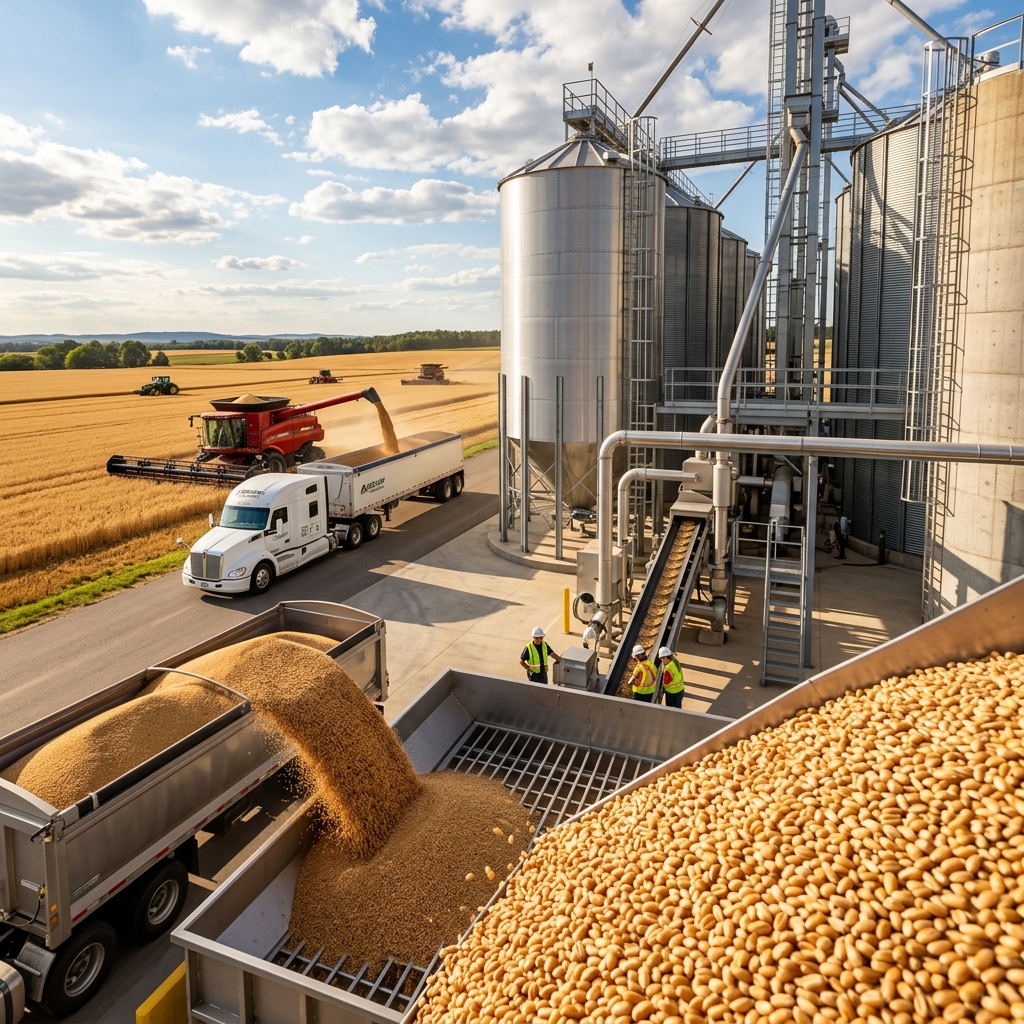
Wheat Technical Specification
Last updated:
Executive Summary
Wheat (Triticum aestivum) is the most important cereal crop cultivated in Turkey, serving as the primary staple food and key raw material for flour milling, pasta, and bakery industries. Turkish wheat is renowned for its high protein content, excellent gluten quality, and consistent performance in food processing. This technical specification covers all wheat types grown and traded in Turkey including bread wheat, durum wheat, soft wheat, and spelt wheat.
Key Features:
- Turkish Production: 25-30 million MT annual harvest
- Growing Regions: Central Anatolia (Konya, Kırıkkale, Aksaray), Eastern Anatolia (Mardin, Şanlıurfa), Marmara Region
- Growing Season: November to May (winter wheat), September to May (spring wheat)
- Export Markets: Balkans, Middle East, North Africa, Central Asia, Caucasus
- Botanical Classification & Varieties: Full taxonomy and major cultivars
- Technical Specifications: Moisture, protein, gluten, test weight, ash content
- Growing & Harvesting: Agronomy, irrigation, pest management, harvest protocols
- Processing & Grading: Cleaning, sorting, milling specifications
- Packaging & Storage: Bagged, bulk, container loading specifications
- Logistics & Transportation: Domestic and international shipping protocols
- Market Analysis: Regional pricing, demand trends, export opportunities
- Compliance & Certifications: TSE, EU, GCC, and international standards
1. Technical Specifications
1.1 Mandatory Quality Parameters
| Parameter | Requirement | Test Method | Units | Tolerance |
|---|---|---|---|---|
| Moisture | ≤14.0% | TSE 10527 | % | ±1.0 |
| Test Weight | ≥750 g/L | TSE 10528 | g/L | ±10 |
| Protein Content | 10.0-14.0% | TSE 10530 | % | ±1.0 |
| Wet Gluten | 25.0-35.0% | TSE 10531 | % | ±3.0 |
| Dry Gluten | 7.0-12.0% | TSE 10531 | % | ±2.0 |
| Foreign Material | ≤1.0% | TSE 10532 | % | ±0.5 |
| Broken Kernels | ≤2.0% | TSE 10532 | % | ±1.0 |
| Green/Discolored | ≤0.5% | TSE 10532 | % | ±0.3 |
| Heating Damage | ≤0.5% | TSE 10532 | % | ±0.3 |
| Weedy Seeds | ≤0.5% | TSE 10532 | % | ±0.3 |
| Insect Damage | ≤0.5% | TSE 10532 | % | ±0.3 |
| Aflatoxin (B1+B2+B3+G1) | ≤20 μg/kg | TSE 10545 | μg/kg | ±10 |
| Ochratoxin A | ≤5 μg/kg | TSE 10545 | μg/kg | ±2 |
| Deoxynivalenol (DON) | ≤1000 μg/kg | TSE 10545 | μg/kg | ±500 |
| Heavy Metals | See Section 1.3 | TSE 10546 | - | - |
1.2 Physical Characteristics
Kernel Characteristics:
- Shape: Oblong to elliptical
- Size: 5-8 mm length, 2-4 mm width, 2-3 mm thickness
- Color: Red or white (varies by variety), uniform color
- Surface: Smooth, clean, no cracks
- Germination Rate: ≥95% (for seed grade), ≥85% (for feed/food)
- Hardness Index: 40-70 (medium-hard to hard)
- Fresh Harvest: 680-720 g/L
- Dried (14% moisture): 750-800 g/L
- Maximum: 820 g/L (premium grade)
- Angle of Repose: 25-30 degrees
- Static Coefficient: 0.30-0.40
- Dynamic Coefficient: 0.20-0.30
1.3 Heavy Metal Limits (TSE 10546)
| Parameter | Limit | Test Method | Units |
|---|---|---|---|
| Lead (Pb) | ≤0.20 | TSE 10546 | ppm |
| Cadmium (Cd) | ≤0.10 | TSE 10546 | ppm |
| Arsenic (As) | ≤0.50 | TSE 10546 | ppm |
| Mercury (Hg) | ≤0.10 | TSE 10546 | ppm |
| Copper (Cu) | ≤20 | TSE 10546 | ppm |
| Zinc (Zn) | ≤100 | TSE 10546 | ppm |
1.4 Microbiological Limits
| Parameter | Limit | Test Method | Units |
|---|---|---|---|
| Total Aerobic Count | ≤10⁶ | TSE 10550 | CFU/g |
| Coliforms | ≤10³ | TSE 10550 | CFU/g |
| E. coli | <10 | TSE 10550 | CFU/g |
| Salmonella | Absent/25g | TSE 10550 | - |
| Staphylococcus aureus | <10² | TSE 10550 | CFU/g |
| Yeasts & Molds | ≤10⁴ | TSE 10550 | CFU/g |
1.5 Pest Infestation Limits
| Pest | Limit | Detection Method | Units |
|---|---|---|---|
| Rice Weevil (Sitophilus oryzae) | ≤2 | Visual inspection | insects/sample |
| Granary Weevil (Sitophilus granarius) | ≤1 | Visual inspection | insects/sample |
| Foreign Bean Weevil (Acanthoscelides obtectus) | ≤1 | Visual inspection | insects/sample |
| Flour Beetles (Tribolium spp.) | ≤5 | Visual inspection | insects/sample |
| Moths (Ephestia spp.) | ≤2 | Pheromone traps | adults/week |
2. Botanical Classification & Varieties
2.1 Taxonomy
Kingdom: Plantae
Clade: Tracheophytes
Clade: Angiosperms
Clade: Monocots
Order: Poales
Family: Poaceae (Grass Family)
Subfamily: Pooideae
Tribe: Triticeae
Genus: Triticum
Species: T. aestivum L. Send the wheat class, the protein target and the tonnage and we will quote Turkish wheat with the analysis and loading plan: request a quote.
2.2 Major Wheat Types in Turkey
Bread Wheat (Triticum aestivum):
- Varieties: Kars 95, Akhisar 98, Marmara 94, Eti 96
- Protein Content: 11-14%
- Gluten Quality: Strong, elastic
- Uses: Bread, pasta, bakery products
- Hardness: Medium-hard to hard
- Varieties: Gemme 96, Svevo 98, Cappello 95
- Protein Content: 12-15%
- Gluten Quality: Hard, glassy
- Uses: Pasta, bulgur, couscous
- Hardness: Very hard
- Color: Amber to golden
- Varieties: Anza 97, Triticum aestivum var. compactum
- Protein Content: 8-11%
- Gluten Quality: Weak, extensible
- Uses: Cakes, cookies, pastries, crackers
- Hardness: Soft to medium
- Varieties: Einkorn, Emmer, Spelta
- Protein Content: 13-16%
- Gluten Quality: Different gluten structure
- Uses: Health foods, organic products
- Hulling: Required (hull tightly encloses kernel)
2.3 Specific Gravity Requirements
| Wheat Type | Minimum Specific Gravity | Test Method |
|---|---|---|
| Bread Wheat | 1.28 g/cm³ | 1000 ml graduated cylinder |
| Durum Wheat | 1.30 g/cm³ | 1000 ml graduated cylinder |
| Soft Wheat | 1.25 g/cm³ | 1000 ml graduated cylinder |
| Spelt Wheat | 1.27 g/cm³ | 1000 ml graduated cylinder |
2.4 Gluten Performance Parameters
| Parameter | Bread Wheat | Durum Wheat | Soft Wheat |
|---|---|---|---|
| Wet Gluten (%) | 28-35% | 25-32% | 20-28% |
| Dry Gluten (%) | 8-12% | 7-10% | 6-9% |
| Gluten Index (%) | 70-90 | 60-80 | 50-70 |
| Alveograph W (10⁻⁴J) | 200-350 | 150-250 | 100-200 |
| Farinograph Water Absorption (%) | 58-62% | 56-60% | 60-65% |
3. Growing & Harvesting
3.1 Agronomy
Climate Requirements:
- Temperature: 15-25°C during growing season
- Frost Tolerance: -8°C (mature plants), -3°C (tillering stage)
- Growing Degree Days: 2,000-2,500 °C
- Frost-Free Period: Minimum 130 days
- pH Range: 6.0-7.5 (optimal)
- Soil Type: Loam, sandy loam, clay loam
- Drainage: Well-drained, no waterlogging
- Organic Matter: 2-4% minimum
- Water Requirement: 400-550 mm per season
- Irrigation Events: 3-5 times depending on rainfall
- Method: Surface irrigation, sprinkler, drip
- Critical Stages: Tillering, jointing, flowering, grain filling
3.2 Planting & Growth Stages
Planting Time:
- Winter Wheat: October 1 - November 15 (Turkey)
- Spring Wheat: February 15 - March 31 (mountainous regions)
- Broadcast: 150-200 kg/ha
- Drill: 120-150 kg/ha
- Row Spacing: 12.5-25 cm
- Stage 1: Leaf development (1-9 leaves)
- Stage 2: Stem elongation (tillering to jointing)
- Stage 3: Booting (ear development)
- Stage 4: Heading (ear emergence)
- Stage 5: Flowering (anthesis)
- Stage 6: Grain development (milk, dough, ripe)
- Stage 7: Ripening (physiological maturity)
3.3 Pest & Disease Management
Major Pests:
- Aphids: Transmit wheat streak mosaic virus
- Armyworm: Defoliates plants
- Cutworms: Damage seedlings
- Grasshoppers: Feed on leaves and grains
- Wheat Stem Sawfly: Stem damage, lodging
- Rusts: Stem rust (Puccinia graminis), Stripe rust (P. striiformis), Leaf rust (P. triticina)
- Powdery Mildew: Erysiphe graminis
- Fusarium Head Blight: Gibberella zeae (DON mycotoxin)
- Septoria Leaf Blotch: Septoria tritici
- Tan Spot: Pyrenophora tritici-repentis
- Cultural Control: Crop rotation, sanitation, resistant varieties
- Biological Control: Natural predators, biopesticides
- Chemical Control: Fungicides, insecticides (following pre-harvest intervals)
3.4 Harvesting
Maturity Indicators:
- Moisture Content: 18-20% (mechanical harvesting)
- Color Change: Golden yellow, straw dry
- Kernel Hardness: Hard, glassy appearance
- Germination Test: ≥85%
- Black Layer Formation: Complete at physiological maturity
- Combine Harvester: Adjust for wheat (standard settings)
- Harvester Settings: Cylinder speed 600-800 RPM, concave clearance 10-15 mm
- Losses: <1% acceptable
- Drying: To 14% moisture within 24 hours
- Cooling: To ambient temperature within 48 hours
- Cleaning: Remove chaff, stones, debris
- Storage: Dry, well-ventilated bins
4. Processing & Grading
4.1 Cleaning & Sorting
Primary Cleaning:
- Sieve Machines: Remove stones, large debris
- Aspirators: Remove light impurities (chaff, straw)
- Wind Selectors: Separate by weight
- Color Sorters: Remove discolored kernels (optional)
- De-stoners: Remove stones, earth clods
- Scourers: Clean seed surface
- Graders: Size separation (sieves, magnets)
- Cleaned Wheat: ≥98% purity
- Stone Content: ≤0.05%
- Metal Content: ≤1 ppm (magnetic separation)
4.2 Grading Standards (TSE 10532)
Grade I (Premium):
- Moisture ≤13.0%
- Test weight ≥770 g/L
- Protein 12-14%
- Foreign material ≤0.5%
- Broken kernels ≤1.0%
- Green/discolored ≤0.3%
- Odorous/decayed ≤0.1%
- Moisture ≤14.0%
- Test weight ≥750 g/L
- Protein 10-13%
- Foreign material ≤1.0%
- Broken kernels ≤2.0%
- Green/discolored ≤0.5%
- Odorous/decayed ≤0.2%
- Moisture ≤15.0%
- Test weight ≥700 g/L
- Protein 8-12%
- Foreign material ≤1.5%
- Broken kernels ≤3.0%
- Green/discolored ≤1.0%
- Odorous/decayed ≤0.5%
4.3 Special Grades
Seed Wheat:
- Germination rate ≥95%
- Purity ≥99%
- Moisture ≤13%
- Free from quarantine pests
- Traced to specific field lot
- Grown without synthetic pesticides/fertilizers
- 3-year conversion period required
- TSE 13485 certification
- Separate handling and storage
- Protein 12-14%
- Wet gluten 28-35%
- Gluten index ≥70%
- Ash content ≤0.55%
- Falling number ≥250 s
5. Packaging & Storage
5.1 Packaging Options
50 kg PP Woven Bags:
- Material: 100% virgin polypropylene, 100-120 g/m²
- Lining: PE inner liner (20-30 μm) for moisture barrier
- Tensile Strength: ≥130 N/50mm (warp), ≥110 N/50mm (weft)
- Sealing: Heat-sealed or stitched (double stitch recommended)
- Labeling: Grade, batch number, weight, origin
- Type: Type A (standard) or Type D (static-safe)
- Safety Factor: 5:1 or 6:1
- Dimensions: ~90 × 90 × 100 cm
- Filling Capacity: 900-1000 kg (bulk density dependent)
- Discharge: Bottom spout or full bottom opening
- Material: Paper or multi-layer composite
- Barrier: Standard film (aluminum foil not required for feed)
- Sealing: Heat-sealed or adhesive tape
- Labeling: Grade, weight, usage instructions
5.2 Container Loading Specifications
20ft GP Container:
- Internal Dimensions: 5.90 × 2.35 × 2.39 m
- Volume: 33 m³
- Max Gross Weight: 30,480 kg
- Payload Capacity: ~28,000 kg
```
Bulk Loading (no bags):
- Bulk density: ~780 kg/m³ (dried wheat)
- Maximum loading: 25-26 MT (90-95% of payload)
- Container volume utilization: 75-80%
- Bags per layer: 4 rows × 5 bags = 20 bags
- Bags per pallet: 20 bags (1 MT)
- Pallets per layer: 12 pallets (600 kg each)
- Total layers: 10-11 layers
- Total weight: 12-13 MT (net wheat)
Moisture Control:
- Container Humidity: <65% RH at loading
- Desiccant: 4-8 kg calcium chloride (optional)
- Temperature: 15-25°C during loading
- Ventilation: Closed during voyage (prevent moisture ingress)
5.3 Storage Requirements
Warehouse Specifications:
- Temperature: 10-25°C (optimal), max 35°C (avoid heating)
- Humidity: <70% RH (critical for mold prevention)
- Ventilation: 4-6 air changes per hour
- Floor: Concrete, raised 15 cm minimum (pallets or racks)
- Pest Control: Regular fumigation, pest monitoring
- Capacity: 500-5000 MT per bin
- Material: Steel or concrete
- Drying: Optional internal aeration system
- Monitoring: Temperature probes, moisture sensors
- Short-term (0-3 months): Standard warehouse
- Medium-term (3-6 months): Controlled environment
- Long-term (6-12 months): Nitrogen flushing or CO₂ treatment
- Maximum: 12 months with quality monitoring
6. Transportation & Logistics
6.1 Domestic Transportation (Turkey)
Road Freight:
- Vehicle Type: Enclosed container truck (20-30 MT capacity)
- Floor Protection: Anti-slip matting required
- Temperature Control: Insulated body (no active systems)
- Documentation: Waybill, quality certificate, phytosanitary certificate
- Container Type: 20ft GP or 40ft HQ dry van
- Loading: Terminal-to-terminal (minimal handling)
- Security: Sealed containers with monitoring
- Transit Times: 12-24 hours (Ankara to major ports)
6.2 International Shipping
Sea Freight (Containerized):
- Container Types: 20ft GP, 40ft GP, 40ft HQ
- Shipping Lines: Maersk, MSC, CMA CGM, Hapag-Lloyd
- Transit Times:
- Turkey → UAE: 18-22 days
- Turkey → Egypt: 7-10 days
- Turkey → Greece: 5-7 days
- Turkey → Romania: 5-8 days
- Turkey → Central Asia: 25-30 days
- Vessel Type: General cargo or bulk carrier
- Hold Preparation: Mandatory cleaning, drying, inspection
- Ventilation: Continuous during voyage
- Insurance: All-risk marine insurance required
6.3 Cold Chain Requirements
Temperature Sensitivity:
- Optimal Range: 10-25°C
- Maximum Tolerance: <35°C (prevents mold growth)
- Minimum Tolerance: >0°C (avoid freezing)
- Critical Moisture Level: <14% (prevents heating)
- Self-Heating Risk: >15% moisture + high temperature
- Monitoring: Temperature probes at multiple points
7. Market Analysis
7.1 Turkish Wheat Market Overview
Production Statistics:
- Annual Production: 25-30 million MT
- Growing Area: 6-7 million hectares
- Yield: 3.8-4.5 MT/ha (average)
- Import Dependency: Minimal (self-sufficient 90-95%)
| Region | Production (MT) | Key Varieties | Characteristics |
|---|---|---|---|
| Central Anatolia | 10-12 million | Kars 95, Akhisar 98 | High protein, excellent quality |
| Eastern Anatolia | 6-8 million | Mardin 96, Urfa 95 | High yield, drought tolerant |
| Marmara Region | 4-5 million | Marmara 94, Eti 96 | Early maturity, good quality |
| Aegean | 3-4 million | Local varieties | Spring wheat dominant |
Market Structure:
- Domestic Consumption: 22-25 million MT (flour, food, feed)
- Export Volume: 1-3 million MT (seasonal, quality dependent)
- Price Range: $180-250/MT (FOB Turkey)
- Flour Milling: 65-70% of domestic consumption
- Food Industry: 15-20% (pasta, bakery, vermicelli)
- Feed Industry: 10-15%
- Seed: 2-3%
7.2 Regional Pricing (FOB Turkey)
2025 Q2-Q3 Forward Rates:
| Destination | Feed Grade ($/MT) | Food Grade ($/MT) | Transit Time |
|---|---|---|---|
| UAE (Jebel Ali) | 220-240 | 240-260 | 18-22 days |
| Egypt (Alexandria) | 210-230 | 230-250 | 7-10 days |
| Greece (Piraeus) | 200-220 | 220-240 | 5-7 days |
| Romania (Constanța) | 205-225 | 225-245 | 5-8 days |
| Bulgaria (Varna) | 200-220 | 220-240 | 4-6 days |
| Kazakhstan (Aktau) | 240-260 | 260-280 | 25-30 days |
| Uzbekistan (Karsakbay) | 250-270 | 270-290 | 28-35 days |
Pricing Factors:
- Global Wheat Prices: Black Sea prices (20-30% correlation)
- Energy Costs: Fuel, electricity, milling (15-20% of cost)
- Exchange Rate: USD/TRY impact on competitiveness
- Seasonality: Higher prices Q4 (post-harvest scarcity)
- Quality Premium: Food grade +10-15%, premium bread wheat +20-30%
7.3 Demand Forecast (2025-2026)
Domestic Demand:
- 2025: 23-25 million MT (stable)
- 2026: 24-26 million MT (slight growth)
- Key Drivers: Population growth, bread consumption, food processing
- 2025: 1.5-2.5 million MT
- 2026: 2-3 million MT
- Growth Markets: Central Asia, North Africa, Balkans, Caucasus
- 2025 Q2-Q3: $210-240/MT (feed), $230-260/MT (food)
- 2025 Q4: $240-270/MT (seasonal increase, holiday demand)
- 2026 Q1: $220-250/MT (post-holiday correction)
- 2026 Q2: $210-240/MT (stable)
8. Compliance & Certifications
8.1 Turkish Standards (Mandatory)
TSE 10527:2019 (Wheat - General Requirements):
- Comprehensive quality specifications
- Testing methods and acceptance criteria
- Mandatory for domestic trade
- Standardized measurement procedure
- Required for grading and pricing
- Representative sampling methods
- Sample size requirements
- Preservation and transport
- Kjeldahl method
- Nitrogen conversion factor 5.7
- Washing method for wet gluten
- Drying and weighing for dry gluten
- Grade definitions and specifications
- Acceptance criteria
- Inspection procedures
- Aflatoxin, ochratoxin, DON methods
- ELISA and HPLC procedures
- Lead, cadmium, arsenic, mercury methods
- AAS and ICP-MS procedures
- Total count, coliforms, Salmonella methods
- Standard plate count procedure
8.2 International Certifications
ISO 9001:2015:
- Quality management system
- Required for major export markets
- Annual surveillance audits
- Food safety management system
- Mandatory for food industry suppliers
- Comprehensive HACCP coverage
- Required for GCC and Muslim-majority markets
- Served by TÜRSAK, HALK, or accredited bodies
- Documentation: Certificate + audit report
- Mandatory product certification
- SABER platform registration required
- Pre-shipment verification by accredited body
- TSE standards harmonized with EU Regulation (EC) No 1169/2011
- No additional certification required for EU exports
- Phytosanitary certificate required for seed wheat
- Traceability system mandatory
8.3 Documentation Requirements by Market
GCC (UAE, Saudi Arabia, Qatar):
- Commercial Invoice (3 originals)
- Bill of Lading (3/3 original)
- Certificate of Origin (GCC Form A)
- Certificate of Analysis (laboratory tested)
- Halal Certificate (recognized authority)
- SASO certification (Saudi-specific)
- Weight Certificate
- Purity Certificate
- Commercial Invoice (1 original + 2 copies)
- Bill of Lading (3/3 original)
- Certificate of Origin (Form A if GSP claims)
- Certificate of Analysis
- Weight Certificate
- TSE Compliance Declaration
- Phytosanitary Certificate (if seed or specific requirements)
- Commercial Invoice (3 originals)
- Bill of Lading (3/3 original)
- Certificate of Origin
- Certificate of Analysis
- SONCAP (Nigeria), PCCI (Egypt), Certificate of Conformity (Morocco)
- Import License (varies by country)
FAQ
What are the main types of wheat exported from Turkey?
Turkey primarily exports high-quality bread wheat, durum wheat (ideal for pasta production), soft wheat, and spelt wheat. These varieties are highly valued for their superior protein content and excellent gluten quality.What are the standard specifications for Turkish milling wheat?
Turkish milling wheat typically features a protein content of 11% to 13%, a moisture maximum of 13%, and test weights ranging from 76 to 82 kg/hl. These specifications make it highly suitable for industrial flour milling and bakery applications.How is Turkish wheat packaged for international export?
Turkish wheat is exported in bulk shipments, 50 kg PP bags, or loaded directly into 20ft and 40ft containers. Bulk vessels are primarily used for large-scale shipments.What quality certifications does Turkish wheat hold?
Turkish wheat shipments adhere to strict international standards, often carrying TSE (Turkish Standards Institution) certification, SGS inspection reports, and phytosanitary certificates.To match a wheat class to your mill or feed line, contact us or call +90 505 679 78 03.