How to Choose a Zip Screen: Buyer's Selection Guide
Last updated:
Choose a zip screen by working through five questions in order: what the screen must do, which fabric achieves it, how exposed the site is to wind, how wide the opening is, and how it will be operated. Settle the purpose first, because it decides almost everything that follows.
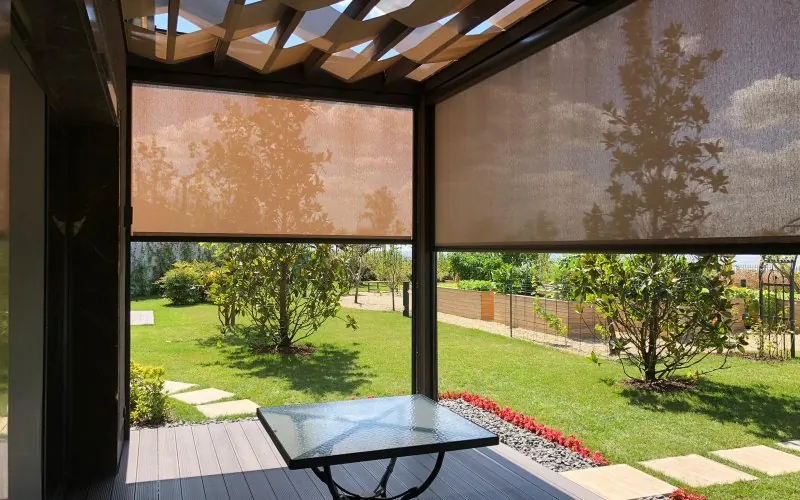
Mesh zip screens lowered on a pergola terrace overlooking a garden
Step 1: Define the job of the screen
Buyers often ask for "a zip screen" when they mean four different things. Each leads to a different specification:
- Wind breaking. The terrace or balcony is too windy to use. You need a closed or nearly closed fabric, solid rails and a drive that can be commanded or automated.
- Sun and heat control. Glare, overheating and fading are the issue. An open-weave screen fabric on the outside of the glass is the right start.
- Rain protection. People want to keep sitting out when it showers. A waterproof, coated fabric is needed, and the screen has to be closed at the sides and bottom.
- Privacy. Overlooked terraces, shop fronts and rooftop dining. Choose an opaque or low-visibility fabric and think about which hours the screen will actually be down.
Step 2: Choose the fabric
Two fabric types cover the majority of orders.
PVC fabric with clear windows keeps the view. A transparent panel sits inside an opaque frame of fabric, so guests can still see the sea, the garden or the street when the screen is closed. It is the natural choice for wind and rain protection, because a solid, waterproof sheet blocks both. Remember that clear panels do not filter sun, so a south-facing PVC screen will not keep the space cool.
Screen (mesh) fabric filters sunlight and reduces glare while letting air and some light through. From outside it limits what people can see into the interior, which gives daytime privacy. It is the better answer for heat and glare, and the weaker one for rain.
If you are unsure, you can split the opening: a clear-window panel on the windward side and screen fabric on the sunny side. Mixed layouts are common on corner terraces. The properties of each material are described in zip screen fabrics.
Step 3: Check wind exposure
Zip screens are among the most wind-resistant vertical shading systems, because the fabric is locked into side rails by a zip profile along its full height. A conventional roller blind has no such guide and gives up much earlier. The practical consequences:
- Locked edges stop the fabric lifting away from the frame, which removes the flapping and noise that make loose blinds unusable on exposed sites.
- Resistance still has limits. It depends on the fabric, the width of the span and the rail design.
- For wide openings, the cassette and rails must be sized by calculation, not by guesswork. This is the point where working with the manufacturer's engineers matters most.
Step 4: Decide vertical or ceiling
This is a question about direction. If the opening is a facade, balcony, window or the side of a pergola, you need a vertical zip screen. If the opening is a roof, skylight, glass roof or sloped surface, you need a ceiling zip screen. The two work on the same principle, but the rails, tension and fabric are specified differently.
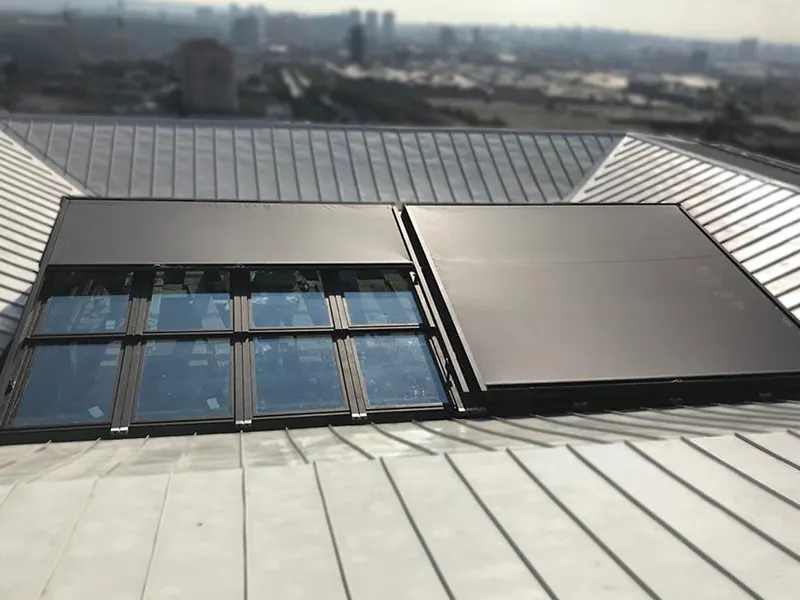
Ceiling zip screens fitted over roof windows on a sloped metal roof
A fully enclosed terrace often needs both: a roof element overhead and vertical screens at the sides. Remember too that a zip screen alone is not a roof. If the area has no overhead cover, plan a pergola, awning or glass roof first. Terrace options are compared in terrace enclosure methods.
Step 5: Pick the operation
Screens can be motorised or manual. Motor options from established brands, including Somfy, are available from the manufacturing partner.
- Motorised is the standard for restaurants, hotels and any wide or high screen. One remote or wall switch can run several screens together, and a sensor can close them when the wind rises.
- Manual can make sense for a small private balcony where cost matters and someone is always nearby.
Decision table
| Your situation | Screen type | Fabric | Drive |
|---|---|---|---|
| Windy restaurant terrace, evening trade | Vertical | PVC with clear windows | Motorised, wind sensor |
| Sunny south-facing facade, glare and heat | Vertical | Screen (mesh) fabric | Motorised, sun sensor |
| Pergola sides, mixed weather | Vertical | Clear-window PVC on windward side, mesh on sunny side | Motorised |
| Glass roof or winter garden overheating | Ceiling | Technical or open-weave fabric | Motorised, sun sensor |
| Skylight glare in office or lobby | Ceiling | Technical textile or acrylic | Motorised |
| Small private balcony, low budget | Vertical | PVC with clear window | Manual or motorised |
| Overlooked rooftop or shop front | Vertical or ceiling | Opaque or low-visibility fabric | Motorised |
Use the table as a starting point, not a final spec. Site conditions will change individual choices.
What to send when you request a quote
Good enquiries get fast, accurate quotes. Prepare the following:
- Width and height of each opening, measured at several points, and whether the screen goes inside or outside the frame.
- For ceiling screens, the length of the run and the roof slope.
- Photos of the site and the surrounding structure.
- The two main purposes of the screen (wind, sun, rain, privacy).
- Preferred fabric and colour, if any.
- Manual or motorised, and any sensors needed.
- Quantity, delivery country and whether you are a dealer, contractor or end customer.
Common mistakes to avoid
- Treating the screen as a roof. It closes sides or shades a roof; it does not make a terrace waterproof by itself.
- Choosing by price per square metre alone. Rails, cassette and drive are a large part of the cost and decide durability.
- Ordering clear PVC for a hot, sunny facade. It will keep out wind but not heat.
- Skipping the sensor on an unattended site. Guests and staff forget; automation does not.
- Guessing sizes. Wide spans need engineering, and a wrong measurement is expensive to correct after manufacture.
Frequently Asked Questions
Which fabric is best for a restaurant terrace?
Most restaurants choose PVC with clear windows so guests keep the view and stay protected from wind and rain. If the terrace also gets strong sun, add screen fabric on the sunny side.How wide can a single zip screen be?
It depends on the fabric, the rails and the wind exposure, and large spans need engineered sizing. The manufacturer can tell you the limit for your case; wider openings are often split into several screens.Do I need a motor?
For commercial use, yes in practice. Motors allow group control and sensor automation. Manual operation suits only small private openings.Can a zip screen make a terrace usable all year?
It helps by cutting wind, rain and cold draughts, but it does not insulate like glass. For a heated, year-round room, consider a glass roof with guillotine glass.Can I mix vertical and ceiling screens on one terrace?
Yes. A ceiling screen over a glass roof and vertical screens on the sides is a common combination, and both can be supplied from the same manufacturer.Request a quote and attach your measurements and photos.
Related: Zip screen overview · Vertical zip screens · Ceiling zip screens · Terrace enclosure methods · Zip screen fabrics