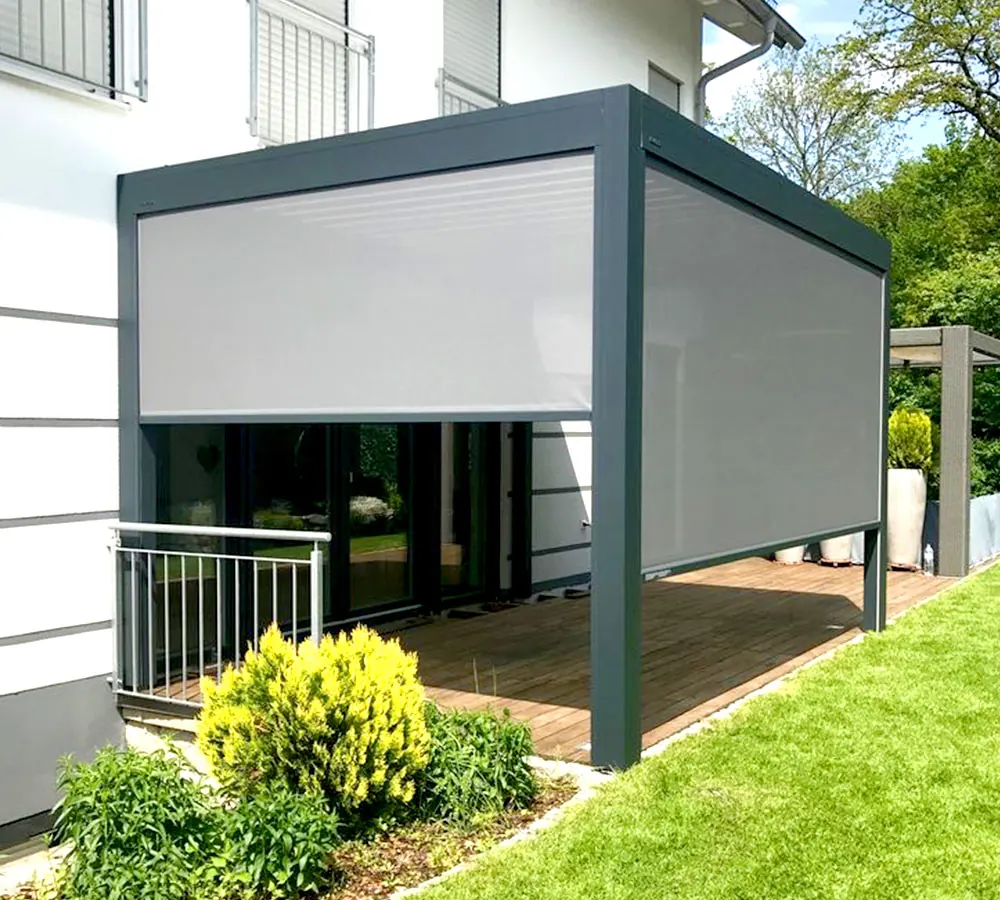
Zip Screen Wind Resistance: Classes and Limits
Zip screen wind resistance is stated as an EN 13561 class from 0 to 3, and a class is only meaningful together with the size and the fabric it was assigned to. The zip in the side guides keeps the fabric locked in its channel, so rated performance is higher than for an ordinary roller blind — but class 3 is still not a storm rating, so the question to ask is which test report covers which panel.
How much wind can a zip screen take?
The short answer: whatever the class says for that exact configuration, and nothing beyond it. A wind class is not a property of a brand or of a product family; it is the outcome of a test on one panel of a stated width and height, with a stated fabric, in a stated installation. Change any of those and the number can change with it.
The honest way to read a rating is in three parts:
- The class — 0 to 3 under EN 13561, assigned from testing to the wind test method (EN 1932).
- The configuration — the panel size, the fabric, the guide system and how it was mounted, because the class applies to those.
- The limits — the maximum sizes for which the class holds, published per model, and the retraction rule that keeps the panel out of wind it was not rated for.
Why do zip tracks matter for wind?
A conventional external roller blind lets the fabric billow. The wind loads the cloth, the cloth swings away from the roller, the load on the bottom bar grows, and past a point the panel starts to beat against the housing. Everything in that sequence is motion, and motion is what tears fabric and bends fixings.
A zip screen removes the motion at the sides. The fabric carries a welded zip bead along each vertical edge, that bead sits inside a channel in the side guide, and the panel therefore cannot lift out of the track or flap sideways. The load path becomes: wind on the fabric → fabric to the guides → guides to the structure. Two consequences follow:
- Higher rated performance for the same size, because the free edge that would oscillate is captured. This is why a zip product and a non-zip product of identical dimensions should not be compared by eye.
- The guides and their fixings become the critical element. Capturing the fabric transfers the load to the guide, so a class 3 panel in a guide fixed to a weak substrate is a class 3 idea rather than a class 3 installation.
Wind classification and test standards
EN 13561 sets performance requirements for external blinds and awnings, including the wind classes. EN 1932 is the test method for wind resistance of awnings and external blinds. A manufacturer's class statement should rest on both: a method that produced the number, and requirements the number is judged against.
The classes as published by makers (bands are as printed in European datasheets and differ slightly between manufacturers and between editions of the standard, EN 13561:2004 and EN 13561:2015):
| Class | Beaufort | Approx. wind speed band as published by makers | What it means in use |
|---|---|---|---|
| 0 | — | Not tested / not stated | No wind performance to read; German installation guidance recommends not using class 0 products outdoors |
| 1 | 4 | Renson: 20–27 km/h; Verano: 20–28 km/h | Light breeze: sheltered terraces, panels expected to stay deployed in gentle conditions |
| 2 | 5 | Renson: 28–37 km/h; Verano: 29–38 km/h | Fresh breeze: normal exposed patio with the retraction rule in place |
| 3 | 6 | Renson: 38–48 km/h; Verano: 38–49 km/h | Strong breeze: the top published class for zip screens, for exposed positions with an agreed limit |
Two cautions about the table. First, the km/h bands are quoted with attribution — they are the figures Renson prints on its ZipShade datasheet and Verano publishes in its wind guide — and they are indicative conversions of a class, not test results for any product sold here. Second, class 3 tops the scale under this standard; a claim of Beaufort 9 or 10, or a figure in m/s, is not an EN 13561 class and cannot be set against one.
One standard to keep out of the conversation: EN 13659 covers shutters, not blinds, and it appears on some zip screen marketing pages. Wind for external blinds is EN 13561 with EN 1932 behind it.
What changes the result?
| Factor | Effect | What to ask |
|---|---|---|
| Width and height | Wider and taller panels catch more wind and put more force on the guides; classes are assigned up to a maximum size per model | The maximum size table for the class, for the model in the quote |
| Fabric | Weight, openness factor, weave and coating change how the panel behaves; the same class is not automatic across the fabric range | Whether the stated class holds for the fabric chosen, and what changes if it is swapped |
| Installation | Face-fixed, reveal-fixed or between columns, and which substrate — each transfers load differently | The fixing detail for the actual wall, and the substrate it assumes |
| Track and cassette | Guide profile depth, how the bead is captured, cassette closure | The guide section for the quoted panel, and whether it is the one tested |
| Bottom bar | Weight, stiffness and how the panel is tensioned | Bar profile for the width; whether it is the tested bar |
| Mounting substrate | Masonry, concrete, steel or timber frame determines what the fixings can take | Pull-out or load figures for the fixing in the substrate, from the fixing maker |
| Sensor and retraction logic | A sensor prevents the panel sitting in wind above its class; it does not raise the class | Sensor type, threshold behaviour, and what happens on power loss |
The last row is the one most often skipped: an anemometer tells the system when to retract, and its usefulness depends entirely on where it sits, how it is calibrated and how quickly the motor responds. The motorization page covers sensors and controls in detail.
Wind sensors and automatic retraction
The principle is simple and worth stating precisely: a wind sensor measures the wind, and above a set threshold the system retracts the panel — or refuses to deploy it. What it does not do is increase the class. The rating belongs to the tested configuration; the sensor is the rule that keeps the panel inside that rating by getting it out of the wind before the limit is reached.
What to ask about the sensor, then, is operational rather than promotional: where it is mounted (a sheltered corner reads lower wind than an exposed leading edge), whether the threshold is adjustable and set per site, whether the panel retracts on power failure as well as on wind, and what the system does if a sensor fails. A sensor that is uncalibrated or badly placed is a false sense of safety, which is worse than no sensor at all because nobody questions it.
Exposure and building height
Wind grows with height and with exposure: a ninth-floor balcony sees winds that a ground-floor terrace does not, and a corner position sees more than a sheltered one in the same building. This is where class statements are most often misread — the class applies to the tested configuration, not to every building the panel could be installed on.
Two practical readings follow. First, ask for the class at the size you intend to buy, at the height and exposure of the actual site; a class certified at a smaller test size says nothing about a larger panel. Second, treat the retraction rule as part of the design: decide in advance when the panels retract, who controls it, and what the default position is during a storm warning. Panels that stay deployed because nobody set the rule are where damage happens.
For exposed positions the sensible sequence is: settle the size and the exposure first, then the class, then the sensor behaviour — rather than choosing a class first and shrinking the panel to fit it.
What should the manufacturer provide?
Before an order, six documents and answers:
- Test report to EN 13561 for the configuration — stating class, panel size, fabric and installation, so the report matches what will be delivered.
- The wind test method behind it — EN 1932, named in the report or the declaration.
- Declaration of Performance / CE marking — the document the construction products route produces for the product, with the characteristics it declares.
- Maximum size table — per model and per fabric: width and height limits for each class.
- Installation manual — fixing pattern, substrate assumptions, torque and the alignment tolerance for the side guides.
- Sensor and retraction documentation — threshold behaviour, defaults and failure modes, if a sensor is part of the offer.
Common failures and how to avoid them
- Fixings undersized for the load. The panel was rated; the screws into a weak render were not. Specify fixings against the substrate with figures from the fixing maker.
- Panels ordered oversize. The class was read from a smaller size in the catalogue, then applied to the largest panel in the project. Check the maximum size table for the class at the quoted dimension.
- No sensor on an exposed site. The class assumes someone retracts the panel; on a windy corner with no sensor, that someone does not exist.
- Fabric chosen for looks alone. A different weave or weight can change behaviour; confirm the class holds for the fabric, not just for the model.
- Side guides out of alignment. A twisted channel does not capture the bead evenly, so one edge carries more load than the other. Alignment tolerance is in the manual and should be checked at installation, not at handover.
- Bottom bar too light for the width. Flutter and wrinkles begin, the panel oscillates, and the edges of the guides take repeated load.
Frequently Asked Questions
What does wind class 3 mean?
It means the panel was tested and classified at the top class defined by EN 13561 for external blinds. Makers publish a corresponding band — Renson prints 38–48 km/h and Verano 38–49 km/h for class 3, both attributions to their own datasheets — and those bands sit around Beaufort 6. The class still belongs to the tested size, fabric and installation, so ask which configuration the statement covers.
Is a zip screen storm-proof?
No. No external blind is, and the class scale stops well below storm conditions. Retract the panels when a storm is forecast, and treat the retraction rule as part of the specification rather than as an operator's judgement call made in the moment.
Why does the wind rating fall with width?
A wider panel presents more surface and puts more force on the guides, so the same fabric and frame reach their limits sooner. That is why classes are published up to a maximum size per model, and why the maximum size table is the first thing to check when the panel gets wider.
Do wind sensors replace a class rating?
No. A sensor keeps the panel inside its rating by retracting it before the limit is reached; it does not raise the limit. The class still comes from the test report for the configuration, and the sensor is an operational safeguard around it.
Can a zip screen be used on a high-rise balcony?
Only if the configuration for that height and exposure is covered by a report, and high-rise positions usually force the conversation back to maximum sizes, fixings and retraction thresholds. Exposure grows with height, so the sensible route is to bring the site details to the manufacturer and let the class follow from them.
Which standard tests wind resistance?
EN 1932 is the wind resistance test method for awnings and external blinds, and EN 13561 sets the performance requirements and the wind classes that results are classified against. EN 13659 covers shutters rather than blinds and should not be cited for zip screens.
What if a maker only gives km/h or Beaufort?
Ask for the class and the tested configuration behind the figure. km/h and Beaufort values are conversions or claims that differ between publishers, while a class with a size, a fabric and a test report is something you can verify and compare with another offer.
Sources and standards
- CEN-CENELEC — publisher of EN 13561 (performance requirements for external blinds and awnings), EN 1932 (wind resistance test) and EN 13659 (shutters); confirm the current edition before writing a clause.
- Wind class conversions in Table A are attributed to European manufacturer datasheets (Renson ZipShade datasheet; Verano wind guide) and are indicative only.
- German installation guidance on class 0 products: aussenrollo.de installation guide.
Related pages
Zip screens overview · Vertical zip screens · Zip blind technology · Motorization and automation · Fire and compliance · Price per m² · Architectural systems FAQ · Request a quote