Terrace Enclosure Methods: Zip Screen, Glass, Pergola, Awning
Last updated:
No single product encloses a terrace best. A bioclimatic pergola gives the most flexible roof, a glass roof with guillotine glass gives the warmest room, a zip screen is the cheapest way to close the sides, and an awning is the simplest shade. Most good terraces combine two of them.
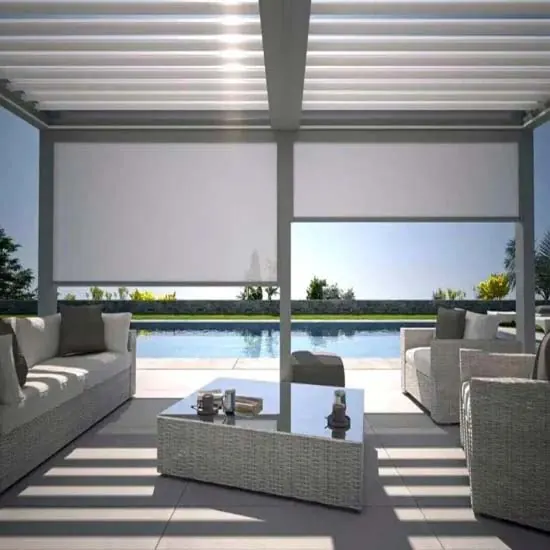
Villa terrace pergola with vertical zip screens lowered beside a swimming pool
Why enclose a terrace at all
An open terrace is unusable for much of the year: too much sun at midday, too much rain in autumn, wind in the evening. For a restaurant or café, every enclosed square metre becomes seating that can earn all season rather than a few weeks, so the investment is usually recovered quickly. For a home, the same logic applies in comfort rather than revenue: a terrace that is usable in more months is a bigger living room.
The decision is easier if you separate two jobs. The roof deals with sun and rain from above. The sides deal with wind, cold and low sun. Each of the four systems below does one or both jobs differently.
1. Bioclimatic pergola: the flexible roof
A bioclimatic pergola has a roof of motorised aluminium louvres. Open them in summer and the terrace is shaded but ventilated; close them in rain and the louvres seal, with water drained through integrated gutters. Rolling-roof (scissor) models go further and retract the whole roof, so the terrace becomes fully open on demand.
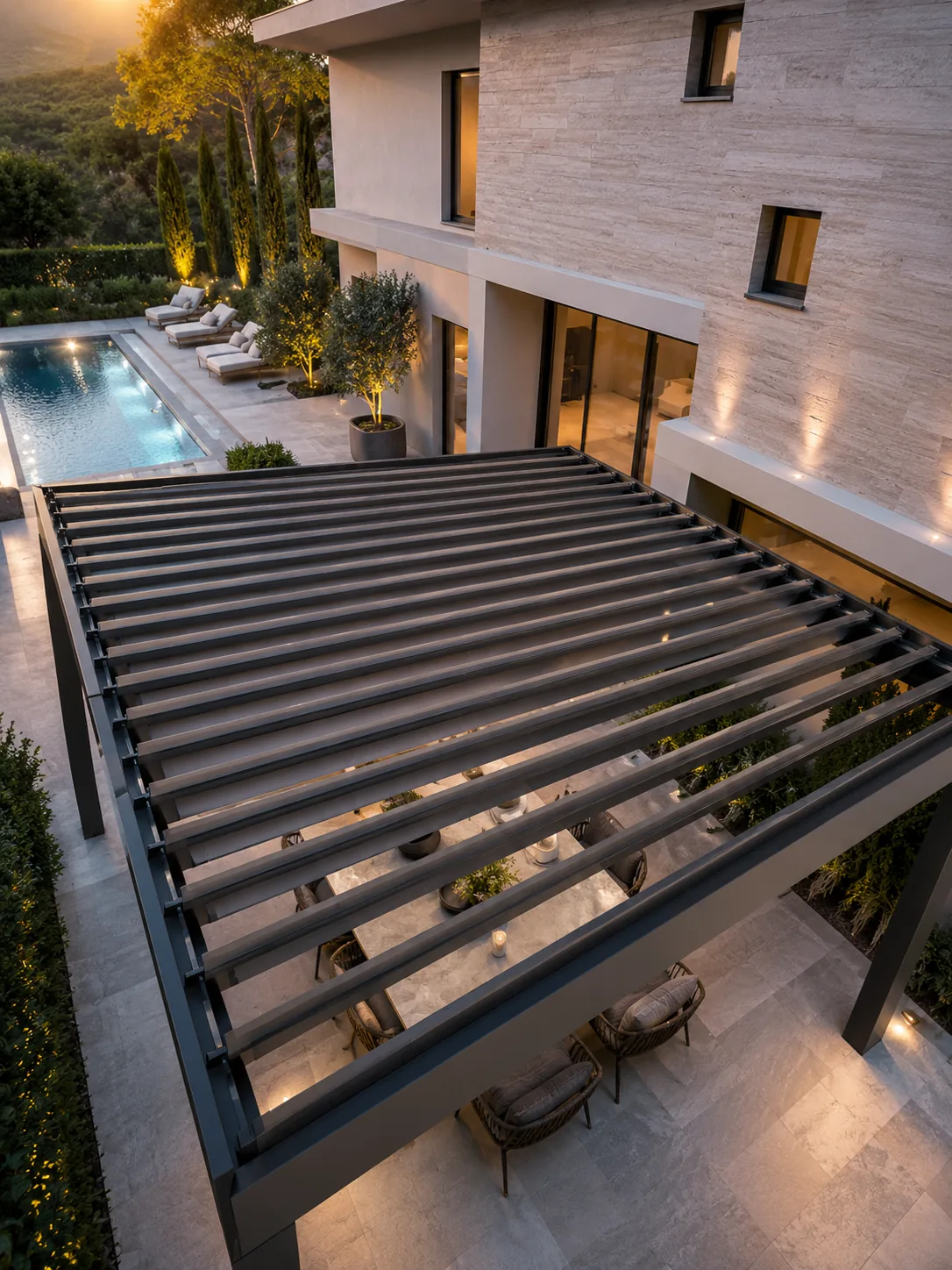
Aerial view of a louvred pergola over a restaurant-style terrace beside a pool
Strengths: switches between open and closed in seconds, good natural ventilation, strong look, suits homes, restaurants and hotels.
Limits: louvres alone do not stop wind from the sides or driving rain at low angles, and they do not insulate like glass. They need side closures to become a true room. See bioclimatic pergolas and rolling roof pergolas.
2. Glass roof and guillotine glass: the four-season room
A glass roof with guillotine glass on the sides turns the terrace into a real room with indoor comfort all year. It has the best thermal insulation of the four options and the lowest draught risk. The roof does not open, though; guillotine glass can be raised in warm weather to ventilate the sides.
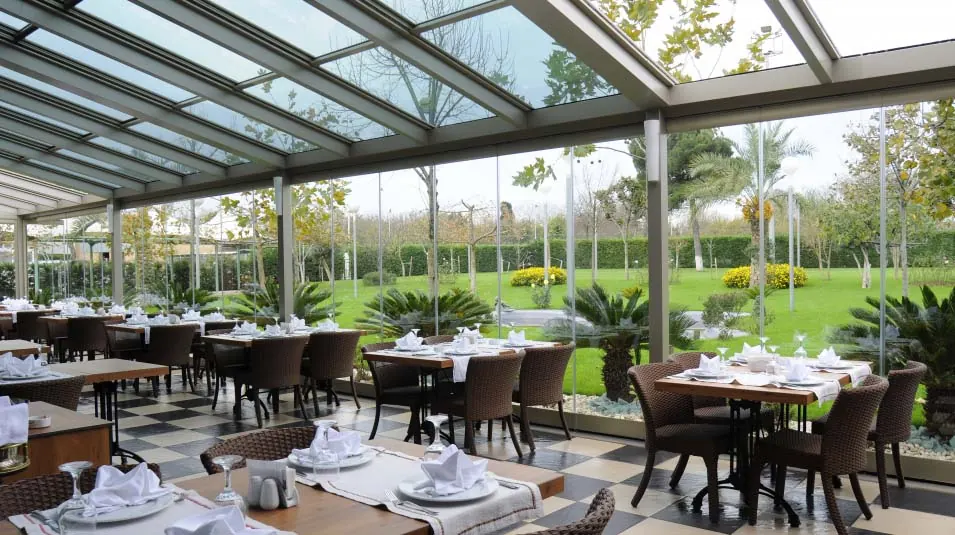
Restaurant dining room inside a glass-roofed winter garden with garden views
Strengths: highest insulation, quietest, full weather protection, works in harsh winters, ideal for year-round dining or living space.
Limits: highest cost, fixed roof, the room can overheat in summer without shading. That is where a ceiling zip screen earns its place. See glass roof systems and winter gardens.
3. Zip screen: the facade completer
A zip screen is not a roof solution on its own. It closes the sides of a pergola, a fixed roof or an existing structure against wind and rain, and fabrics with clear windows keep the view. It is the most economical enclosure step, it can be added to an existing building, and it can be opened completely when conditions are good. Vertical versions close facades; ceiling versions shade roofs.
Strengths: lowest cost, fast to add, wind-resistant thanks to zip rails, rolls away when unused, keeps out insects.
Limits: fabric does not insulate like glass, it needs a roof overhead, and it should be retracted in storms. See vertical zip screens.
4. Awning: the simplest shade
An awning is a fabric roof on arms or guides that extends from a wall or frame. Folding-arm, cassette, track-guided and motorised versions exist. It is quick to install, inexpensive for a given area, and effective for sun. But an awning is open at the sides and tends to be less stable in wind than a rigid roof, so it is the weakest on weather protection. See awning systems.
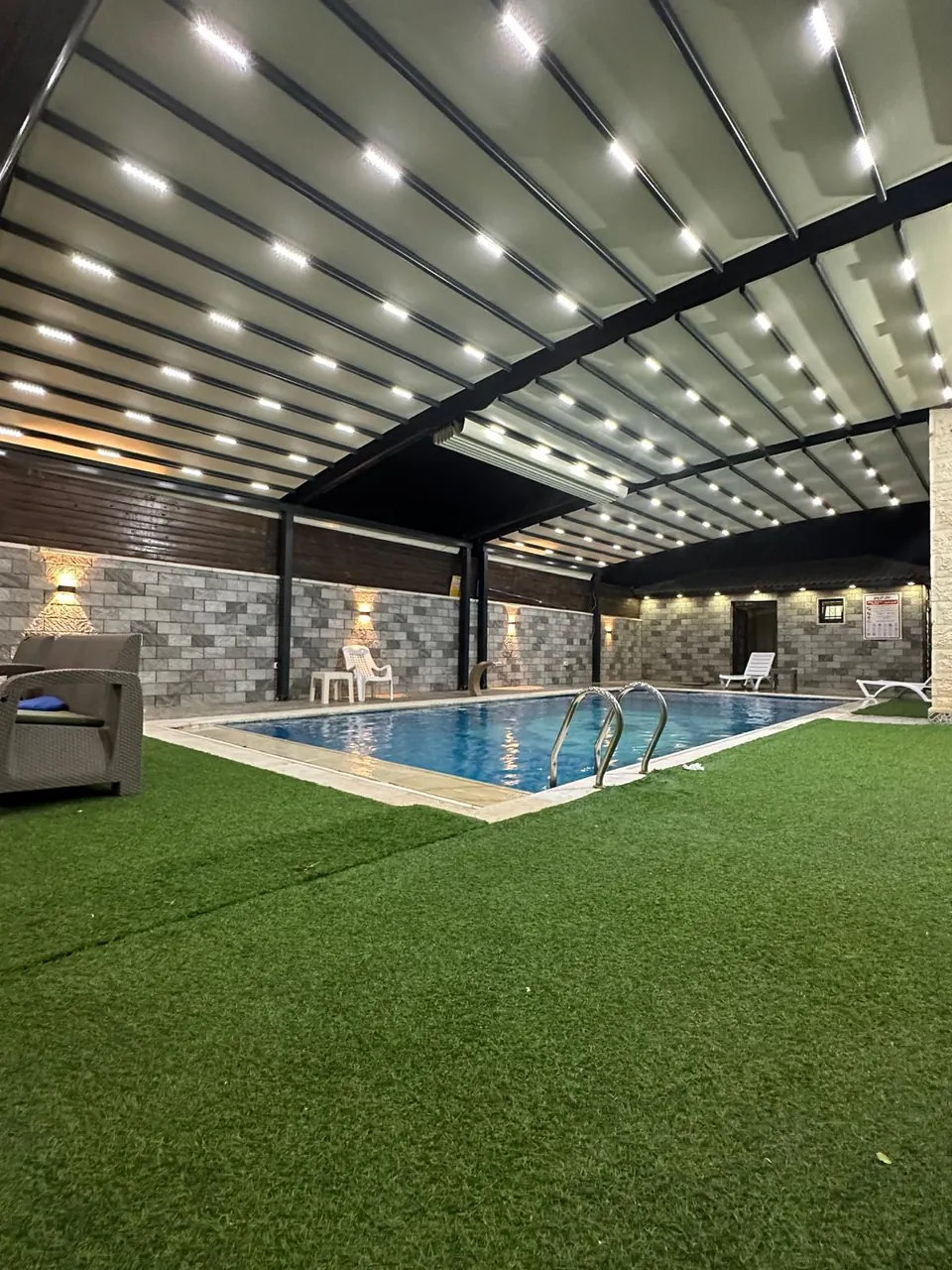
Retractable fabric roof panels with integrated lights over a covered pool terrace
Strengths: economical, simple, good for sun and light showers, retractable.
Limits: limited wind and rain performance, no side protection, not an all-season solution.
Why combinations usually win
Trying to solve every problem with one system often costs more than it should. A bioclimatic pergola left on its own lets rain blow in from the side and evening wind scatter the tables; adding zip screens to the sides fixes both for a modest budget. The reverse holds as well: a glass-roofed winter garden is excellent in January but heats up like a greenhouse in July, and a ceiling zip screen over the glass stops much of that heat before it reaches the room.
Phased investment is another practical point for hotel and restaurant operators. You can build the roof first and close the sides later, or start with a low-cost screen and move to a pergola the next season. Because zip screens can be added afterwards, this staged plan works, provided the frame and fixing points are planned from the start.
Side-by-side comparison
| Criterion | Zip screen | Awning | Bioclimatic pergola | Glass roof + guillotine glass |
|---|---|---|---|---|
| Main role | Closes the sides (or shades a roof) | Shade from above | Adjustable roof | Complete enclosed room |
| Cost level | Lowest | Low | Medium to high | Highest |
| Thermal insulation | Low | None | Low to medium | Highest |
| Wind and rain protection | Good on sides, needs roof | Limited | Good overhead, sides open | Full |
| Opens fully | Yes | Yes | Yes (rolling roof models) | Sides only |
| Retrofit to existing structure | Easy | Easy | Needs own frame or wall mount | Needs structure and permits |
| Best for | Windy facades, existing roofs | Small balconies, sun | Restaurants, villas, hotels | Year-round rooms, harsh winters |
Costs are shown as relative levels, because actual prices depend on size, finish and drive. Ask for a project quote rather than relying on a general range.
Which one to choose
Choose by the main use of the space:
- Restaurant or café terrace: bioclimatic pergola plus zip screens, which extends the season to twelve months.
- Residential terrace used as a year-round room: glass roof with guillotine glass, a winter garden.
- Windy facade with an existing roof: vertical zip screens alone.
- Pool side or garden: a rolling-roof pergola that opens completely.
- Small balcony, limited budget: an awning for sun, with a vertical zip screen if wind is the problem.
Planning checks before ordering
- Local rules. Fixed roofs and glass enclosures may need a permit; open pergolas and screens often face lighter rules, but check locally.
- Wind exposure. The windier the site, the more important rigid roofs, engineered rails and wind sensors become.
- Drainage. Pergola gutters and glass roofs need somewhere for the water to go.
- Heating and cooling. If the space will be heated, favour insulating sides; if it overheats, plan roof shading.
- Sizes and fixing points. Send dimensions and photos so the manufacturer can propose a system.
Frequently Asked Questions
Which enclosure method is the cheapest?
Zip screens are the most economical way to close a terrace, followed by awnings for shade. Pergolas and glass roofs cost more but add a roof and, in the case of glass, insulation.Can a zip screen replace a roof?
No. A vertical zip screen closes the sides. If the terrace has no cover overhead, add a pergola, awning or glass roof. Ceiling zip screens shade a roof but are not a watertight roof either.Which option gives the warmest space in winter?
A glass roof with guillotine glass, as it has the highest insulation. Pergolas with zip screens reduce wind and cold draughts but do not heat a space on their own.Can I combine systems?
Yes, and most successful projects do. Pergola plus zip screens is the standard for restaurants; glass roof plus ceiling screen handles overheating in winter gardens.How do I get a recommendation?
Send the dimensions of the terrace, a few photos and the intended use. The manufacturing partner's engineers can propose a suitable system for the site.Request a quote with your terrace dimensions and photos.
Related: Zip screen overview · Vertical zip screens · Bioclimatic pergolas · Glass roof systems · Project gallery