Awning Systems: 6 Types Compared for B2B Buyers
Last updated:
An awning system is a fabric canopy on a mechanical frame that opens for shade and retracts when it is not needed. Our manufacturing partner in Türkiye builds six distinct types, and the right one depends on span, facade, exposure to weather and how often the awning is used.
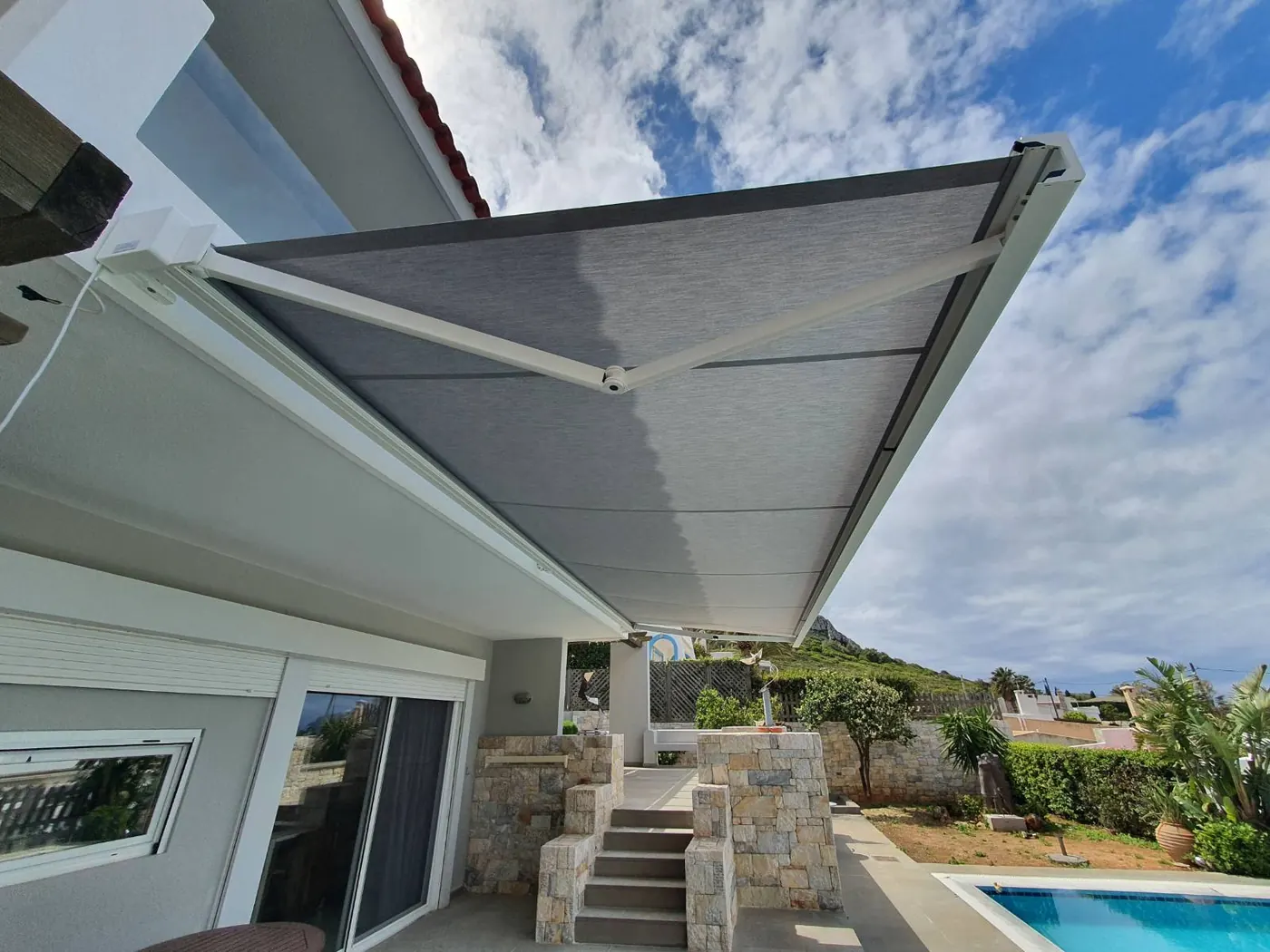
Retractable grey fabric awning extended over a villa terrace with garden and pool in the background
Why "awning" is not one product
Buyers often ask for "an awning" and receive a quotation for a single model, when the project would have been better served by a different one. A balcony over a busy street, a cafe terrace, a villa patio and a row of shop windows are four different problems. The six systems below cover them.
All six share a common base. The frames are aluminium or steel, the fabrics are UV-resistant, and every system can be built with a manual crank or a motor. Sizes, fabric and profile colours are set per project, so there is no fixed catalogue size to order from. What changes from type to type is how the fabric is carried, where it is stored when closed, and how much wind and weather it can reasonably tolerate.
The six systems at a glance
| Type | How it works | Best for | Main limit |
|---|---|---|---|
| Articulated (folding-arm) | Jointed arms push the fabric forward from the wall | Balconies, shop fronts, wide spans at low cost | Fabric stays exposed when closed |
| Cassette | Fabric and arms retract fully into an aluminium housing | Heavily used facades, long fabric life | Higher purchase price than articulated |
| Oval | Rounded, special-form canopy, manual or motorised | Shop windows, entrances, cafes where look matters | Made to measure only |
| Automatic | Motorised canopy driven by remote control or wind and sun sensors | Hotels, restaurants, villas needing hands-free operation | Needs power supply and sensor setup |
| Shade | Retractable or fixed-mount shading | Terraces, gardens, balconies | Fixed versions give no option to open up the sky |
| Wintent | Modular shading mounted over a window or facade opening | Homes, offices, cafes, retail windows | Covers the opening, not a seating area |
Each type has its own page with materials and options. The sections below explain how to choose between them.
Articulated awning: the economical classic
The articulated awning extends forward on folding arms and is the most widely used awning worldwide. It suits wide openings because the span costs little compared with a rigid structure. It can be fixed to a wall or ceiling, or stand on its own posts, and is available with acrylic, polyester or PVC fabric on an aluminium or stainless-steel frame. Read the full details on the articulated awning page.
Its weakness is simple: when the awning is closed, the fabric sits rolled on the roller bar without a cover, so sun, rain and dust act on it all year.
Cassette awning: fabric kept in a housing
The cassette awning solves exactly that. In the closed position, the fabric, the arms and the mechanism are all inside an aluminium cassette. The fabric lasts noticeably longer, which matters on a storefront that opens and closes every day. Acrylic, PVC and polyester fabrics are available, with manual, motorised, remote or smartphone control. See the cassette awning page.
Oval awning: when the facade needs a statement
The oval awning has a rounded profile that breaks the straight lines of a facade. It protects entrances and windows while carrying a brand or colour scheme, and can be opened by hand or by motor. Because the shape is bespoke, each one is produced to project dimensions and fabric. Details are on the oval awning page.
Automatic awning: shade without anyone touching it
The automatic awning is a motorised system with remote control or sensors. A wind sensor can retract it when gusts rise, and a sun sensor can extend it as the temperature climbs. The structure is aluminium and steel, with UV-resistant fabric, and LED lighting can be added for evening use. For hotels and restaurants where staff cannot watch the sky, this is usually the correct specification. See the automatic awning page.
Shade awning: terraces, gardens and balconies
The shade awning is the practical option for outdoor sitting areas. It comes as a retractable installation or as a fixed one, in UV-resistant fabric cut to the project. Fixed versions suit places where shade is wanted all season; retractable ones suit places where winter light matters. See the shade awning page.
Wintent awning: shade at the window
Wintent is a modular system mounted above windows and facade openings. It stops sunlight before it reaches the glass, which reduces solar gain inside and keeps blinds from doing all the work. Homes, offices, restaurants, cafes and shops use it, with manual or motorised operation. See the Wintent awning page.
How to choose: five questions
- How wide is the opening? Wide spans at limited budget point to articulated. Anything the customer will see every day points to cassette.
- How often will it be used? Daily use rewards a cassette housing and a motor. Occasional use does not.
- How windy is the site? Exposed roofs and coastal terraces need a sensor-driven system or a decision to retract manually. No awning is a storm shelter.
- Who operates it? If the operator is a guest, a tenant or a busy waiter, motorisation avoids damage from rough handling.
- Is shape part of the design? If the awning is visible from the street, oval or custom colour work is worth the extra time.
What awnings cannot do
An awning gives shade and some rain cover, not weather sealing. It does not close a terrace from wind, cold or heavy rain. For year-round use you would pair or replace it with another system: see the terrace enclosure options or the bioclimatic pergola for adjustable roofs, and zip screens for vertical side protection.
Supply terms for distributors and contractors
The awnings are produced at the manufacturing partner's facility in Türkiye. Fabric and profile colours are selected per project, and motors, sensors and lighting are specified at the quotation stage. Send width, projection, mounting surface and preferred operation, and you receive a factory price. For what drives that price, read the awning models and prices guide.
Care and handover for resellers
Whichever model you supply, the end client's experience depends on a few simple habits. Fabric should be kept dry when retracted for long periods, and cleaned with mild soap and water rather than strong solvents. Motors and sensors should be tested after installation and again at the start of each season. Retracting the awning before storms is the owner's responsibility, so give clients a one-page instruction at handover. A short written guide of this kind prevents most warranty disputes and keeps the product looking good.
Frequently Asked Questions
Which awning type lasts longest?
The cassette awning, because fabric and mechanism are stored inside an aluminium housing when closed. Motorisation also helps, since it removes uneven manual handling. Actual life still depends on fabric class, climate and maintenance.
Can every awning type be motorised?
The manufacturer lists manual and motorised options for articulated, cassette, oval, Wintent and automatic systems, and the automatic type is motorised by definition. Shade awnings are produced in retractable and fixed forms, so confirm the operation you need at the quotation stage.
Are awnings suitable for windy locations?
Only with sensible limits. A wind sensor on a motorised awning retracts it when gusts rise, but an extended awning in strong wind is still at risk. For exposed sites, ask the manufacturer about the frame and sensor configuration before ordering.
Can the fabric colour be chosen freely?
Fabric and profile colours are selected per project from the available ranges. Share your colour references with the quotation request so they can be matched.
What information do you need for a quotation?
Width, projection, mounting position, wall or ceiling type, the number of units, preferred fabric and whether you want manual or motorised operation with sensors.
Related: Awning models and prices · Cassette awning · Automatic awning · Architectural systems overview · Project gallery