Cassette Awning Manufacturer: Long-Life Fabric Protection
Last updated:
A cassette awning stores its fabric, arms and mechanism inside a closed aluminium housing whenever it is retracted. Rain, dust and sun no longer reach the fabric between uses, which is why it outlasts open-roller awnings. Our manufacturing partner in Türkiye builds it in manual, motorised, remote and smartphone-controlled versions.
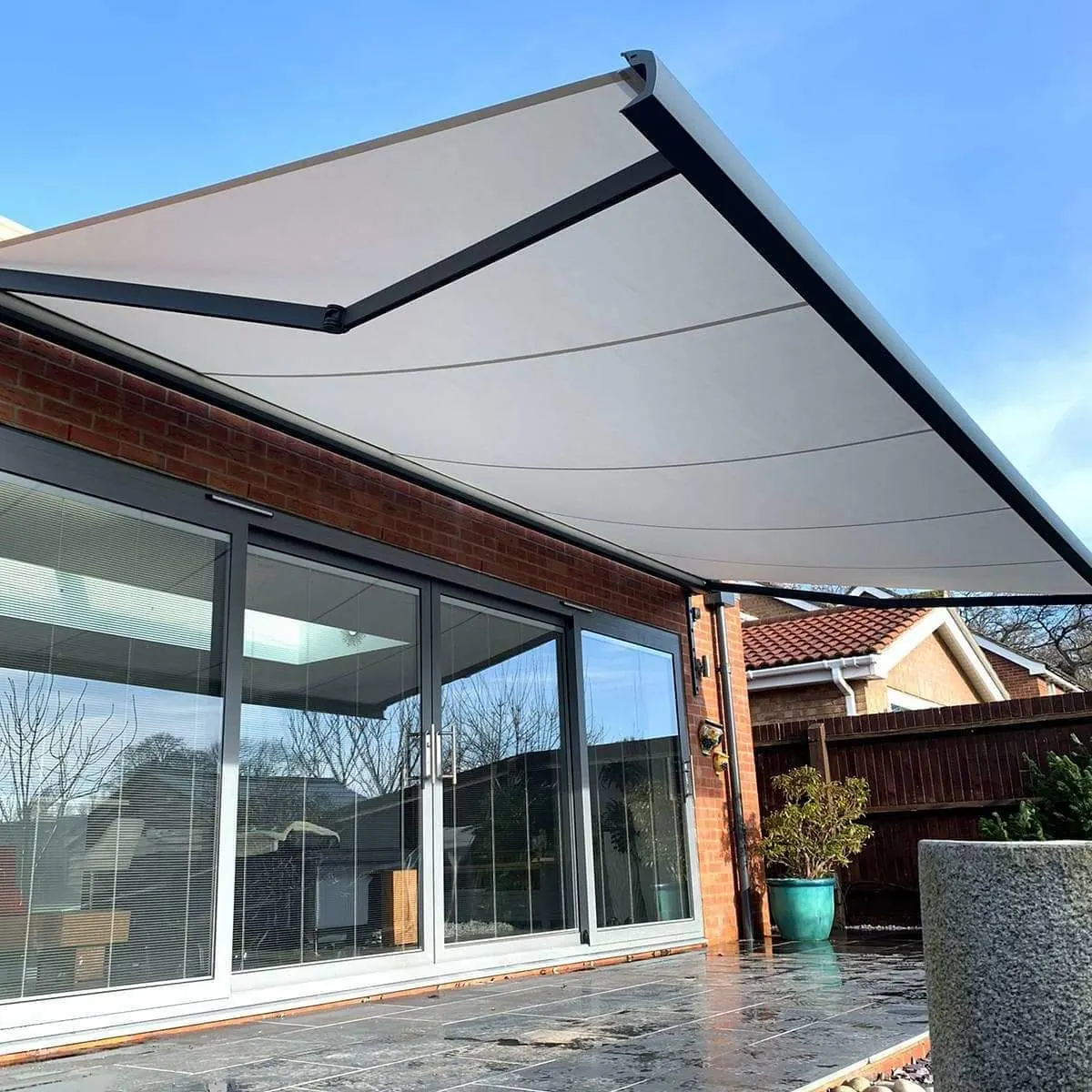
White and grey cassette awning extended over a patio beside large sliding glass doors
How a cassette awning works
The principle is the same as a folding-arm awning: jointed arms push a roller-wound fabric outward from the wall. The difference is the cassette, a box-shaped aluminium housing that surrounds the roller, the arms and the mechanism. When the awning closes, the arms fold in and the fabric rolls up fully inside. From outside you see a clean aluminium box with a front closing line, and nothing else.
That closed housing is the whole point. On an open-roller awning, a rolled fabric stays visible and exposed all year, collecting dust and ageing in sun. In a cassette it is shut away. The manufacturer's specification is plain on the effect: the cassette significantly extends fabric life.
Fabric, frame and control options
| Feature | Options |
|---|---|
| Fabric | Acrylic, PVC, polyester |
| Housing | Aluminium cassette, full closure |
| Operation | Manual, motorised, remote control, smartphone control |
| Sizing | Made to project width and projection |
| Colours | Fabric and profile colours chosen per project |
Acrylic is the usual choice where colour stability and a textile look matter, for example on a restaurant frontage. PVC is picked where water resistance and easy cleaning matter more. Polyester is a practical fabric for many standard terraces. Whatever you choose, the fabric is UV-resistant by specification, but ask for a sample if your client has strong colour expectations.
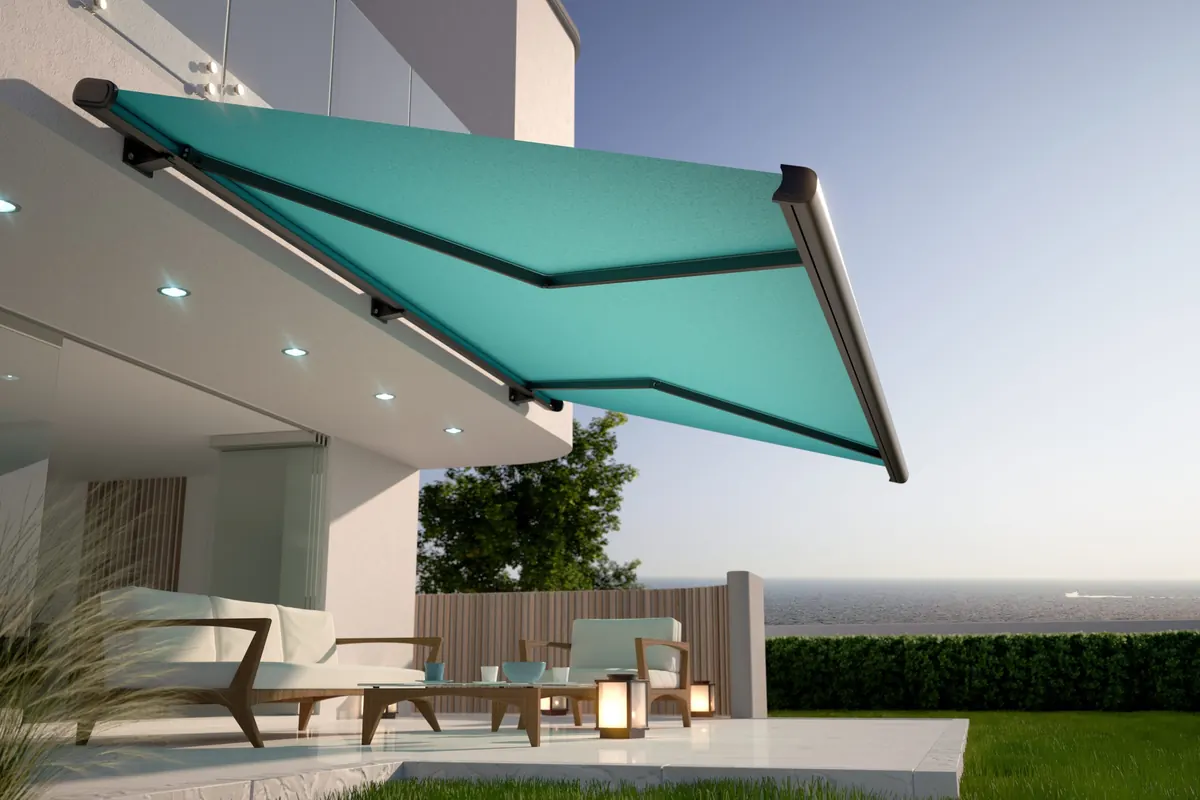
Teal cassette awning extended above a lounge terrace with recessed spotlights in the soffit
Motorised and smartphone control
Manual operation uses a crank and works well for small units that are opened occasionally. For anything used daily, a motor is the better choice. It opens and closes the awning at the same steady speed every time, and avoids the pulled or jammed arms that tend to follow hurried manual handling. Remote control is the standard way to run a motor, and smartphone control adds scheduling and operation from inside the building.
If the awning will be left unattended, consider sensors. A wind sensor is the most valuable addition because an awning left out in a squall is the most common cause of damage. Whether sensor packages can be combined with your preferred motor should be confirmed at the quotation stage.
Where cassette awnings are the right choice
- Storefronts and commercial facades that open every day and need the fabric to look new for years.
- Restaurant and cafe terraces where the awning is part of the visible brand.
- Villa terraces and patios where owners want a tidy appearance when the awning is closed.
- Hotel balconies where maintenance staff want low service demands.
Cassette units on house walls and windows
A cassette awning is not limited to shopfronts and terraces. A smaller unit above a house window works on the same principle: the fabric drops forward and down over the glass, and when it is retracted the housing closes and the cloth is out of sight. Because nothing is left outside between uses, there is little for dust, rain and sun to work on, and routine maintenance stays minimal. That closed form also gives a clean, modern line on the wall, which is why the type is often chosen for residential facades where appearance counts.
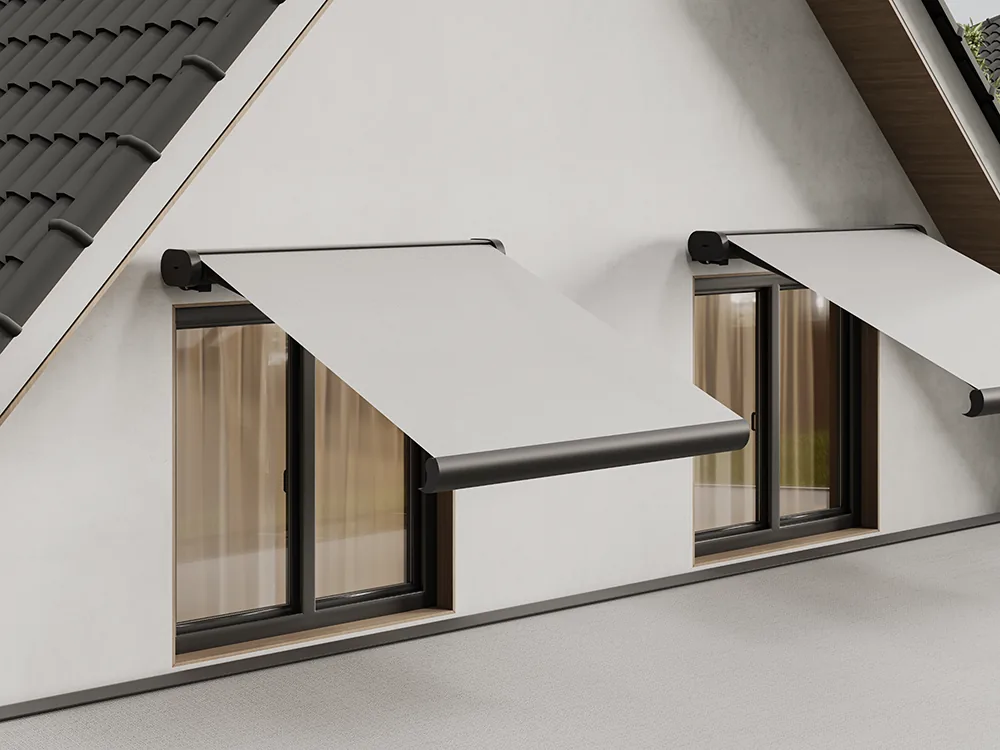
Two cassette awnings with light fabric extended over first-floor windows of a white house with a tiled roof
The manufacturer lists protection from sun, rain and wind. Read that realistically: extended, the fabric shades the glass and sheds light rain; in strong wind or heavy rain, the right response is to retract it, and a motor with a wind sensor makes that automatic. The housing helps here too, since a retracted unit presents very little surface to the wind.
At the wall, the load is carried by the bracket that joins the housing and arms to the facade. In the detail below, a rounded dark end cap sits on a wall bracket with one folding arm leaving it. Check what the fixing is going into before ordering: brick, concrete, insulated render and timber cladding each need a different anchor and sometimes a spacer.
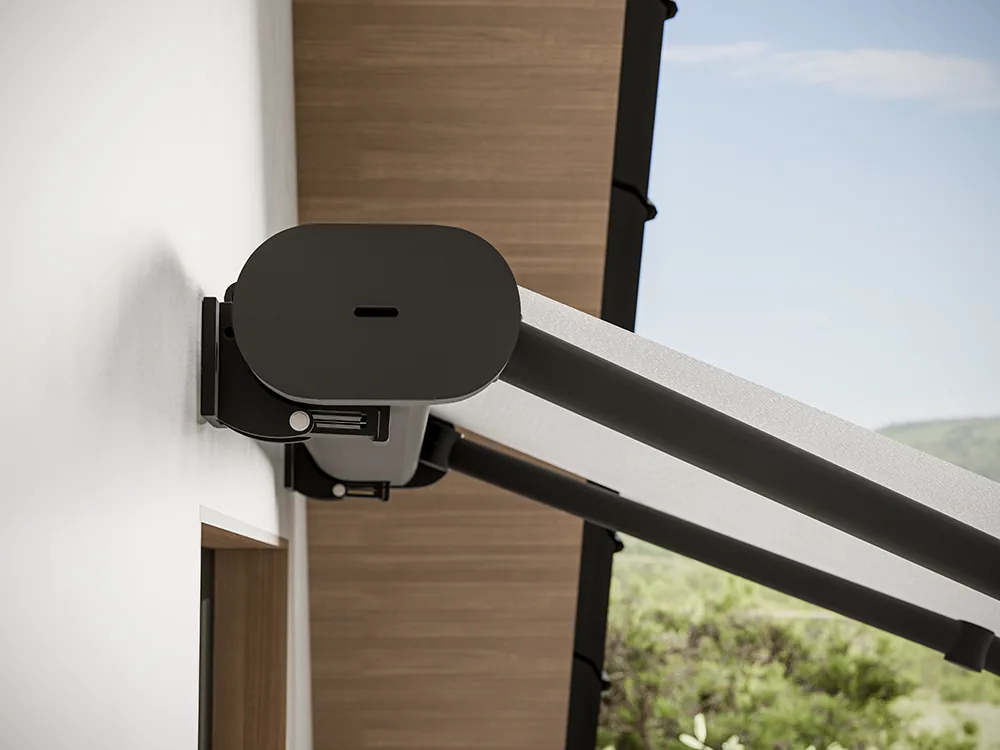
Dark rounded cassette end cap on a wall bracket with a folding arm leading out over a wooden soffit
For a lighter, window-only unit, compare the Wintent window awning, which is built to shade the opening and nothing more.
Where a cassette is not the right choice
A cassette is not for every job. If the span is very wide and the budget is tight, the articulated awning is more economical. If you want a canopy that stands without a wall, or a rounded facade feature, consider the oval awning. And no cassette awning protects a terrace in storm conditions: it is a shading product, not a weather enclosure.
Application: motorised cassette awning on a high-street storefront
One of the manufacturing partner's references in Türkiye is a motorised cassette awning fitted to a street-front commercial unit. The setting illustrates the typical logic for this system: a facade that is seen all day and an awning that is opened and closed often, where protected fabric keeps its appearance.
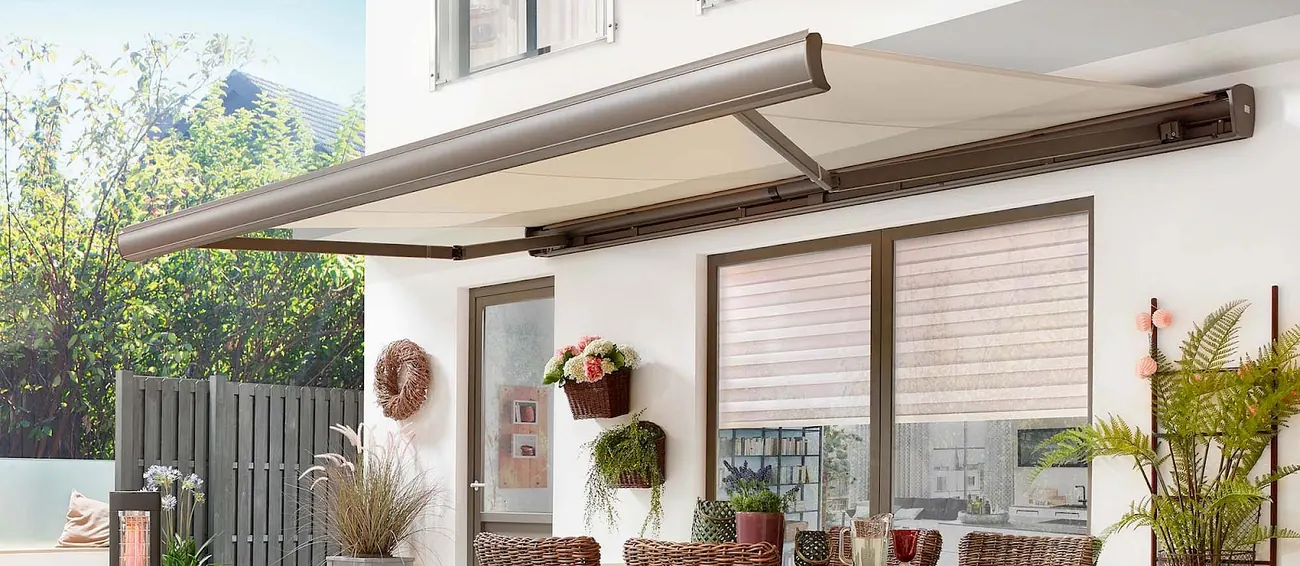
Cream cassette awning with brown frame extended over a patio with shuttered windows
For a storefront, the key specifications to settle early are the mounting height above the pavement, the projection into public space allowed by local rules, and whether the unit will carry signage. Local authorities set their own limits on awnings that project over public ground, so always confirm the permit situation before finalising dimensions.
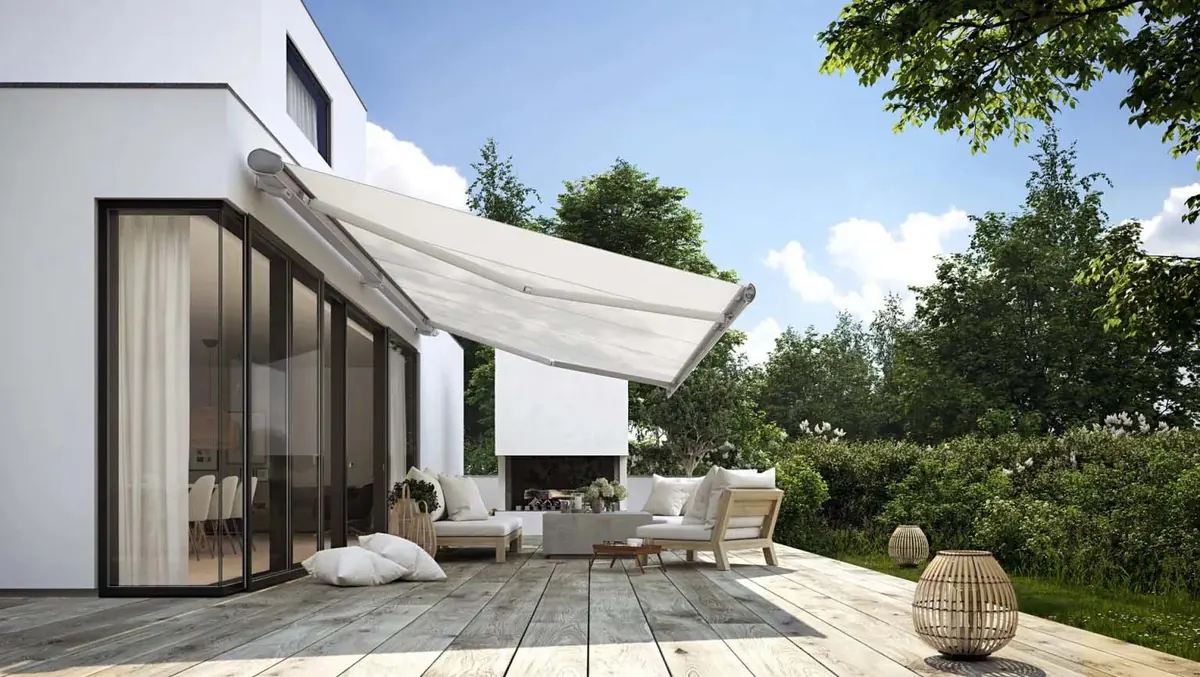
Large white cassette awning over a villa terrace with wooden decking and lounge seating
Specifying and ordering
For a precise quotation, send:
- Width and projection required.
- Wall, ceiling or soffit type, and mounting height.
- Fabric type and colour reference.
- Manual, motor, remote or smartphone control, with or without wind and sun sensors.
- Number of units and delivery country.
Care and service life
A cassette awning needs little attention, but a few habits keep it in good order. Clean the fabric with mild soap and water, and let it dry before closing the awning for a long period. Keep the cassette opening free of leaves and debris so the closing line seals properly. Have the motor and its limit settings checked at the start of each season. If the awning is left closed for months, a quick test run before the first hot weekend avoids surprises. These steps are simple, and they are the reason the closed housing pays back on busy facades.
Frequently Asked Questions
What is the main advantage of a cassette awning?
The fabric and mechanism are protected inside an aluminium cassette when closed. This significantly extends fabric life compared with an open-roller awning, and gives a cleaner look.
Which fabrics are available?
Acrylic, PVC and polyester. All are UV-resistant. The choice depends on colour stability, water resistance and budget.
Can the awning be operated from a phone?
Yes. Smartphone-controlled versions are available alongside manual, motorised and remote-controlled ones.
Is a cassette awning more expensive than a folding-arm awning?
Yes, the purchase price is higher. The extra cost is recovered on heavily used facades through longer fabric life, but the exact balance depends on your climate and usage.
Can it be used for storefronts?
Yes. The manufacturer has supplied a motorised cassette awning for a high-street storefront in Türkiye. Check local rules for awnings that project over public ground.
Related: Awning systems overview · Articulated awning · Automatic awning · Awning models and prices · Project gallery