Articulated Awning Supplier: Folding-Arm Awnings Wholesale
Last updated:
The articulated awning, also called a folding-arm awning, extends forward from the wall on jointed arms. It is the most widely used shading system because it covers wide spans at a modest price. Our manufacturing partner in Türkiye builds it with a choice of fabrics, frames, mounting styles and manual or motor drive.
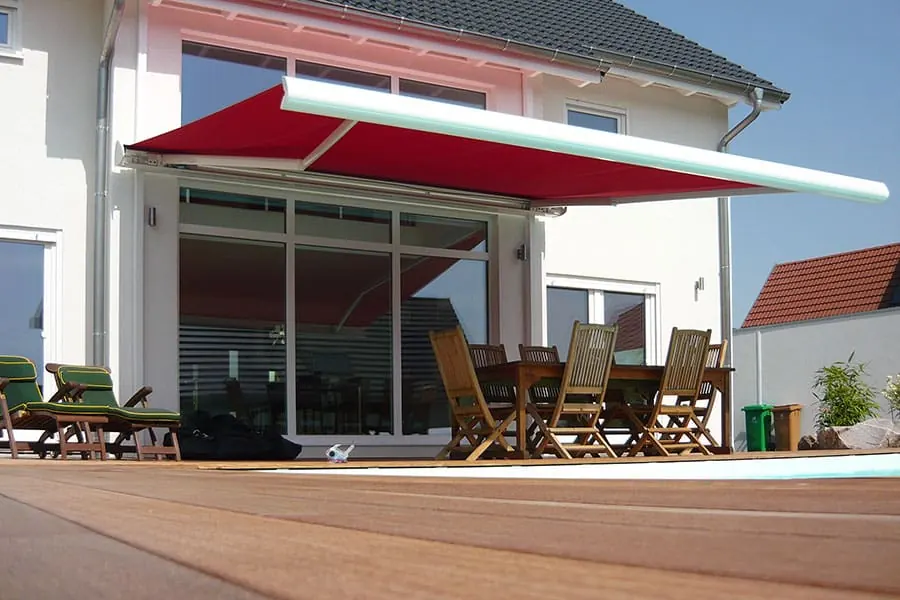
Red folding-arm awning extended over a house terrace beside a pool with wooden chairs
How a folding-arm awning works
A roller tube carries the fabric. At each end a pair of arms, each with a joint in the middle, is attached to the front bar. When the roller turns, the fabric is drawn out and the arms straighten, pushing the front bar away from the wall. When the roller turns back, the arms fold at their joints and the fabric winds up.
Because the arms carry the load, no posts are needed at the front. The covered area stays open underneath, which is why this type is the usual answer for balconies, shop fronts and terraces where furniture or customers need free space. The tension of the fabric is held by the arms themselves, so a well-set awning keeps a taut, flat surface.
Specification options
| Feature | Options |
|---|---|
| Fabric | Acrylic, polyester or PVC |
| Frame | Aluminium or stainless steel |
| Mounting | Wall, ceiling or free-standing |
| Operation | Manual or motorised |
| Sizing | Per project |
| Colours | Fabric and profile chosen per project |
Frame material. Aluminium is light, corrosion-resistant and covers most projects. Stainless steel is selected where the environment is harsher, such as sites near the coast, or where the client expects a sturdier structure.
Fabric. Acrylic offers a woven look and stable colour. Polyester is a sound general-purpose choice. PVC suits situations where water resistance and wipe-clean surfaces are needed. For all three, ask for a sample before the client signs off colours, since screen images and printed swatches differ from real material in daylight.
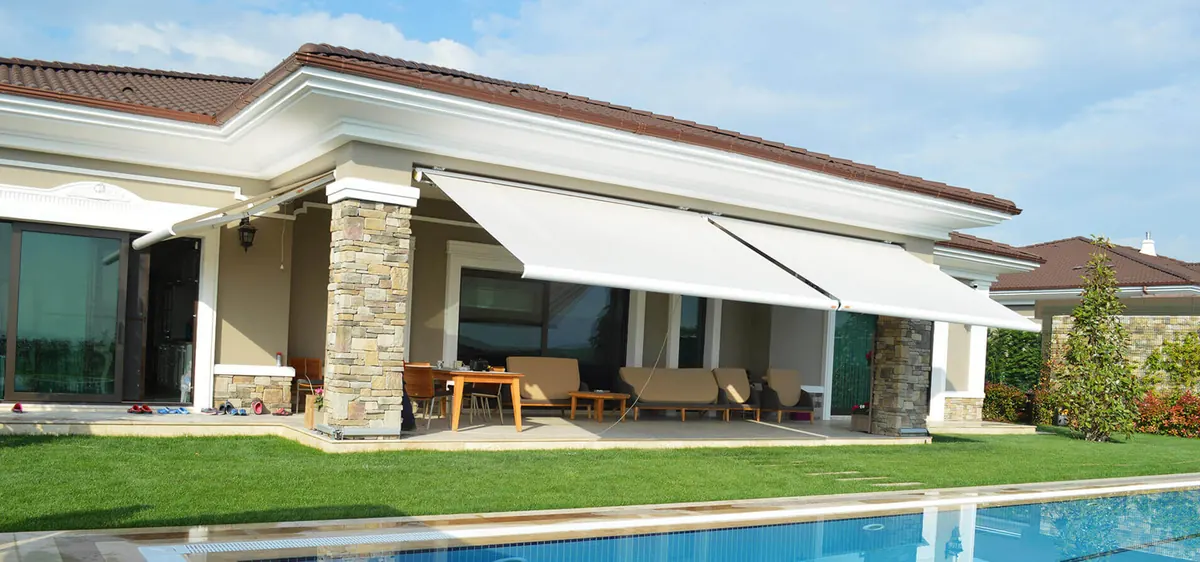
White folding-arm awning extended over a villa terrace with a pool in front
Mounting choices
Wall mounting is the standard: brackets are fixed to the facade above the opening. It needs a solid substrate such as concrete or masonry, and the installer must check that the wall can carry the load. A lightweight cladding or thin render is not a substrate.
Ceiling mounting places the awning under a balcony slab or soffit. It is useful when the facade above is not suitable for fixing, or when the awning should sit flush under an overhang.
Free-standing mounting uses posts so the awning does not depend on the building. It is chosen when the wall cannot take loads or the awning should shade an area away from the facade, such as a garden table.
Manual or motorised
A manual crank is simple and cheap, and fine for small units that are opened and closed now and then. A motor is worth specifying on wide units, on awnings that are used daily, or where guests operate them. Motorisation also reduces mechanical stress on the arms. Sensors for wind and sun can be added to motorised units; confirm the package when you request the quotation.
Where articulated awnings fit best
- Residential balconies and terraces where cost per square metre of shade matters.
- Shop fronts that need a wide, low-cost canopy over the pavement.
- Restaurant and cafe frontages with a budget that does not stretch to a cassette housing.
- Dealer stock programmes, because the system is familiar to installers and customers.
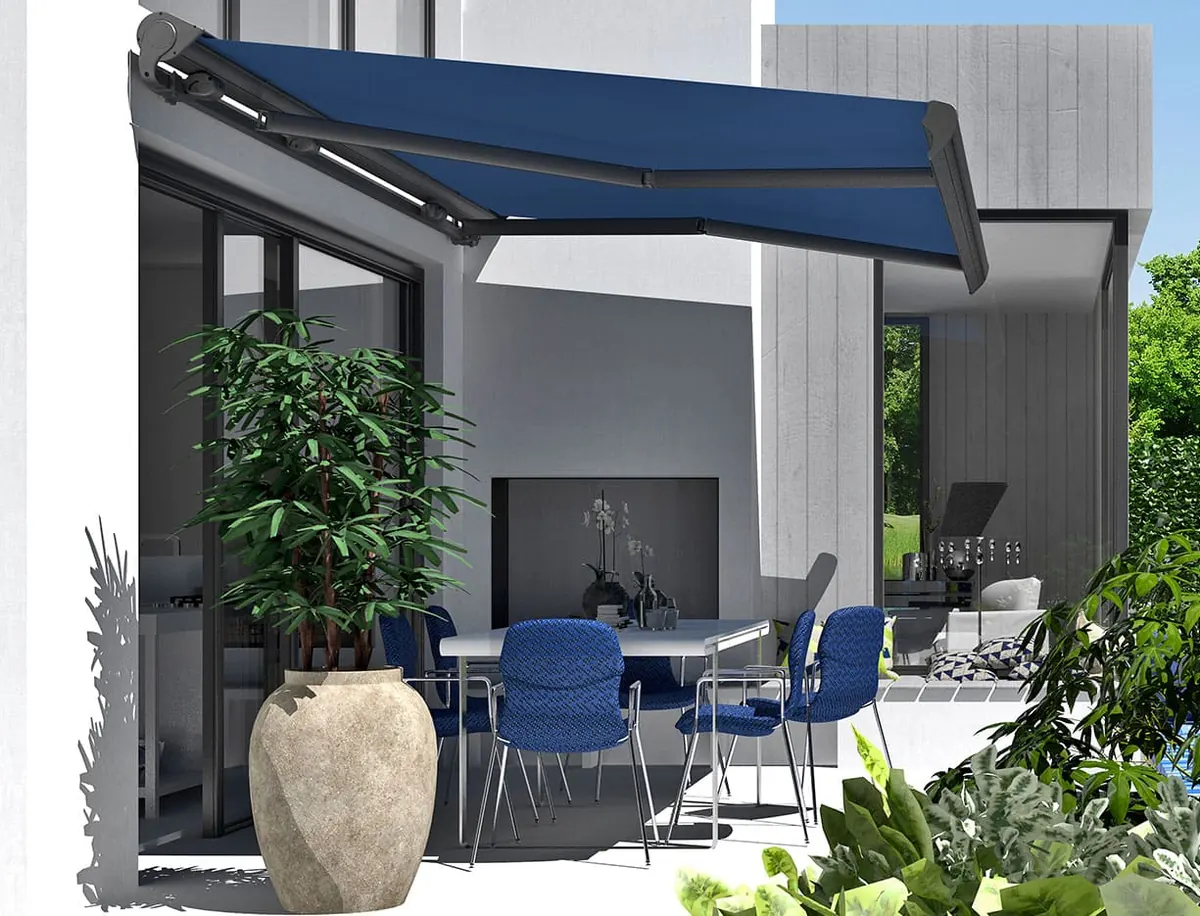
Blue folding-arm awning extended over a patio dining table and chairs next to a grey facade
Honest limits
The articulated awning leaves its fabric exposed when closed. It is rolled around the tube but not enclosed, so sun, rain, dust and pollution act on the outside layer through the year. That is the trade-off for the lower price. If your client has a facade that is seen daily and wants the fabric to age slowly, a cassette awning is a better fit. A winter cover or a habit of retracting the awning in bad weather can extend the life of an articulated unit.
Folding-arm awnings are also sensitive to wind. They should be retracted in strong gusts, and the span and projection should be chosen with the site's exposure in mind. They give shade and light shower cover, not weather protection.
Ordering for distributors and contractors
Provide the following for a factory quotation:
- Width and projection per unit.
- Mounting type and substrate.
- Fabric type and colour.
- Frame material (aluminium or stainless steel).
- Manual or motor drive, with or without sensors.
- Quantity and destination country.
Care and maintenance
Folding-arm awnings reward regular attention because the fabric is exposed. Brush off dust and leaves, wash the fabric with mild soap and water, and let it dry fully before rolling it up, since damp fabric stored closed can mark or mildew. Check the arm joints and the brackets once a year, and have loose fixings tightened. In seasons when the awning is not needed, keep it retracted. In regions with winter snow, leaving it closed and, if possible, covered gives the fabric a longer life. Good habits matter more on this type than on any other.
Frequently Asked Questions
What is an articulated awning?
It is an awning whose fabric is extended by jointed arms attached to a front bar. It reaches forward from the wall without front posts and is the most common form of retractable awning.
Can it be installed on a ceiling?
Yes. Wall, ceiling and free-standing mounting are all available. The right choice depends on the substrate and where the shade is needed.
Which frame material should I choose?
Aluminium suits most sites. Stainless steel is considered where the environment is more demanding or a stronger structure is required.
Does it come with a motor?
Manual and motorised versions are both produced. Motorisation is recommended for wide awnings and daily use.
How long does the fabric last compared with a cassette awning?
The fabric of an articulated awning stays exposed when closed, so its life is generally shorter than a cassette model's. Real life depends on fabric class, climate and care.
Related: Awning systems overview · Cassette awning · Shade awning · Awning models and prices · Project gallery