Standard Guillotine Glass: Motorised Vertical Façade
Last updated:
Standard guillotine glass is a façade system in which tempered or laminated panels travel vertically inside aluminium profiles. It comes manual or motorised, with remote or smartphone control, and gives balconies, terraces and restaurant fronts an uninterrupted view when open and a weather-tight wall when closed. It is made in Türkiye.
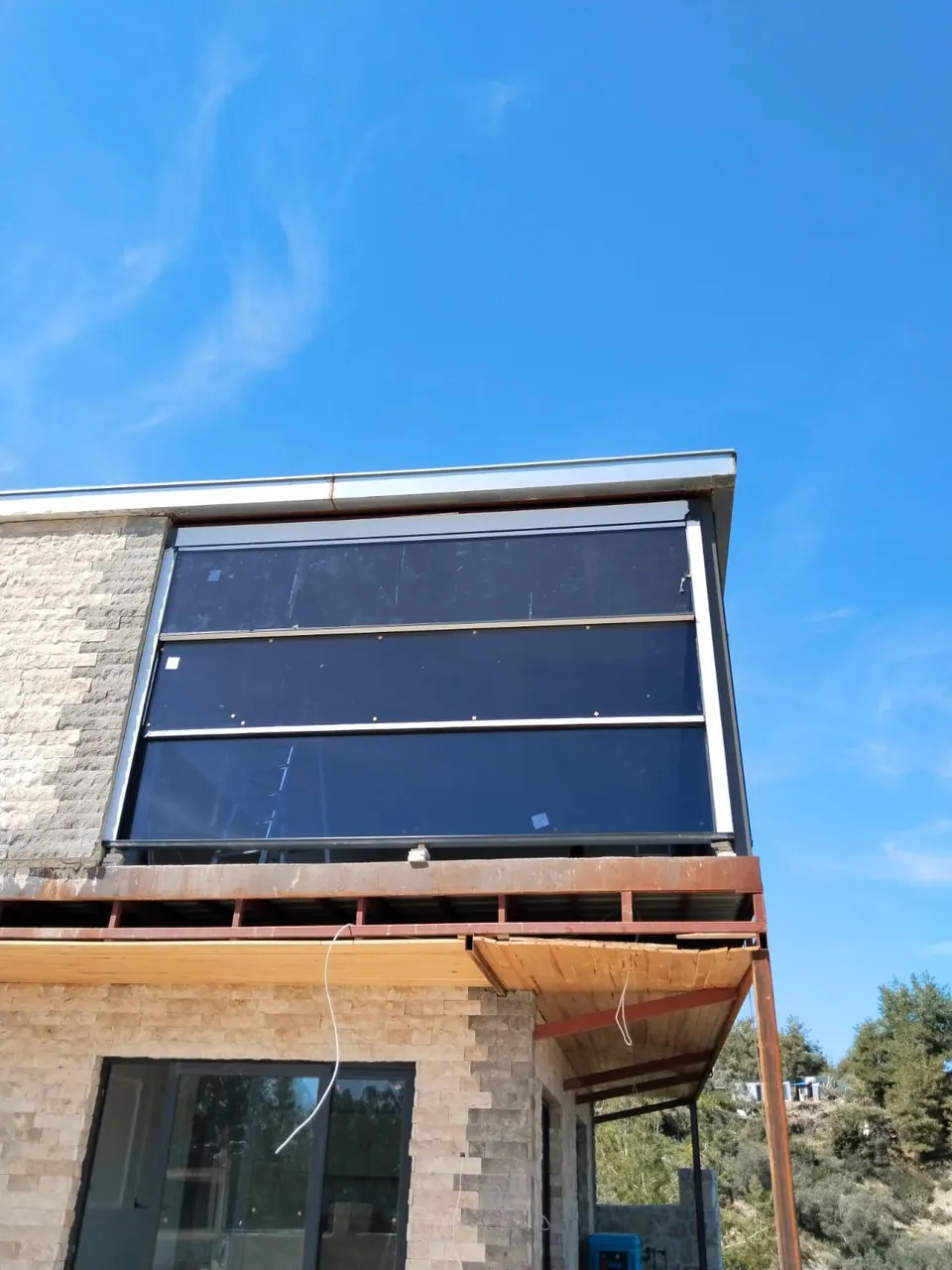
Three stacked dark glass panels closing an upper terrace opening of a stone-clad building
What the system consists of
The product is easier to judge once you split it into its four parts.
Glass panels. Two or more panes of tempered or laminated glass, sized to the opening. Tempered glass is heat-strengthened and, if it breaks, crumbles into small blunt pieces. Laminated glass holds two layers together with an interlayer, so fragments stay in place after impact; that matters wherever panels travel above people. The choice between them is a safety and budget decision to make with your engineer, not a style decision.
Aluminium frame and guides. The profiles are made of AA 6063 alloy (AlMgSi 0.5, temper F22) to EN 573-3, an extrusion alloy widely used in architectural framing because it extrudes cleanly, takes coating well and resists corrosion. The side guides are where the panels run, so their straightness decides how quietly and evenly the system moves.
Seals. EPDM gaskets combined with a high-density brush pile close the gaps between panels, and between panels and guides. EPDM keeps its elasticity in sun and cold, and the brush pile stops wind-driven dust and light water from creeping through the running gap.
Drive and control. Manual versions suit smaller openings. The motorised version, available with Somfy, Mosel or Cuppon motors, is operated by remote control or from a smartphone app. For a venue that opens and closes its front several times a day, this is the practical option.
Key features at a glance
- Vertically sliding glass panels, so no floor track and no mid-view frame when open.
- Tempered or laminated glass.
- Remote and smartphone-app control on motorised units.
- Uninterrupted view across the whole width when the panels are raised.
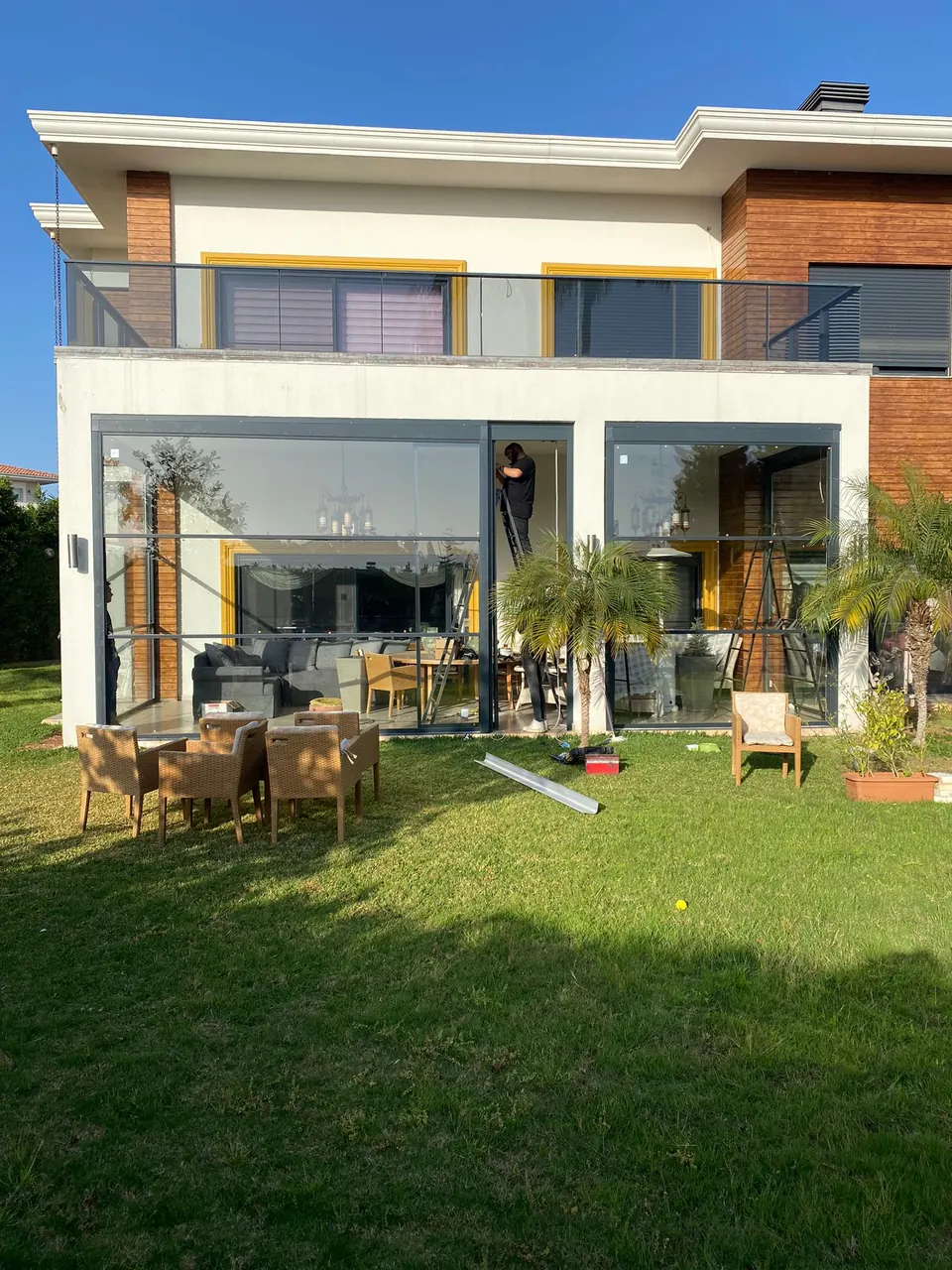
Garden-side villa terrace enclosed by dark-framed guillotine glass panels while an installer works on a ladder
Technical data
| Parameter | Specification |
|---|---|
| Profile | AA 6063 (AlMgSi 0.5 F22), EN 573-3 |
| Glass | Tempered or laminated, thickness per project |
| Gasket | EPDM plus high-density brush seal |
| Surface finish | Electrostatic powder coating, minimum 60 micron |
| Colours | Full RAL range |
| Operation | Manual or motorised (remote / smartphone app) |
| Motor options | Somfy, Mosel, Cuppon |
| Size | Set by the project drawing |
If you need a number that is not in the table, such as a specific wind class or glass thickness, ask in the quote form. The manufacturer calculates it against the site rather than quoting a catalogue figure that might not suit your location.
Where it works well
Café and restaurant fronts. A street-side café can run an open front at lunch and a closed, heated room at night with the same installation. The motorised version means staff do not fight a heavy panel at closing time.
Terraces and balconies. Residential and hotel balconies gain a glass wall that keeps wind and rain off furniture and guests while the view remains clear.
Wind exposed positions. Because panels run in guides on both sides rather than hanging free, they hold their line better in gusts than a folding wall whose leaves swing. You can also stop the panels at a partial opening, which is how many operators handle breezy days.
Hotels and homes. On hotel balconies and villa terraces, a standard guillotine turns a seasonal area into a year-round one without a permanent extension. At home, the main expectation is a quiet, wind-free sitting area that opens and closes on demand, which is where the motorised version beats a fixed glass wall most clearly.
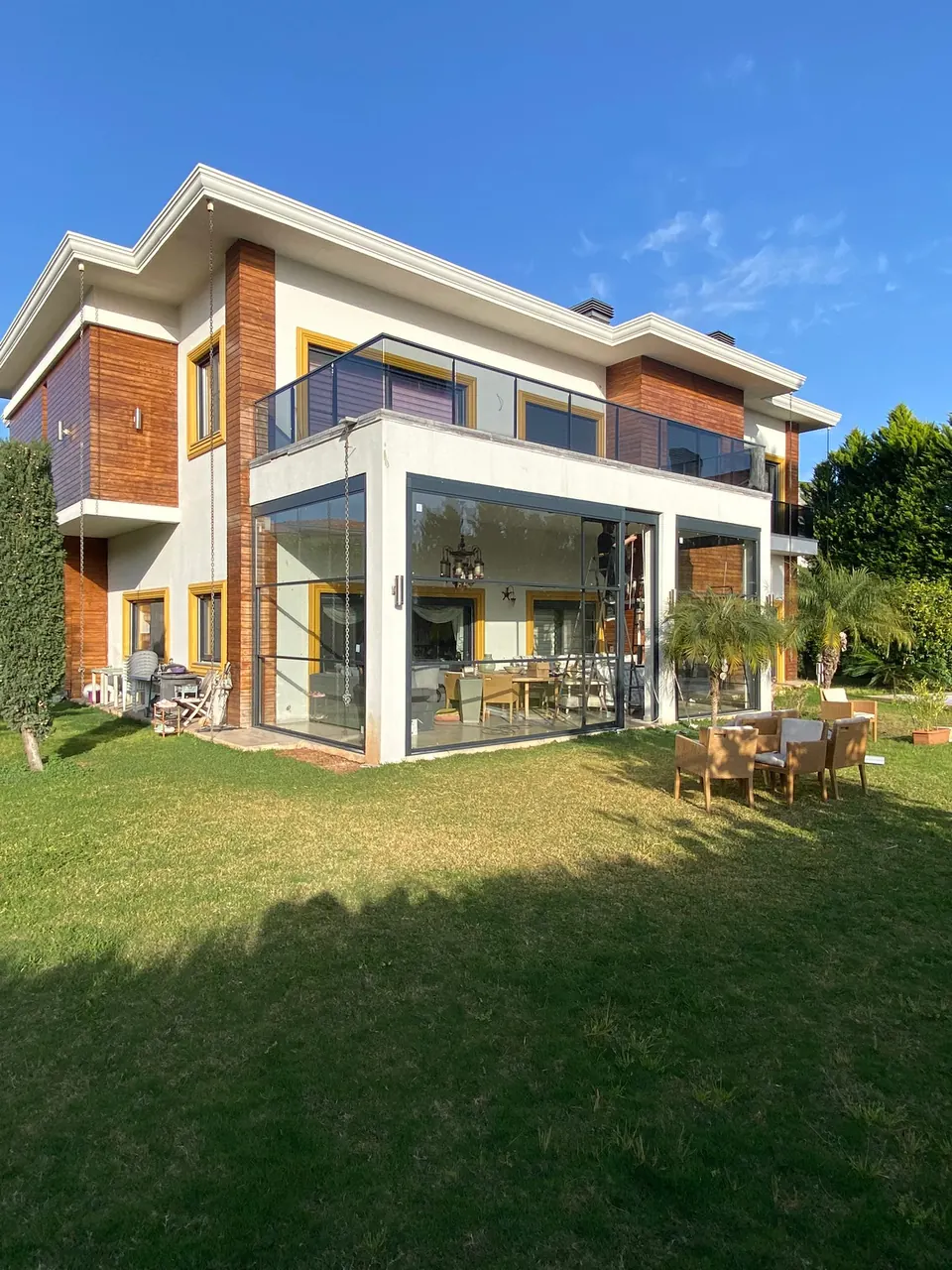
Corner view of a villa with a glass-enclosed ground-floor terrace beneath an upper balcony
Where it is the wrong choice
- If you need the cheapest closure. Sliding glass costs less. See the guillotine versus sliding glass guide.
- If you must clean the outer face without outside access. The standard version does not promise inside cleaning. On upper floors consider the washable guillotine glass.
- If the supporting beam is weak. The housing and raised panels add load, so a structural check comes before any order.
- If the opening must disappear completely. Panels stack in the upper housing, which takes some height.
Ordering and installation
Pricing depends on glass type, motorisation and size. Engineering is done by the manufacturer, and installation is performed by dealers or local teams using the technical documentation delivered with the order. Distributors who want to supply installers in their own country can raise this when requesting a quote.
Prepare a dimensioned sketch or photograph of the opening, the glass target, the control preference and your destination port. That is usually enough for a first indicative offer.
Frequently Asked Questions
Is standard guillotine glass available without a motor?
Yes. A manual version exists and fits smaller openings. For larger panels, frequent use or commercial venues, the motorised version is the normal choice because it removes the lifting effort and allows remote or app control.Which motor brands can be specified?
The manufacturer offers Somfy, Mosel and Cuppon motors. State your preference in the enquiry, particularly if you want to match control hardware already used in the building.Does the frame come in any colour?
Frames are electrostatically powder coated to a minimum of 60 micron and can be supplied in any RAL colour. Give the RAL code in your enquiry so the finish matches your façade or brand.What is the difference between this and the washable version?
Both are vertical-lift systems. The washable version is built so that inner and outer glass faces can be cleaned from inside, and it adds insulation features, safety locks and a stainless chain drive. The standard version is the simpler, general-purpose choice.Can it be used on a restaurant terrace in cold climates?
Yes, if you specify insulating glass units and suitable profiles and gaskets. Without that, the enclosure shields from wind and rain but does not hold heat well. Tell us the target season and the manufacturer will propose a glazing build-up.Request a quote with your opening dimensions and destination.
Related: Guillotine glass systems overview · Washable guillotine glass · Guillotine vs sliding glass · Glass roof systems