Automatic Awning Systems: Motorised Sensor Shade for HoReCa
Last updated:
An automatic awning opens and closes by motor, controlled from a remote or by wind and sun sensors. It suits hotels, restaurants and villas where nobody wants to crank an awning or watch the sky. Our manufacturing partner in Türkiye builds it on aluminium and steel with UV-resistant fabric and optional LED lighting.
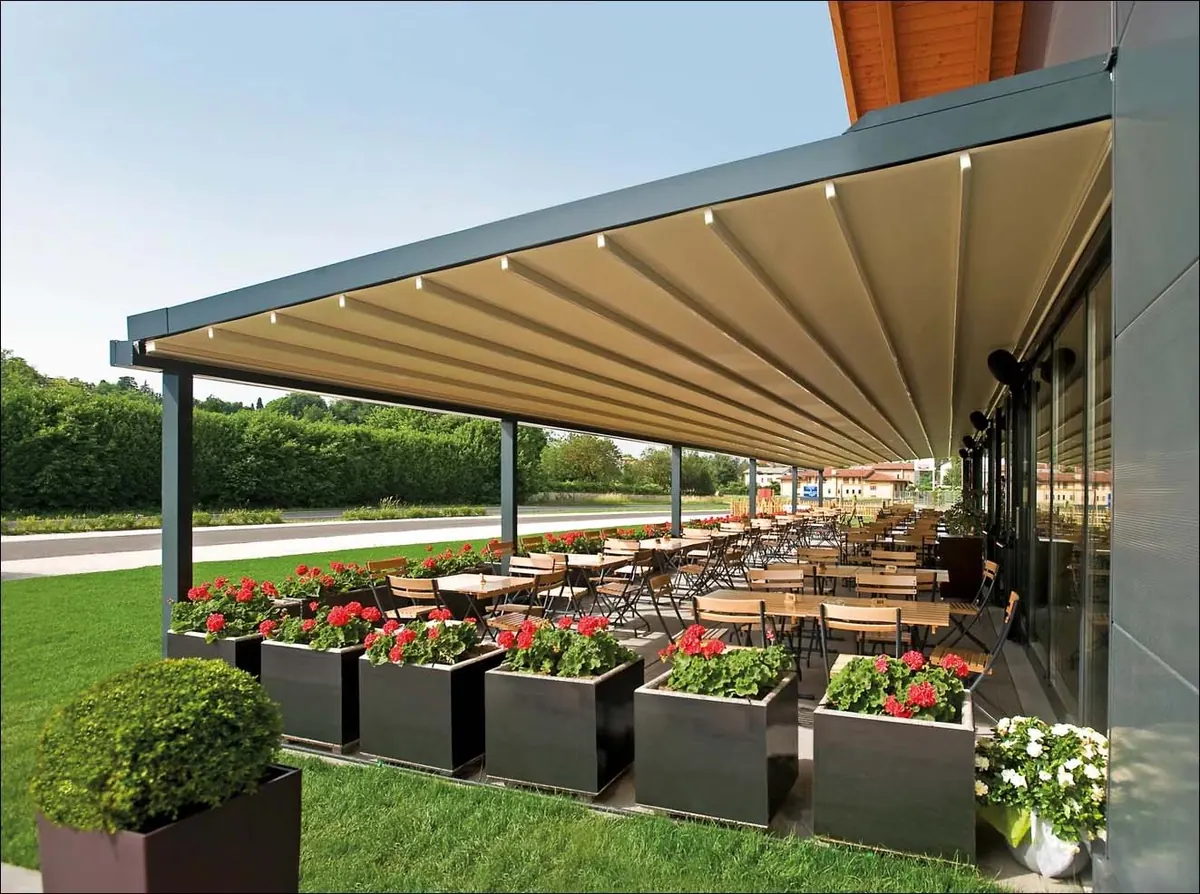
Tensioned bronze fabric canopy over a restaurant terrace with tables and flower planters
What "automatic" means in practice
The word covers three levels of control, and it is worth separating them when you specify a project.
- Motor with remote. A person presses a button. This removes the crank but still needs a decision from someone.
- Motor with sensors. A wind sensor retracts the awning when gusts rise. A sun sensor extends it when sunlight reaches a set level. The awning responds to the weather by itself.
- Motor with sensors and a control system. The awning is integrated into a building or terrace control system, with timings or scenes.
Why sensors matter
Most awning damage in commercial use comes from two situations: a gust catching an extended awning, and a staff member forgetting to retract it at closing. A wind sensor deals with the first. A timer or evening routine deals with the second. For a hotel terrace or restaurant with changing weather, these two functions are the real reason to buy an automatic awning rather than a manual one.
A sun sensor is a comfort feature: it extends the awning when the terrace gets hot and pulls it back in when clouds arrive. This keeps seating areas usable without a staff member managing them.
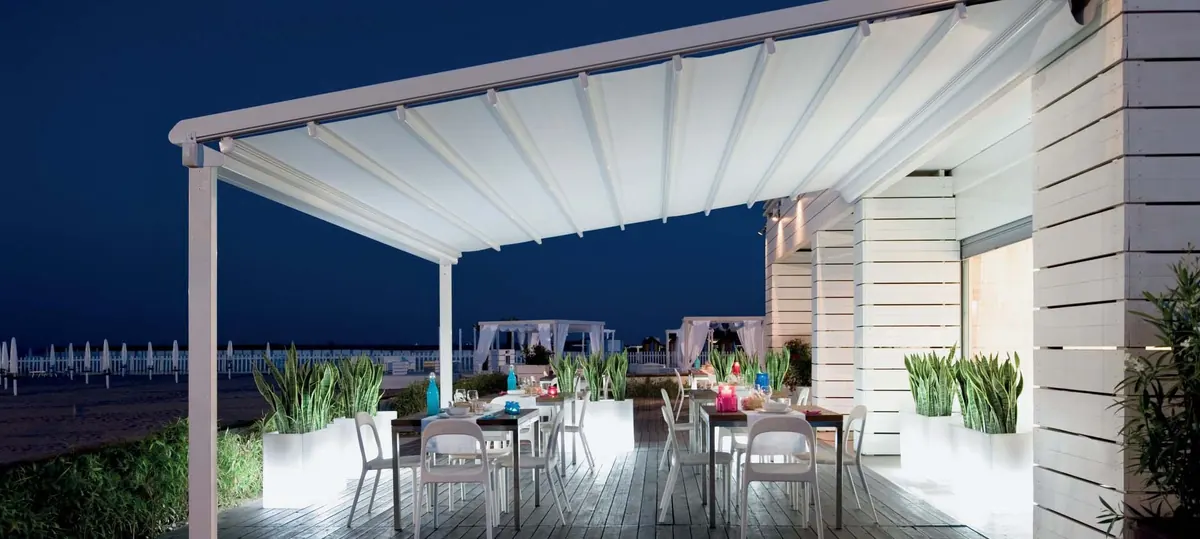
White canopy extended at night over outdoor dining tables on a lit terrace
Construction and options
| Feature | Detail |
|---|---|
| Structure | Aluminium and steel construction |
| Fabric | UV-resistant fabric options |
| Control | Remote control, wind and sun sensors |
| Lighting | Optional LED lighting for evening use |
| Sizing | Per project |
| Colours | Fabric and profile colours chosen per project |
Aluminium and steel. Aluminium keeps weight and corrosion down; steel adds stiffness where spans or loads demand it. The manufacturer combines them to suit the design of each unit.
UV-resistant fabric. Constant sun is hard on any fabric. UV-stable yarns and coatings slow fading and weakening. Ask for samples of the colours you plan to use, and discuss fabric class with the manufacturer if the site has strong sun or sea air.
LED lighting. Lighting built into the structure lets the same awning serve an evening terrace. This matters for restaurants and hotel bars, where the evening trade is often the most valuable. Lights, cabling and control should be planned at the same time as the motor and sensors so cables are routed before installation.
Where automatic awnings fit best
- Hotel and resort terraces where guests expect shade without staff intervention.
- Restaurants and cafes with large outdoor seating areas and variable weather.
- Villas and residential terraces where owners want a button or an app instead of a crank.
- Commercial facades where an awning is part of the front of house.
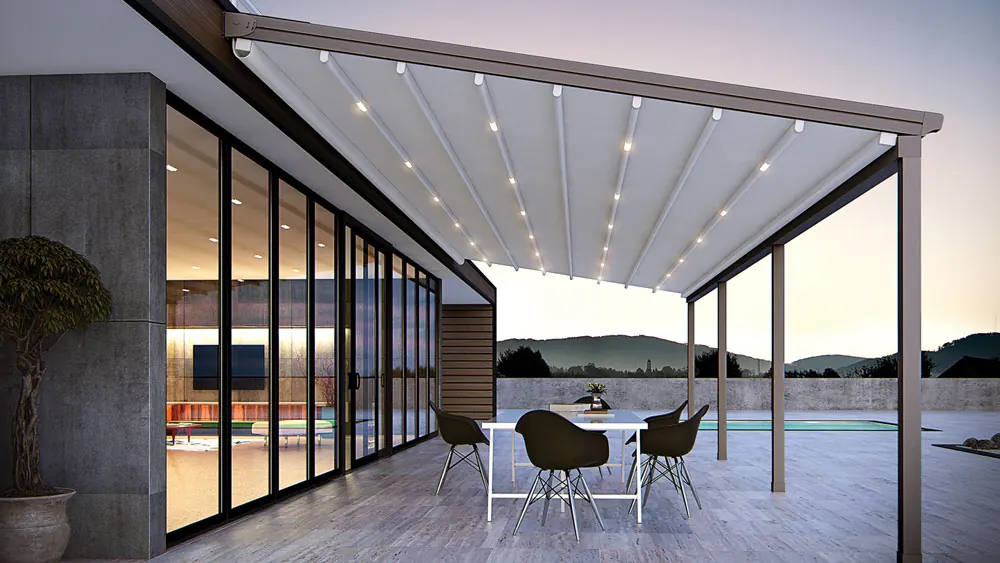
White canopy with integrated lights extended over a glazed facade and a dining table
Planning an installation
Automatic systems need a few things that manual awnings do not.
- Power supply. A motor, sensors and lighting need a safe, protected connection at the installation point.
- Sensor position. A wind sensor must see the real wind, not a sheltered corner of the building. Placement should be agreed with the installer.
- Override. Staff should be able to retract the awning on demand, whatever the sensor says.
- Commissioning. Sensor thresholds are set on site and may need adjustment after the first weeks of use.
Honest limits
A sensor lowers the risk in wind but does not remove it. Retraction takes time, and a sudden gust in a few seconds can still stress a large canopy. Do not treat an automatic awning as storm protection: in forecast bad weather, retract it and leave it closed. An awning also does not provide a sealed enclosure. If you need protection from cold and driving rain, combine it with zip screens or a winter garden.
If the budget is limited and the site is sheltered, a motorised articulated awning or cassette awning may be enough. See the awning models and prices guide for the cost drivers.
What to send for a quotation
- Width and projection of each unit, and mounting surface.
- Fabric type and colour reference.
- Control level: remote, sensors, or integration with a control system.
- Whether LED lighting is required.
- Quantity and destination country.
Maintenance and seasonal checks
Automatic systems need slightly more attention than manual ones because there are electronics involved. Test the wind sensor and the sun sensor at the start of each season by simulating the trigger conditions, and keep the sensors clean so dust or bird droppings do not cause false readings. Check that cable glands and connections are weatherproof, especially where LED lighting is fitted. Keep the remote control batteries fresh, and agree who holds the spare remote. If the awning belongs to a hotel or restaurant, a short written routine for opening, closing and storm response takes the guesswork out of daily use.
Frequently Asked Questions
How does the awning open and close automatically?
It is motorised and can be operated by remote control or by wind and sun sensors. The sensor package is set when you request the quotation.
Can LED lighting be added?
Yes. LED lighting is available as an option, so the same awning can be used for evening service.
Which materials are used?
Aluminium and steel construction with UV-resistant fabric.
Is an automatic awning safe in storms?
No awning should be left extended in storm conditions. A wind sensor retracts the awning in gusts, but you should still retract it manually when severe weather is forecast.
Does it work for a small balcony?
It can, but for a small balcony a manual or simple motorised articulated awning is usually enough. Automatic systems earn their cost on larger and busier terraces.
Related: Awning systems overview · Cassette awning · Awning models and prices · Bioclimatic pergola · Zip screens