Pergola & Awning Manufacturing and Quality in Türkiye
Last updated:
Our manufacturing partner builds pergolas, awnings, zip screens and glass systems under one roof in a 35,000 m² enclosed plant in Türkiye. Aluminium processing, powder coating, fabric work, assembly and testing all happen on site, with an annual capacity of 2.5 million m² of product and 2,000 tonnes of coating.
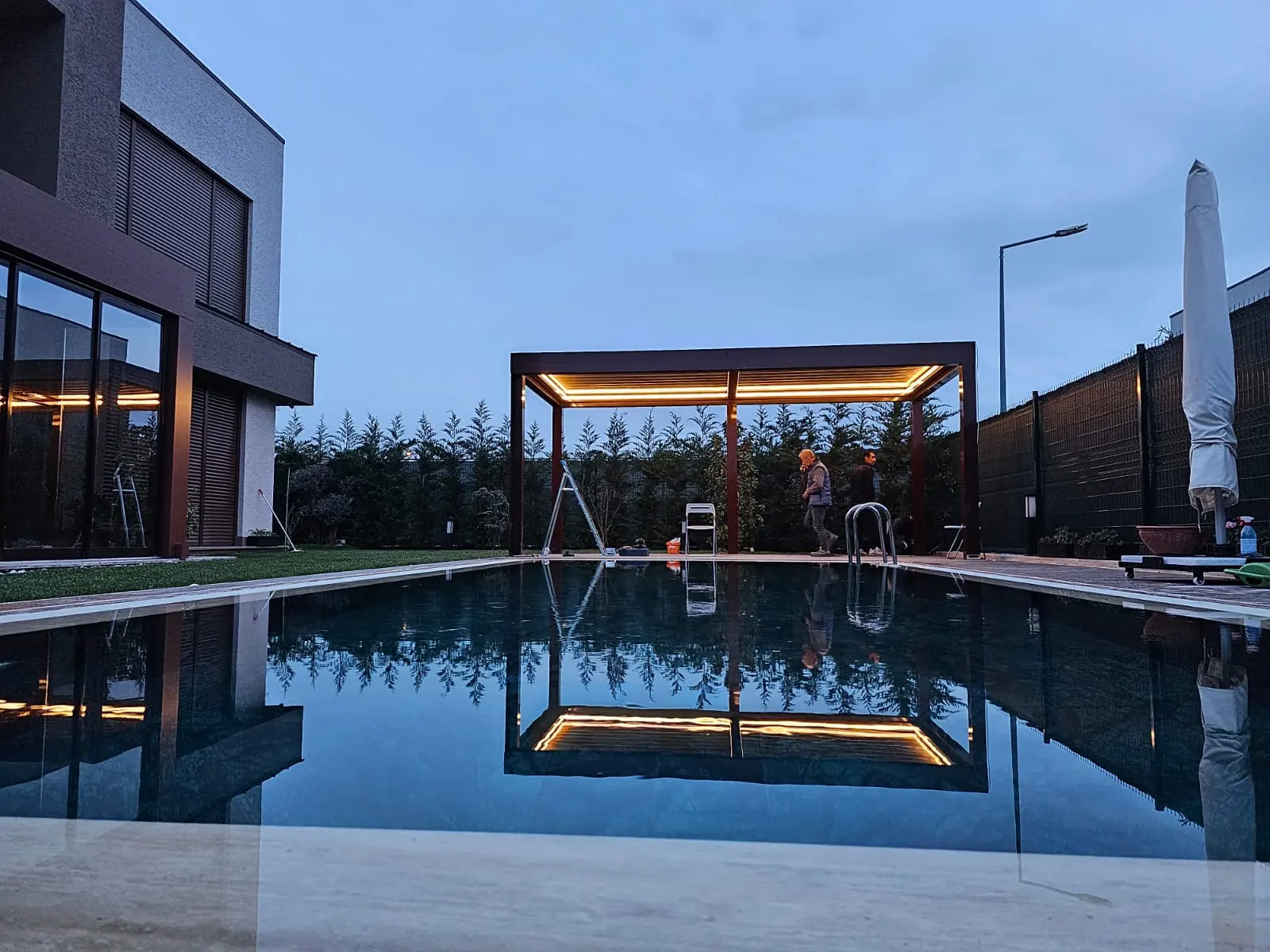
Production facility in Türkiye with aluminium processing and assembly lines for pergolas and awnings
Why the factory matters to a buyer
When you buy architectural outdoor systems, the factory decides most of what goes wrong or right later: whether a louvre closes square after five years, whether a powder coat survives sea air, whether a motor is matched to the actual weight of the roof. Buying from a company that makes the product itself shortens the chain of questions. A dimension problem goes to the engineer who drew the profile; a coating question goes to the people who run the paint line.
The manufacturer has operated in aluminium shading and architectural systems since 2018-2019. Its product range covers scissor bioclimatic (rolling roof) and piston bioclimatic pergolas, guillotine glass, glass roofs, articulated and cassette awnings, the Wintent awning and zip screens. Because everything is built in one location, a project that combines, say, a pergola with zip screens and guillotine glass can come from a single production schedule instead of three.
The production lines
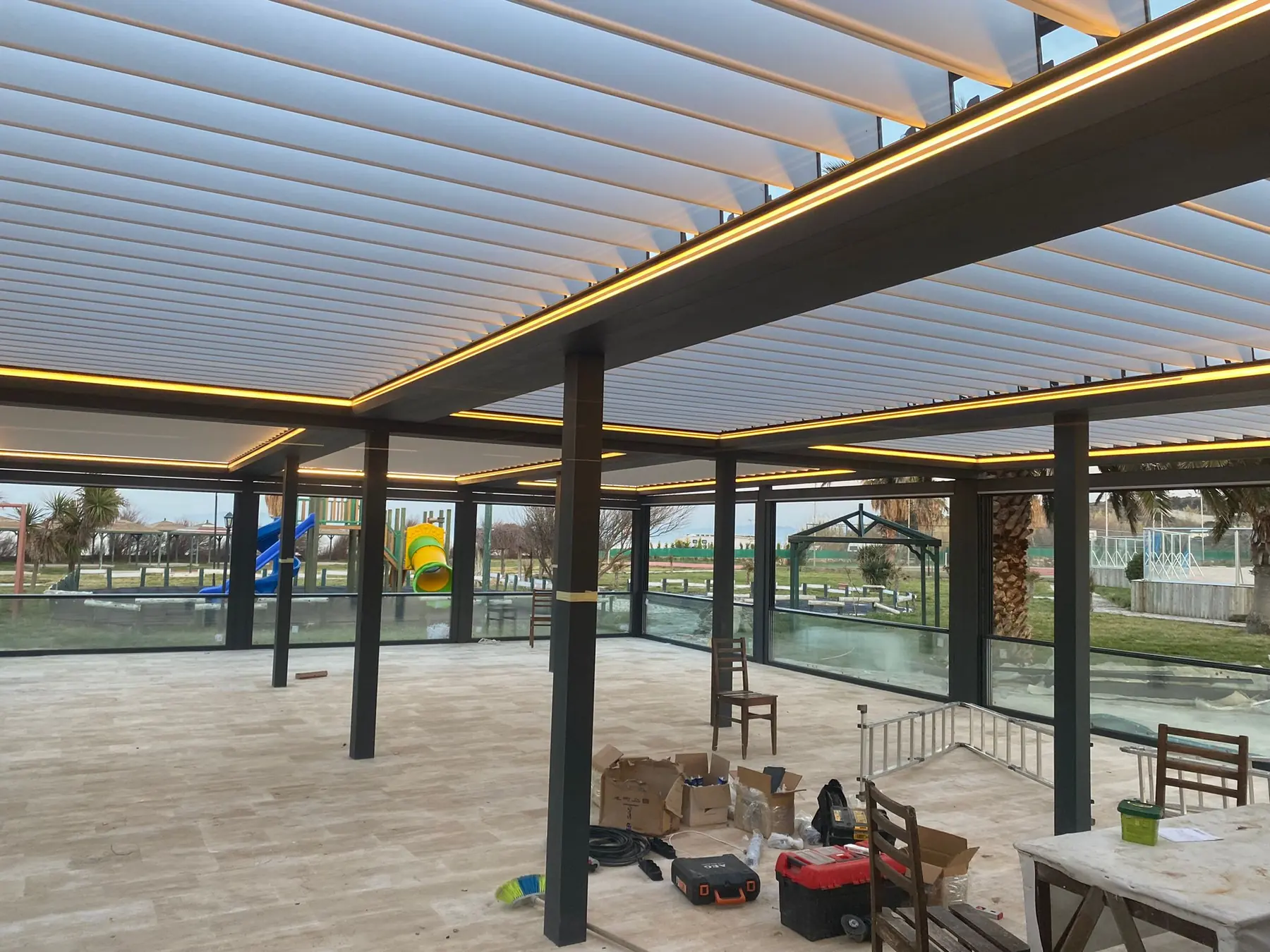
Movable building systems leaving the Turkish facility for international projects
| Stage | What happens | Why it matters |
|---|---|---|
| Aluminium processing | Profiles are cut and bent on CNC lines; system-specific dies and accessories are made in-house | Tight tolerances on louvres, tracks and frames, and parts that fit the same system year after year |
| Electrostatic powder coating | A paint shop with a capacity of 2,000 tonnes a year applies RAL colours and textured finishes in a coating built for marine-type exposure | Colour consistency across large orders and better resistance to salt and humidity |
| Fabric confection | Cutting and welding lines process acrylic, PVC and screen fabrics for awnings and zip screens | Seams and welds made on the same equipment for every order, rather than outsourced |
| Assembly and testing | Every system is assembled once and passes motor, sensor and drainage tests before it is packed | Faults are found in the factory, not on the customer's terrace |
Aluminium and structure
Aluminium is the core material: lightweight, corrosion-resistant and easy to extrude into the hollow sections that give a pergola its stiffness at long spans. Cutting and bending on CNC lines keeps joints repeatable, which matters when you order twenty identical units for a hotel and need all of them to line up. Custom accessories and dies are produced in the same plant, so special requests do not wait for an outside toolmaker.
Coating
Colour is not cosmetic on an outdoor product. Powder coating protects the metal and sets the visual quality of the finished system. All RAL colours are available on aluminium profiles, together with textured and exclusive finishes. If a project is by the sea, say so in the enquiry; the coating specification should reflect it.
Fabric work
Awning and zip screen fabrics are cut and welded in a dedicated line. The available materials include UV-resistant acrylic, polyester and PVC fabrics, screen fabric for zip systems, and fire-retardant blackout fabric for pergolas. Fabric choice affects both appearance and function (light, heat, privacy, fire behaviour), so the right material depends on the application rather than on price alone.
Engineering and R&D
Structural calculation for snow load, wind speed and span is part of every project, not an optional extra. That is the reason the technical team asks about site conditions before it quotes. An R&D team works on profile sections and mechanisms, that it keeps refining over time.
Standard maximums give a feel for the engineering envelope: a scissor bioclimatic pergola reaches 700 cm of façade in a single module and 1531 cm of projection in multi-module layouts, and guillotine glass is produced up to 4000 x 3500 mm. Larger or unusual spans are engineered case by case from the measurements you send. Where a span needs intermediate columns, the system is designed around them.
Quality policy
The policy rests on six commitments. Each is a working principle for how production is organised, not decoration.
- Customer focus. Solutions are chosen to fit the use, customer feedback is analysed, and after-sales support is part of the process.
- High quality standards. Modern production techniques and premium raw materials aim at durable products.
- Continuous improvement. Processes and the quality management system are reviewed regularly, and staff are trained.
- Innovation and technology. Developments in the sector are integrated into products, supported by R&D investment.
- Environment and sustainability. Eco-friendlier production, energy efficiency and waste management.
- Safety and health. Protection of employees and customers, and prevention of workplace accidents.
Certification: how to use it
The manufacturer lists CE and a set of management system standards: ISO 9001:2015 (quality management), ISO 10002:2018 (customer complaint handling), ISO 14001:2015 (environmental management), ISO 22301:2019 (business continuity), ISO 31000 (risk management) and ISO 45001:2018 (occupational health and safety).
Read these correctly. Management system standards describe how a company organises its processes; they are not a performance test of a particular pergola or awning. CE and product test reports are what relate to a specific product. So the practical advice is:
- ask for the certificate and test documents that apply to the exact system you are buying, not only a general list;
- check validity dates and the scope each document covers;
- tell us at quotation stage which documents your authority, client or insurer needs, so they are prepared with the order;
- keep the documents with the project file, as installers and building control may request them.
Packing, shipping and warranty
Systems leave the factory assembled once, tested and then packed ready to install. That packing approach reduces transport damage and speeds up work on site. Shipments go within Türkiye and to 72 countries with technical documentation. Bioclimatic systems carry a five-year warranty on the motor and two years on the mechanics; ask for the terms of other product groups in writing.
Installation is carried out by dealers or local teams from the manuals and exploded drawings, with remote technical support from the manufacturer. For more on logistics and commercial models, read export and project supply.
What the factory is not suited for
Honest limits help you choose well. The plant is set up around aluminium-based architectural systems; do not assume other materials or fully bespoke façade engineering are included, and ask first. Very small, one-off retail orders do not suit a trade-only model. And a very tight delivery date after a late design change is unrealistic in any factory; confirm dates in writing once the order is released.
Frequently Asked Questions
What is the production capacity?
The plant is rated at 2.5 million m² of product a year and 2,000 tonnes of powder coating a year, within 35,000 m² of enclosed production space.Which certificates will I receive?
That depends on the system. Ask for the documents that apply to your product and market when you request a quote, and check the scope on each.Is the coating suitable for coastal projects?
The paint shop works with coatings intended for marine-type exposure. State the coastal location in your enquiry so the specification matches the site.Does every unit get tested?
The factory states that each system is assembled and passes motor, sensor and drainage tests before shipment.Can you produce to my own specification?
Yes. Standard systems are made to measure, and OEM or private-label production is available. Special profiles or mechanisms need to be discussed with engineering first.Request a quote and tell us the system, size and destination.
Related: Architectural systems overview · Export and project supply · Bioclimatic pergola · Project gallery · FAQ