Oval Awning Manufacturer: Special-Form Facade Awnings
Last updated:
An oval awning is a special-form shading canopy with a rounded, arched profile instead of the straight edge of a standard awning. It protects an entrance, window or seating area and gives the building a recognisable shape. Our manufacturing partner in Türkiye produces it to project dimensions, with manual or motorised operation.
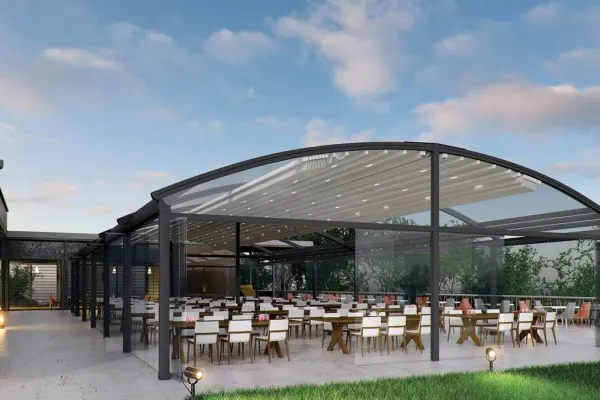
Arched retractable canopy over a restaurant terrace with tables and glass side panels
What makes an awning "oval"
Standard awnings are designed around function: a straight leading edge and a flat or sloped surface. The oval awning is designed around form as well. Its curved outline softens a hard facade and draws the eye to the entrance. For retail and hospitality, that visual role is as important as the shade.
Because the shape is non-standard, there is no off-the-shelf size. Dimensions, curve, fabric and colour are set for the project. This is a made-to-measure product, and the lead time and drawing stage should be planned with that in mind.
Key characteristics
| Feature | Detail |
|---|---|
| Form | Rounded oval profile |
| Operation | Manual or motorised |
| Typical use | Shopfronts, entrances, balconies, cafes, gardens |
| Sizing | Project-specific dimensions and fabric |
| Role | Shade, weather shelter at the entrance, brand visibility |
Where oval awnings work best
Shopfronts and entrances. A rounded canopy above a door or display window works as a landmark. Customers read it as an entrance, and the colour can match the shop's identity. The awning protects the display from direct sun, which also protects stock from fading.
Cafes and restaurants. Outdoor tables are the revenue-making area of many venues. A curved canopy above them gives shade and defines the terrace as a distinct, designed space.
Balconies. On residential and hotel balconies, an oval awning gives a little character to an otherwise uniform facade.
Gardens and seating areas. Where there is no facade to attach to, the form can be built to stand over a seating area, which brings us to the project below.
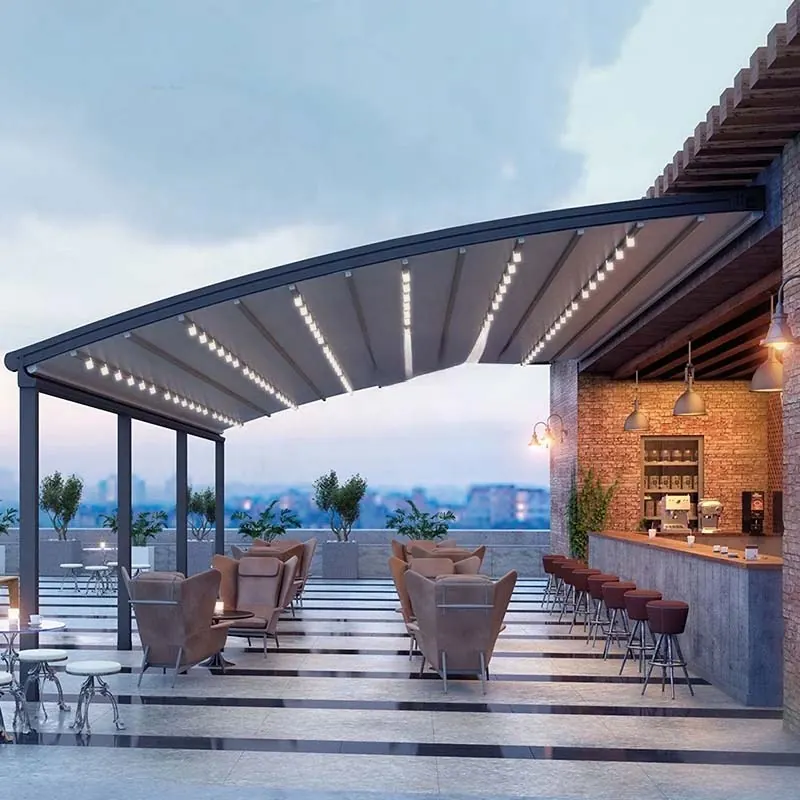
Arched canopy with built-in LED lights over a bar terrace at dusk
Application: garden seating area in Baku, Azerbaijan
One residential project in Baku, Azerbaijan used an oval awning to shade a garden seating area. A garden has no wall to hang a standard awning from, and a house owner usually wants the seating to look finished rather than temporary. A rounded canopy over the seating gives a defined outdoor room with shade, and at dusk the structure can carry lighting, as the project photograph shows.
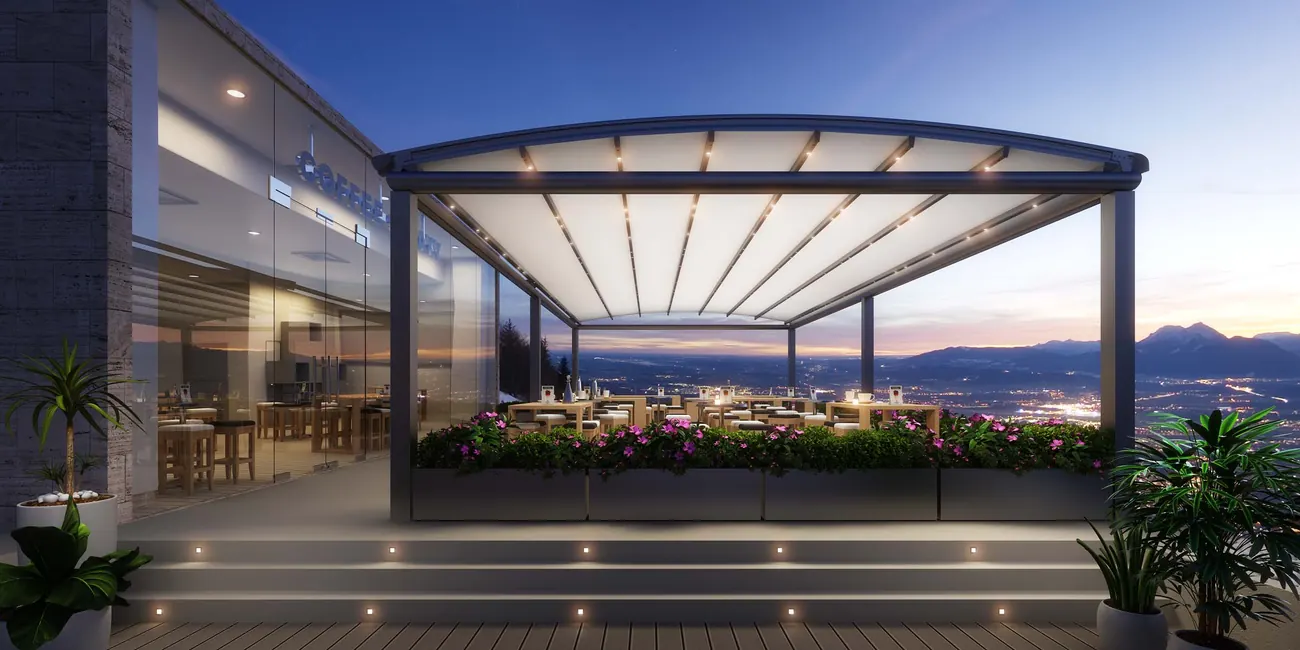
Arched canopy with warm lighting over an outdoor seating area at dusk with glass screens on the sides
When specifying a garden installation, confirm the foundation or fixing method with the installer, since free-standing frames carry wind loads through their posts and bases. The drawing stage should include the ground conditions.
Manual or motorised operation
Manual operation keeps the system simple and is adequate for small canopies. For large spans, or where the awning is opened several times a day, a motor is better. A motor gives smooth, repeatable movement and prevents damage from uneven handling. If the system is installed in an exposed location, ask the manufacturer about adding wind sensing so the canopy can retract in gusts.
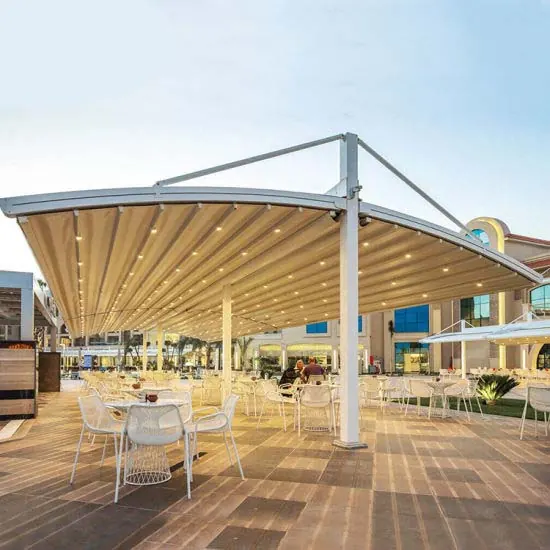
Oval canopy on a central mast over a cafe terrace with white chairs
Honest limits
An oval awning is a shading and brand-presentation product. It is not a weather enclosure. Rain run-off, snow and strong wind need to be considered at design stage, because a curved fabric surface behaves differently from a flat one. Cleaning and re-tensioning follow the usual rules for fabric structures. Because every unit is custom, replacement fabric must be cut to the original pattern, so keep the project drawings and fabric reference after handover.
If your priority is lowest cost per square metre, an articulated awning is more economical. If you need the fabric protected between uses, look at a cassette awning.
Information needed for a quotation
- Where the awning will be mounted: wall, entrance, balcony or free-standing in a garden.
- Width, projection and desired curve or height.
- Fabric type and colour, and whether the colour should match a brand.
- Manual or motorised operation, and whether lighting or sensors are wanted.
- Quantity, destination country and installation schedule.
Fabric choice, care and handover
The curved outline makes fabric choice more than a matter of colour. A fabric must stretch smoothly over the frame without wrinkles, so ask the manufacturer to confirm that the selected material suits the curve. Clean with mild soap and water, and avoid scrubbing hard on printed or branded areas. Keep a copy of the final drawing and the fabric reference with the building file, so the owner can order an exact replacement later. For retail clients, agree who is responsible for opening and closing the awning each day, and whether the motor will be linked to shop opening hours.
A project plan for an oval awning normally runs in four steps: brief and photographs, drawing and fabric sample, production, then delivery and installation. Allow time for client approval at the drawing stage, since changes after production starts are costly.
Frequently Asked Questions
Is the oval awning a standard size product?
No. It is made to project dimensions and fabric. Send the measurements and a sketch or photograph of the location.
Can it be motorised?
Yes. Both manual and motorised versions are produced.
Where is it typically used?
Over shopfronts, entrances, balconies, cafe terraces and garden seating areas, anywhere the awning is also a visible part of the design.
Does it work as a free-standing garden shade?
It has been used in a residential garden in Baku, Azerbaijan. Free-standing designs need a suitable foundation, so check ground conditions with the installer.
Can the fabric match our brand colour?
Fabric and profile colours are chosen per project. Supply a colour reference with the quotation request.
Related: Awning systems overview · Cassette awning · Automatic awning · Shade awning · Project gallery