Zip Screen, Pergola & Awning FAQ for Trade Buyers
Last updated:
This FAQ answers what dealers, contractors and architects ask most about zip screens, bioclimatic pergolas, awnings and glass systems made in Türkiye: warranty, maximum sizes, wind behaviour, fabrics and motors, glass options, shipping and installation, dealership and how pricing works. Each answer is short and points to the detailed page.
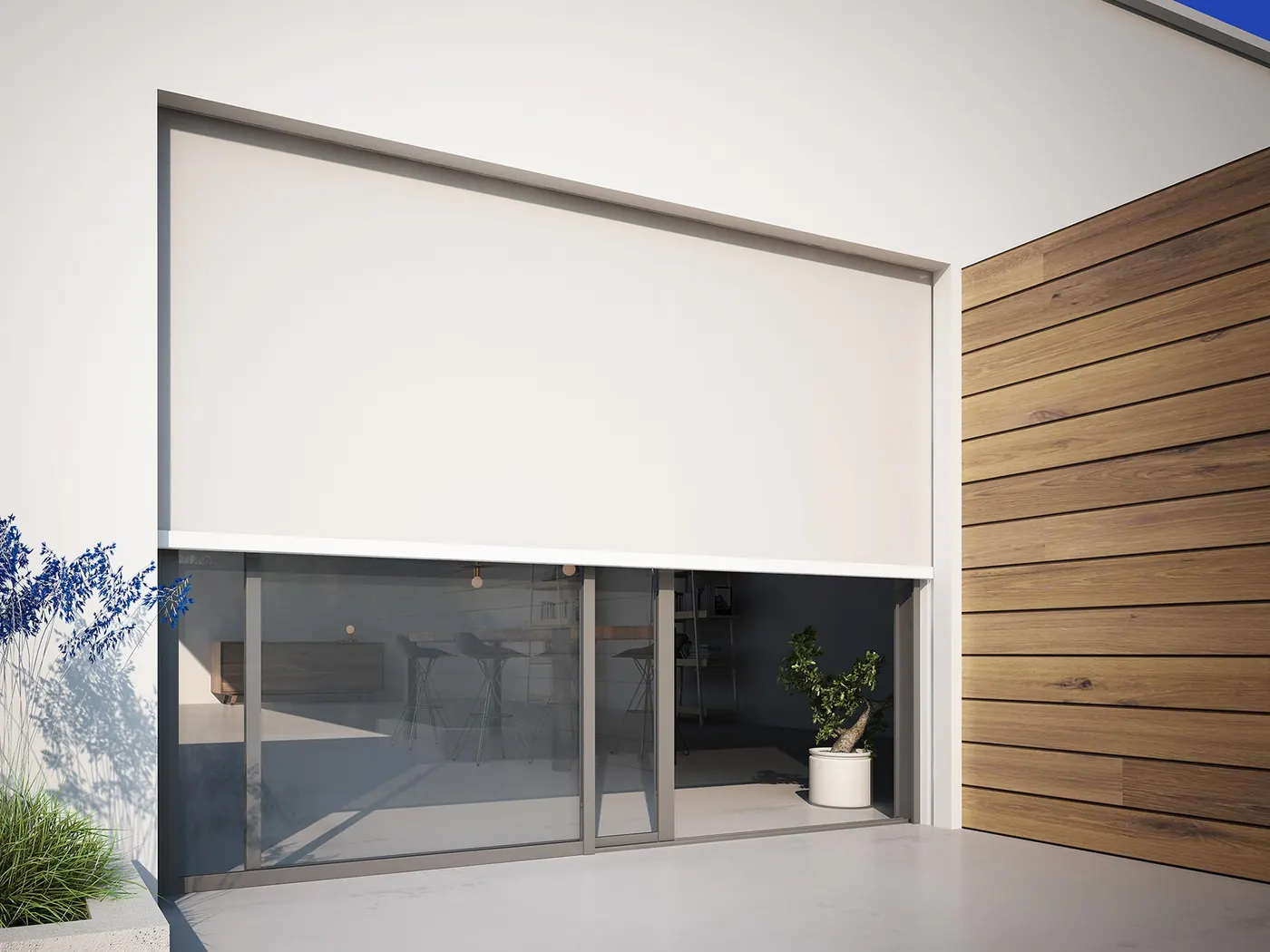
Vertical zip screen system installed on an outdoor terrace opening
Ordering, quotes and dealership
How does the quotation process work?
Send the quote form with your project sizes and what you want the system to do. The technical team then contacts you about dimensions and needs, and prepares system selection, technical drawings and pricing from the measurements you provide. The more complete the first message (country, openings, quantities, finish), the fewer questions come back.How can I become a dealer?
Submit the partnership form and choose the dealership request type. The team looks at your region and business model, then returns with training, documentation and supply terms. A dealer receives a price list, marketing material and samples, and works factory-direct. Details are on the export and project supply page.Do you export internationally?
Yes, to 72 countries. Systems are packed ready to install and shipped with technical documentation, and the export team manages the process from quotation to loading. Delivery terms such as EXW, FOB or CIF are agreed per project.What determines the price of a bioclimatic pergola?
Several things set the price: the size (width by projection), the louvre type (rotating, or fully retractable rolling roof), the motor and automation package, LED lighting, side enclosures such as zip screens or guillotine glass, and the installation conditions. As the manufacturer builds each project to measure and quotes without a middleman, a quote follows from your drawings rather than from a list price. See bioclimatic pergola prices for the factors in more detail.Can I order under my own brand?
OEM and private-label production is available: your profile, colours and packaging. The factory's coating and fabric lines are organised for such orders. Settle tooling ownership, labelling and the certificate documents you need before the first order.Sizes, colours, fabrics and motors
What are the maximum production sizes?
A scissor bioclimatic pergola reaches 700 cm of façade in a single module and up to 1531 cm of projection with several modules. Guillotine glass is produced up to 4000 x 3500 mm. For project-specific sizes the technical team works out a solution from the measurements and project information you send.Which colours are available?
All RAL colours can be applied to the aluminium profiles, along with textured and exclusive finishes. If the site is by the sea, mention it so the coating specification matches the exposure.Which fabrics are used?
Awnings use UV-resistant acrylic, polyester and PVC fabrics. Pergolas use fire-retardant (FR) blackout fabric. Zip screens use waterproof, UV-protected fabrics, with clear-panel options for views. The right fabric depends on whether you want shade, privacy, rain protection or a view.Which motor brands do you use?
Somfy, Mosel and Cuppon motors and controls are offered. Remote controls, sensors and smartphone integration are configured per project.What warranty do the systems carry?
Bioclimatic systems carry a five-year warranty on the motor and two years on the mechanics. For other product groups, ask the team for the terms in writing when you request the quote.Bioclimatic pergolas and retractable roofs
Should I choose a winter garden or a bioclimatic pergola?
A winter garden is glazed and fixed, so it turns the space into an enclosed room all year. A bioclimatic pergola is flexible: the louvres open for summer and close against the weather. Choose a winter garden (glass roof plus guillotine glass) if you want room-like use in every season, and a bioclimatic pergola if open-closed flexibility matters more. The manufacturer also engineers projects that combine both. See winter garden and bioclimatic pergola.Where can a retractable roof be installed?
Retractable (rolling) roofs suit restaurant and café terraces, hotel poolsides and gardens, mall dining areas, villa terraces and winter gardens. Wide spans are bridged with intermediate columns. Rain drainage, LED lighting, heaters and zip screen integration are added according to the project.What is the difference between scissor and piston pergolas?
Both are bioclimatic systems with a retractable or adjustable roof, but the mechanism that moves the roof differs. Read scissor bioclimatic pergola and piston bioclimatic pergola before choosing, because the right answer depends on span, appearance and how the roof should behave when open.Zip screens
How wind-resistant is a zip screen?
The fabric is held tensioned inside zipped side rails, so a zip screen withstands high wind speeds without billowing. If a wind sensor is added to a motorised system, the screen retracts by itself in strong wind. That makes it a very safe vertical enclosure for seafront and high-rise applications. No fabric screen is a wall, though: follow the wind rating for your size and the sensor setup advised for the site.What is a zip screen used for?
It encloses windows, balconies and terrace façades. Waterproof, UV-protected fabric helps with energy use, controls airflow and makes outdoor areas usable in more seasons. Typical sites are restaurant and café terraces, hotels and villa terraces. For selection help see the zip screen overview.Do zip screens still let air through, or does the space feel sealed?
The fabrics used are breathable, so air keeps circulating and the space does not become stuffy; the zip seals the edges, not the weave. Mesh fabric gives the most airflow, while blackout cloth gives the least. If ventilation matters for a closed terrace, say so when you choose the fabric.Can zip screens be made in any size?
They are built to the size you need. For very large openings, several screens are installed side by side instead of one very wide unit. Send the opening dimensions and the team will propose how to divide them.Do zip screens reduce noise?
A little. The fabric takes some of the edge off noise coming from outside, so the area behind it feels calmer. A fabric screen is not acoustic glazing, so expect a modest reduction rather than insulation.Can people see in through a zip screen?
The fabrics are designed so that you see out from inside while the interior is hard to see from outside. This works best in daylight; at night with the lights on inside, the effect reverses, so choose an opaque fabric where evening privacy matters.Can the motor or the fabric be replaced later?
Yes. The motors are made for long service life and can be swapped for a new one if one fails. A damaged fabric can likewise be replaced without replacing the whole system, which keeps repair cost down.Can zip screens be remote-controlled or linked to a smart-home system?
They run from a remote control. Smart-home integration is possible and depends on the features of the controller specified. Name the platform or controller you want to use in your enquiry.What warranty applies to zip screens?
A two-year warranty is stated for zip screen systems. Ask for the scope in writing with your quote, including what it covers on the motor, the fabric and the mechanics.Awnings
What are the main awning types?
The range includes cassette awnings, articulated (folding-arm) awnings, oval awnings, automatic awnings, shade awnings and the Wintent awning. Cassette awnings keep fabric and mechanism protected inside an aluminium cassette when closed, which extends fabric life. Articulated awnings extend on folding arms and can be wall, ceiling or free-standing mounted. Oval awnings are used over shopfronts, entrances and balconies. Wintent is a modular system for window and façade openings. Compare them on the awning systems page.Can awnings be motorised or smartphone-controlled?
Yes. Depending on the model, awnings are available manual, motorised, remote-controlled or smartphone-controlled. Frame options include aluminium and, on articulated models, stainless steel.Glass systems
What is the difference between guillotine glass and folding glass?
Folding glass stacks its panels to the side, so a block of glass remains at the edge when open. Guillotine glass lowers motorised panes vertically over each other, opening the façade with no divisions and keeping the view uninterrupted. That is why restaurants, cafés and view terraces often prefer it. Double-glazed options give full insulation in winter. A direct comparison is on the guillotine vs sliding glass page.Can the glass be cleaned from inside?
The washable version of the guillotine system lets both surfaces of its panels be cleaned from indoors. It also offers thermal, acoustic and water insulation, electric automation and safety locks. See washable guillotine glass.What glazing options exist for guillotine glass?
The washable system uses 8 mm tempered glass or double glazing in 4+12+4 or 5+10+5 build-ups, in two or three panels, driven by a stainless chain and with a motor from the offered brands. Maximum width is 4000 mm and height 3500 mm. Prices depend on glazing, motorisation and size.What are glass roofs made of?
Glass roofs use tempered or laminated panels on aluminium or steel carriers, fixed or movable. They bring daylight into gardens, terraces, winter gardens and large interiors. Combined with guillotine glass and zip screens they form an all-season, openable space.Choosing between systems
How do I choose between a zip screen, an awning and a pergola?
Start with the problem. If the issue is wind or rain blowing in from the side, a zip screen on the open face is the direct answer. If you need shade from above on a facade or a patio, an awning is lighter and cheaper to fit. If the space needs a proper roof that can open and close, with drainage and lighting, a bioclimatic pergola fits. Many hospitality projects combine two of these, for example a pergola with zip screens on its sides.What is a rolling roof?
Rolling roof is the trade name for a scissor-type bioclimatic roof: the covering moves in sections along a scissor mechanism and retracts fully, so the terrace can be completely open or completely covered. Rotating-louvre bioclimatic pergolas are a different design that tilts slats rather than retracting the roof. The two are compared in the bioclimatic pergola pages.Can I get samples before placing an order?
Dealers receive samples as part of the dealership programme. For project buyers, ask the export team at quotation stage what sample or fabric swatch support is possible for your case; do not assume it, because it depends on the product and the order.Can the systems be controlled from a phone?
Smartphone integration is available and is configured per project together with remotes and sensors, on motorised systems from the listed motor brands. Specify at enquiry stage how you want to control the system (remote, wall switch, phone, automatic sensor) so the correct motor and control package is quoted.Shipping and installation
How do shipping and assembly work?
All systems are packed ready to install and shipped within Türkiye and abroad with assembly documentation. Ready-to-install packing reduces transport damage and speeds up installation.Do you provide installation?
No. The manufacturer builds and exports but does not provide installation services. Each system is assembled and tested at the factory and then packed; your dealer or local team installs it with detailed technical documentation. Remote technical support is available to installation teams when needed. Plan for an installer in your own market before ordering.Which documents come with an order?
Installation manuals, exploded drawings and structural calculation for each project, plus certificate and test documents that apply to the system. Ask for the list when you request your quote.Request a quote with your sizes, destination country and preferred system.
Related: Architectural systems overview · Export and project supply · Manufacturing and quality · Awning models and prices · Project gallery