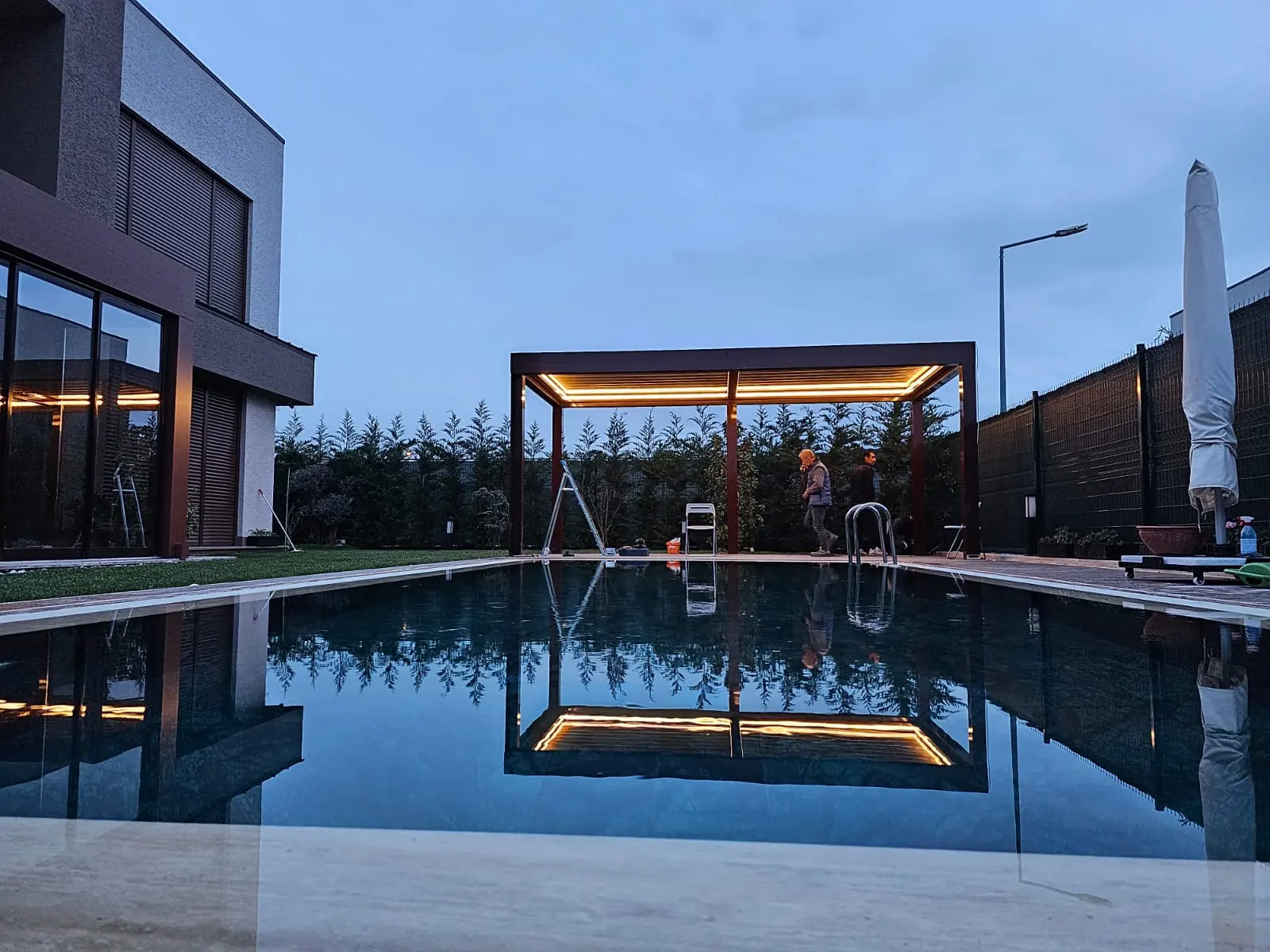
Pergola OEM Manufacturer: Private-Label Supply
Pergola OEM manufacturer private label supply means a dealer sells a producer's pergolas, awnings or zip screens under its own brand. The dealer decides labels, colours and packaging; the manufacturer controls engineering and production — so branding rules, documentation, warranty responsibilities and spare-parts access have to be agreed before the first order, not during it.
What does pergola OEM manufacturer private-label supply mean for a dealer?
A dealer programme in this industry comes in two shapes, and the difference matters when you compare offers:
- OEM (original equipment manufacturing) usually means the product is built to your specification or to your own profile — a structure, a mechanism or a colour that is yours as a brand, produced on the manufacturer's lines.
- Private label (often used interchangeably, and worth pinning down in a conversation) usually means an existing catalogue model produced with your brand on it: your labels, your packaging, sometimes your manual, on a proven system.
What the arrangement is not: it is not a franchise, not a licence to claim the product as designed by you in a technical sense, and not a substitute for the documents your market requires under your own name. Those documents, and who carries the warranty afterwards, are the two things a dealer should settle before comparing prices at all.
Branding options
Branding is the visible part of the programme, and each element has an owner and a question attached. The table is the conversation to have with the producer before the first order:
Table A: option, who does it, typical question
| Option | Who does it | Typical question to ask |
|---|---|---|
| Labels and plates on the cassette and components | Manufacturer applies per your artwork | Which components carry a label, and what is the smallest run for a custom plate? |
| Manuals and installation documents | Manufacturer, with your branding where agreed | Who writes and updates the manual, and in which languages? |
| Colours and finishes (RAL range) | Factory coating line | Which colours are standard in the coating line, and which are made to order? |
| Packaging and carton marking | Manufacturer per your packing rules | Can packaging carry your brand only, and who supplies the artwork? |
| Catalogue and price list | Dealer | Which technical data does the producer supply so your catalogue matches the product? |
Two disciplines keep this workable. First, artwork and rules in writing: labelling positions, colour references and packaging rules sent as files with a version, not as descriptions in an e-mail thread. Second, the rules stay consistent across batches — a private-label programme fails when batch two arrives with the old plate because the specification was never filed.
Catalogue models vs custom engineering
The choice between catalogue and custom decides cost, lead time and, most importantly, who carries the risk when something is wrong:
- Catalogue model, branded. A system that already exists, made to measure in size and colour, carrying your brand. Engineering risk stays low — the mechanism is proven — and the conversation is about branding, colour and documents. This is the route most first-time dealers take.
- Custom engineering. A new profile, a different drive, a modified cassette, a special geometry. This is a project: engineering has to design it, calculate it, prototype or pre-series it, and validate it. The producer's own guidance is consistent here — special profiles or mechanisms are discussed with engineering before anything else happens.
Documentation to agree
Documents are where a private-label programme either becomes a business or becomes a liability. The list to agree in writing:
- Installation manual, in the languages your installers work in, carrying your branding where agreed, with the assembly sequence, torque or fixing instructions and the exploded drawings.
- Technical drawings and dimension sheets, so your catalogue, your website and your quotations describe the product you actually ship.
- Spare-parts list, keyed to the same numbering the drawings use — this is what turns a warranty call into a fifteen-minute parts order instead of a reverse-engineering exercise.
- Test and compliance documents for the systems you sell: performance documentation for the finished product (external blinds fall under EN 13561 as the performance standard), and any fabric classification documents where your market asks for them. The details of how to read fire and compliance paperwork are on the fire and compliance page; what matters here is that the documents exist for the configuration you are branding, and that you hold copies.
- A document register: which document, which version, which language, held by whom. Without it, a two-year-old manual keeps being quoted as current.
Order process
The dealer ordering route follows the same sequence the factory uses for any project order, with branding decisions inserted at the front:
- Brief. Product or catalogue model, sizes and quantities per market, branding elements (labels, manual, packaging), colour references, and the documents your market requires under your own name.
- Quotation. Per project, per configuration — the producer prices the branded version, not the catalogue version, and states the commercial terms that apply. Minimum quantities and lead times are set here in writing.
- Sample or pre-series. For a branded programme this is the moment to check the label position, the plate, the colour against the reference, and the manual as printed. Approve it as the contractual reference, tagged and stored.
- Production. Against the frozen configuration; the coating and fabric confection lines are set up for private-label batches, which is what makes the model workable.
- Quality control and packing. Cartons checked against the branding rules, piece or opening numbering intact, packing lists matching the drawings — the same discipline described on the packing and lead-time page.
- Shipment and documents. The folder travels with the goods: invoice, packing list, transport document, origin proof where required, and your branded manuals in the languages your installers use.
Minimums and lead times
Two questions every dealer asks first, and the only honest general answer to both is: they are set per product, per configuration and per project, and confirmed in writing with the quotation. A minimum quantity for a branded cassette plate is a different number from one for a full model programme; a lead time for a catalogue colour differs from a lead-time for a new RAL.
What a dealer can do to make those answers precise:
- Ask per item, not per programme. "What is the minimum for private label?" invites a vague answer; "what is the minimum quantity for a branded plate on this cassette, and for this colour?" invites a number.
- Split the minimums. Branding elements and the product itself often carry different minimums — separate them in your order planning so a small first season stays possible.
- Put dates in the document. A lead time quoted in a call is a courtesy; a lead time in the quotation is a commitment you can plan stock and showroom seasons around.
- Ask what moves the date. New artwork, a colour outside the standard range, or a documentation change each have their own effect on the schedule — knowing them prevents surprises.
Quality control and warranty responsibilities
The last thing to agree is the least pleasant to discuss, which is exactly why it belongs at the start. A private-label product carries your brand, so your customer's claim arrives at your door first — and what happens next depends on what was written before the first shipment.
Points to settle in writing:
- Who receives claims and who decides them. In most dealer programmes the dealer is the first contact and the manufacturer is the technical authority; agree how a disputed claim is escalated and who pays when the finding is a manufacturing fault.
- What the warranty covers and for how long. Terms are agreed per project in the quotation — for the systems in question the written terms accompany the offer, and the warranty and service page sets out how claims run.
- Spare parts after the warranty. A brand that cannot source a runner or a receiver three years later is a brand that loses its reputation for a fifty-euro part; the parts list and an ongoing supply arrangement are part of the programme, not an afterthought.
- Where the boundary sits. Installation quality, site conditions and misuse sit with the installer and the operator; manufacturing faults sit with the producer. Writing that boundary down prevents the common argument where both sides assume the other is covering it.
Frequently Asked Questions
What is the difference between OEM and private label?
In this industry the terms overlap, so define them in your own conversation rather than trusting the label: OEM usually means building to your specification or your own profile, private label usually means a catalogue model carrying your brand. Most dealer programmes end up as a catalogue system adapted in colour and branding — worth stating which of the two you are being offered, and on what documents.
Can I put my brand on the cassette and manual?
Usually yes for both, subject to the producer's rules: labels and plates applied per your artwork, manuals produced with your branding where agreed. The practical questions are the minimum quantity for custom plates, who maintains and updates the manual, and in which languages it is issued — agree them before the first order and file the artwork with a version number.
Is there a minimum order?
Minimum quantities are set per product and per project — a branded plate and a full model programme carry different minimums — and confirmed in writing with the quotation. Ask per item rather than per programme, so the answer comes back as a number you can plan a first season around. No general figure appears on this page for that reason.
Who provides installation training?
Ask the producer at quotation stage: what training or technical briefing accompanies a dealer order, in what form (documentation, remote session, on-site), and in which languages. Installation quality is also where warranty boundaries start, so the answer matters commercially, not just technically.
Who is liable for warranty claims?
Terms are agreed per project in the quotation and set out in the written documents — in most dealer programmes the dealer is the first contact for the customer and the manufacturer is the technical authority on the fault. Agree the escalation route, the finding process and who carries a manufacturing fault before the first shipment; the warranty and service page describes how claims run.
Can colours be customised?
Colours are a standard part of these programmes: the factory coating line runs a standard range and makes other references to order. Ask which colours are in the standard range, how a new reference is sampled and approved, and whether the approved colour reference becomes part of the contractual sample — a colour that lives only in an e-mail is a colour two batches will disagree about.
Sources and standards
- OEM and private-label statements follow this site's published pages — export and project supply, manufacturing and quality and the systems overview — which state that standard systems are made to measure and that OEM or private-label production is available with own profile, colours and packaging, with tooling ownership, labelling rules and certificate documents agreed before the first order.
- EN 13561 (external blinds — performance) is named as the performance standard relevant to CE and Declaration of Performance questions for the finished product; fabric classification documents are covered on the fire and compliance page. Confirm the current edition with the producer.
- No minimum order quantities, lead times, factory sizes, certifications, dealer names or export countries are stated on this page; every commercial figure belongs to the producer's project quotation, in writing.
Related pages
Architectural systems · Export and project supply · Manufacturing and quality · Warranty and service · Zip blinds export: packing and lead time · Fire and compliance · Request a quote