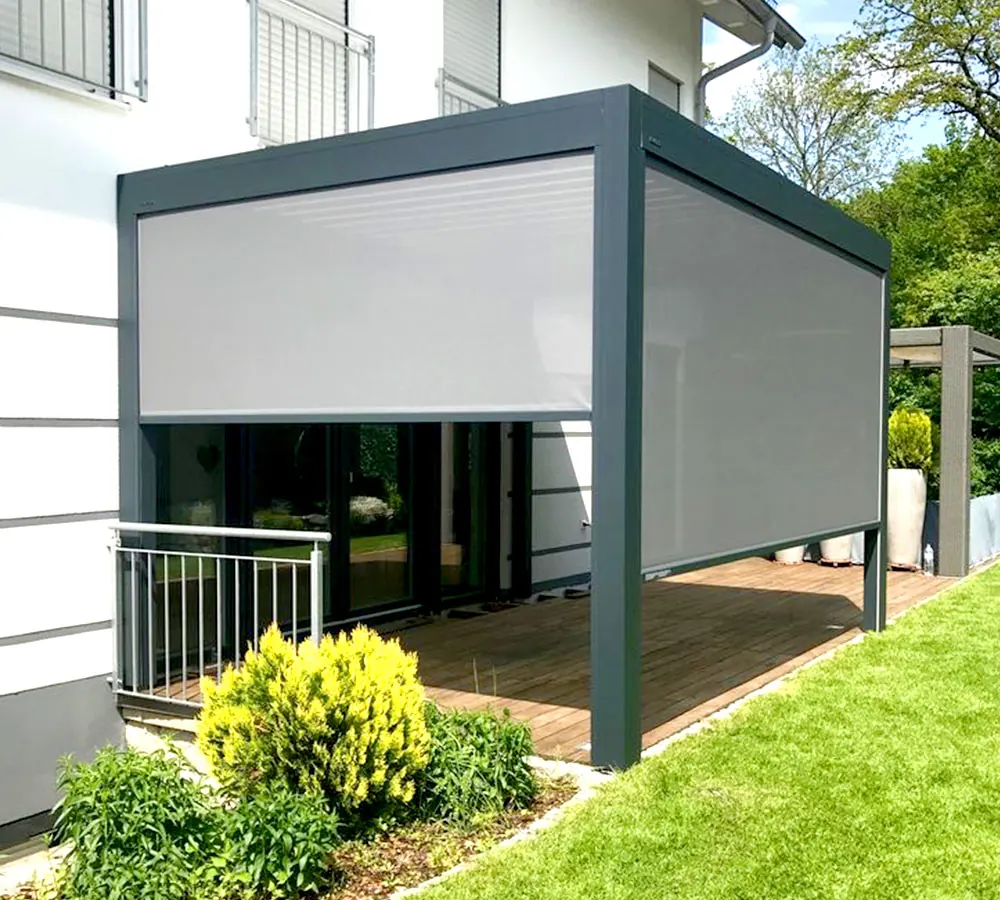
Zip Screen Fabrics: Fire Class and Compliance
Ask the maker for the fire-test report of the exact fabric in the exact mounting, not a logo on a brochure. EN 13501-1 grades reaction to fire from A1 to F with smoke and burning-droplet indicators, while German B1 and French M1 are national schemes that are not interchangeable with it or with each other.
Which compliance documents should a zip screen buyer ask for?
A zip screen is an assembled product — fabric, profile, zipped edge, guide system, motor where fitted — and its paperwork comes from more than one place. For a specification-driven project, the useful list is:
- The fire test report for the fabric, naming the standard, the class achieved, the laboratory, the date, and — critically — the sample description and the end-use and mounting conditions under which it was tested.
- The fabric data sheet: composition, weight, openness factor, coating, and the manufacturer's own colour-fastness and UV figures.
- UV and colour-fastness test results, because exterior screens fail by fading and losing strength long before they fail by anything fire-related.
- Chemical or composition declarations — what the coating contains, and any restricted-substance statement the project asks for.
- CE and Declaration of Performance documents for the blind itself, where the project applies them: external blinds fall under EN 13561 as a performance standard, and the DoP describes the performance claimed for the product, not a fire class for the fabric.
- Motor and electrical documents where the screen is motorised — applicable directives, wiring requirements and the motor documentation.
Fire classification explained
Reaction to fire describes how a material behaves in a fire test — it is not a statement about how often a fabric will ignite in service, and it says nothing about a building's overall fire strategy.
Table A: scheme, region, example class, note
| Scheme | Region | Example class | Note |
|---|---|---|---|
| EN 13501-1 | European Union and projects specifying EN | A1 to F, with smoke (s1–s3) and burning droplets (d0–d2) appended to the combustible classes | The report should state the class, the indicators, the test methods and the edition; for textiles, the most favourable class typically seen is B-s1,d0 |
| DIN 4102-1, class B1 | Germany (national scheme) | B1 | A national class: recognised in Germany, not automatically transferable to an EN classification or another country's scheme |
| NF P92-503, class M1 | France (national scheme) | M1 | National class, strict on burning droplets; a German B1 certificate usually cannot stand in for M1 |
Reading a class string: the letter-and-number code is a position in a scale, and the appended indicators carry their own information — `s` for smoke production, `d` for burning droplets. A report reading `B-s1,d0` therefore says class B with the least severe smoke and no burning droplets, and that combination is the favourable result typically seen for coated textiles in EN 13501-1 reports.
Two habits keep buyers out of trouble:
- Never compare across schemes by name alone. "B1" and "B-s1,d0" look similar and are produced under different standards with different test methods. The comparison is valid only where a formal relation exists and is stated by the project authority.
- Read the whole report, not the headline page. The class is one line; the scope, the sample description and the conditions are the rest of the result.
Document checklist
Table B: document, why it is asked for, what to check
| Document | Why | What to check |
|---|---|---|
| Fire test report | The only acceptable evidence of reaction-to-fire class | Standard and edition; class string with indicators; laboratory and its accreditation; date; sample description (composition, coating, weight); stated end use and mounting |
| Fabric data sheet | Defines what the fabric physically is | Composition, weight, coating type, openness factor, manufacturer's stated UV and colour-fastness values |
| UV / colour-fastness results | Exterior exposure is the dominant real-world stress | Test method used, how results are expressed, whether results are for the face, back or both |
| Chemical / composition declaration | Restricted-substance and project compliance questions | Scope of the declaration, date, whether it covers the coating as supplied |
| CE marking + Declaration of Performance (to EN 13561) | Describes the performance claimed for the finished external blind | That the DoP exists for the product configuration offered; which characteristics are declared; not a substitute for a fabric fire report |
| Motor / electrical documents | Motorised screens carry electrical obligations | Directives listed, motor documentation, wiring requirements for the installation |
A practical rule for each row: the document must describe the thing you are buying. A report on a different coating weight, a DoP for a different configuration, or a declaration covering a product family rather than the specified fabric answers a question you did not ask.
Fabrics: PVC-coated polyester, fibreglass, acrylic
The three common zip screen fabrics raise different questions, and none of them can be answered with a class in the abstract — behaviour depends on coating, weight and construction as much as on the base yarn:
- PVC-coated polyester. The workhorse of exterior screens: dimensionally stable, good colour range, coated on both sides. Questions to ask: the coating's composition and its behaviour in the fire report for this weight; whether the fabric is specified with the same coating for interior and exterior use; how the coated edge is handled where the zip is welded or stitched.
- Fibreglass. A glass base yarn with a coating (commonly PVC), valued for stability and for how it behaves in heat. Questions to ask: what the report says about smoke and droplets for this exact construction, and how edge finishing is treated, since cut glass yarns at an edge are a handling and durability issue rather than a fire one.
- Acrylic (often solution-dyed). Valued for colour-fastness outdoors and a softer look. Questions to ask: the colour-fastness method and results, the fabric's behaviour in the fire report, and whether the same fabric is offered for interior applications under a different test.
Which projects demand fire classes?
Local rules decide, and they decide per building type and use — the same terrace screen can be treated differently on a hotel, a restaurant, an office and a private house:
- Hotels and accommodation. Hospitality projects commonly ask for fire documents for textiles in guest and public areas; the class, the scheme and the age of the report are set by the project authority or the insurer, not by the supplier.
- Public venues and assembly spaces. Restaurants, event terraces and covered public areas are where national schemes bite hardest, because the authority applying them works in its own national class.
- Specified commercial work. Where the architect's specification names a class or a scheme, the buyer's job is to match it exactly rather than to find the nearest equivalent.
- Ordinary residential. Fire class requests are less common, but a client or a local rule can still require them — the correct response is the same document request.
How do you verify a certificate?
A certificate is checked the way a banknote is checked: against its own details, not its general appearance.
- Laboratory and accreditation. Who tested it, and is that laboratory accredited for the standard cited? An accredited laboratory's mark on the report is the first line of evidence.
- Date. Reports do not expire on a fixed schedule, but project authorities commonly impose an age limit — ask them, not the supplier, what is acceptable.
- Standard and edition. A report to an older edition can be perfectly valid and still not satisfy a specification written against the current one.
- Sample description. Composition, weight, coating, colour — the description must match the fabric being offered, letter for letter where the specification is tight.
- Mounting and end use. Test results are tied to how the material was mounted and the conditions it was tested for; a report for a freely hanging configuration does not automatically describe a zipped-and-tensioned screen.
- Scope. What exactly is certified: a fabric, a product family, a production site? The scope line is usually what determines whether the certificate answers your question.
Durable vs non-durable treatments: why outdoor exposure and wetting matter
Where fire performance comes from a topical (applied) treatment rather than from the material itself, two words on the datasheet decide how the fabric behaves outdoors: durable and non-durable.
- A durable treatment is formulated to withstand weathering and wetting to a stated degree — which is what an exterior screen experiences every time it rains or the fabric is cleaned.
- A non-durable treatment can be partly or fully removed by washing or prolonged exposure. One datasheet in this field warns plainly that a wetted non-durable treatment may require retreatment after drying — which is exactly the maintenance question an exterior application raises.
Honest limits
We are a trade group that sources from producers. Certificates, test reports and Declarations of Performance belong to the producer's fabric and configuration — a report describes the sample it tested, on the date it was tested, in the mounting it was tested in. What this page can do is tell you which documents to request and how to read them; what it cannot do is promise a class for a product before a producer confirms it for the exact specification you send.
Equally: no fabric on this page is described as fire-proof or non-flammable, no validity period is stated for any certificate, and no class is claimed for any product. Where a project needs a specific class in a specific scheme, that requirement goes into the RFQ, and the answer comes back with a report number attached — or it does not come back, which is also an answer.
Frequently Asked Questions
What is the difference between B1 and B-s1,d0?
They come from different systems. B1 is a German national class under DIN 4102-1; B-s1,d0 is a class within EN 13501-1, where `B` is the reaction-to-fire class and `s1` and `d0` describe smoke production and burning droplets. They are not the same test and not formally interchangeable — a project that names one should receive a report to that scheme, not to the one that happens to be available.
Is a B1 certificate valid in France?
Not automatically. M1 (under NF P92-503) is the French national scheme, and a German B1 certificate usually cannot substitute for it — the tests, and in particular the treatment of burning droplets, differ. Where a French authority or insurer asks for M1, the answer is a report to the French scheme or a written acceptance of an alternative from that authority itself.
Do all zip screen fabrics have a fire class?
Fabric can usually be tested and classified, but not every fabric on the market carries a report, and some products are sold on performance attributes without a published fire classification. When a class is required, ask for the report on the specific fabric and coating — a "suitable for hotels" claim without a class string is not a classification.
Does CE marking mean the fabric is fire classified?
No. CE marking on external blinds relates to the performance standard for the product — EN 13561 — and the Declaration of Performance describes the performance claimed for the blind. Reaction-to-fire classification of the textile is a separate question answered by a fire test report on the fabric. Both documents may be needed; neither replaces the other.
How old can a fire report be?
Reports do not carry a universal expiry date, but project authorities, insurers and specifiers commonly set an age limit for submissions. Ask the party who will accept the document — not the supplier — and put their answer in the RFQ, so the report requested comes back with the right date range attached.
What if the report was for a different mounting?
Then it does not cover the configuration being bought. Mounting and end-use conditions are part of the stated result, because material behaves differently when it is freely hung, zipped and tensioned, or fixed in a frame. The remedy is a report for the actual mounting, or a written confirmation from the laboratory or producer that the tested configuration covers it.
Can the fabric be treated after delivery?
A fabric may be able to receive a treatment after delivery, but the result is a new condition that should be evidenced — a treated fabric is no longer strictly the fabric the original report described, and re-treatment after wetting is specifically flagged in datasheets for non-durable treatments. If post-delivery treatment is part of the plan, ask for the report covering the treated state, and record it in the maintenance file.
Sources and standards
- CEN-CENELEC — publisher of EN 13501-1 (reaction-to-fire classification, classes A1–F with smoke and droplet indicators) and EN 13561 (external blinds — performance, including CE marking), both named here as references; confirm the current edition before citing a clause. EN 13773 is the standard associated with freely hung textiles — ask which fire test applies to freely hung textiles in your market.
- National schemes: DIN 4102-1 class B1 (Germany) and NF P92-503 class M1 (France) are described from vendor technical explainers; a German B1 certificate usually cannot substitute for M1.
- Vendor documentation (SGS-type reports and mill datasheets) illustrates that stated end use and mounting conditions form part of a test result; no report is reproduced or claimed here.
- This page claims no certificate, CE mark, class or validity period for WorldwideTradeX or for any producer, and describes no fabric as fire-proof.
Related pages
Zip blinds · Fabric · Fabric collection · Zip blinds technology · Wind resistance · Request a quote