Vertical Zip Screens: Wind-Resistant Facade Enclosure
Last updated:
A vertical zip screen is a tensioned fabric curtain that drops in front of a window, balcony or terrace opening, with both edges locked into side rails by a zip profile. Because the fabric cannot billow out of the guides, it holds in wind that would tear a loose roller blind from its track.
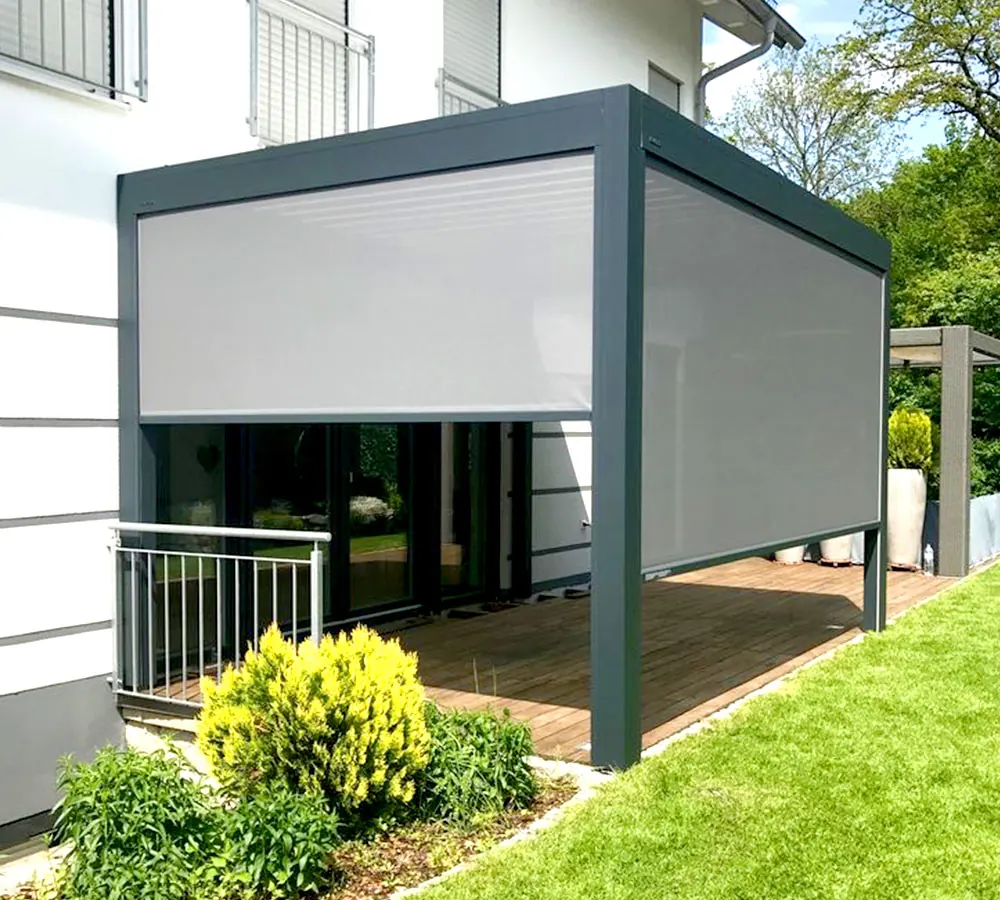
Grey vertical zip screens enclosing the sides of a house terrace pergola
How a vertical zip screen is built
The system has four working parts. A housing at the top, called the cassette or headbox, holds the roller tube and the motor or manual drive. Two aluminium side rails run down the opening and carry a zip channel. A weighted bottom bar keeps the fabric straight and slides in the same rails. The fabric itself has a zip bead welded along each vertical edge, and this bead is what travels inside the channel.
When the screen is lowered, the bead feeds into the channel and locks. The fabric is then held on three sides instead of hanging free, which is why it stays flat and quiet in gusts and does not flap against the frame. The closed screen also leaves almost no gap at the sides, so it keeps out rain spray, dust and flying insects better than a blind with open edges.
The manufacturing partner in Türkiye produces the system to measure for each opening, so the cassette, rails and fabric are matched to the span and the exposure of the site rather than picked from a small set of stock sizes.
What it is used for
Vertical zip screens are a facade product. They are installed where an opening needs to be closed on demand, without building a permanent wall:
- Balconies and loggias in apartment blocks, where wind and rain limit use for much of the year.
- Restaurant and café terraces, as side walls that turn an open seating area into a sheltered one.
- Pergola and fixed-roof sides, closing the open flanks of a bioclimatic pergola or a covered patio.
- Villa terraces and pool houses, where a wind-exposed side needs protection but the owner wants the view back on calm days.
- Shop fronts and entrances that need sun control and some weather protection without a solid shutter.
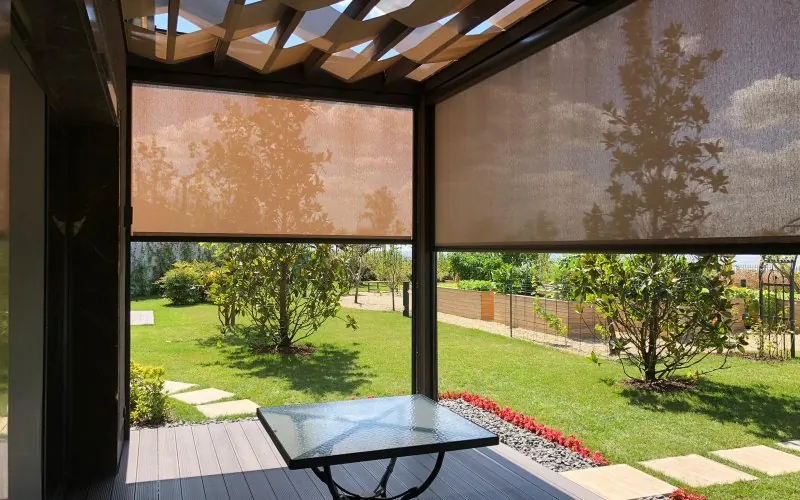
Lowered mesh zip screens on a pergola terrace, filtering sun above a garden lawn
Fabric options
Waterproof, UV-protected fabrics are standard. Two families cover most jobs:
- PVC fabrics with clear windows. A transparent panel lets people see out and keeps the view while the opaque borders carry the structure. This is the usual choice for restaurant terraces and villas, where a closed screen should not feel like a wall.
- Screen (mesh) fabrics. These filter sunlight and reduce glare and heat, while keeping the interior from being seen from outside. They suit south and west facades and offices or shops where privacy matters.
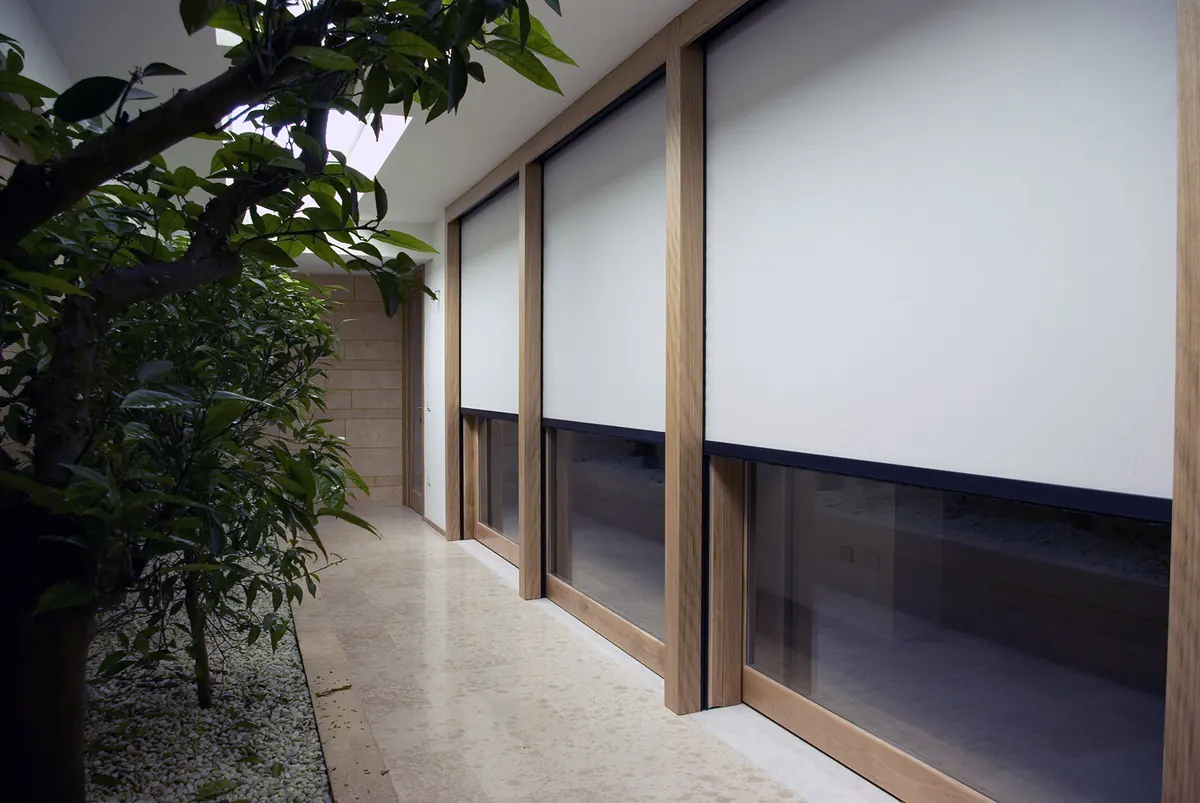
Row of vertical zip screens in timber frames shading a glazed facade corridor
Operation and wind protection
Screens can be supplied motorised or with manual operation. Motorised versions are the standard for commercial use: one button or remote closes several screens together, and staff do not have to climb steps or pull cords at closing time. Somfy motor options are available, and a wind sensor can be added so the screen retracts by itself when gusts pass a set limit. This matters because the rails and fabric are only rated up to a certain load, and an unattended screen is the one most likely to be damaged in a storm. More on controls is in the motorization guide.
Wide openings need engineered sizing of the cassette and the rails. The wider the span, the more load the fabric transfers to the guides, so large facades should be designed with the manufacturer rather than ordered by approximate size.
Housing and profile materials
The headbox and the side rails are aluminium. The metal is light enough to fix to a pergola beam or a facade, stiff enough to keep the fabric under tension, and it does not rust, so the same profile can be used near the sea. Width and height are not tied to a fixed size chart: the system is modular, so a tall glass front and a low balcony opening can be built from the same design.
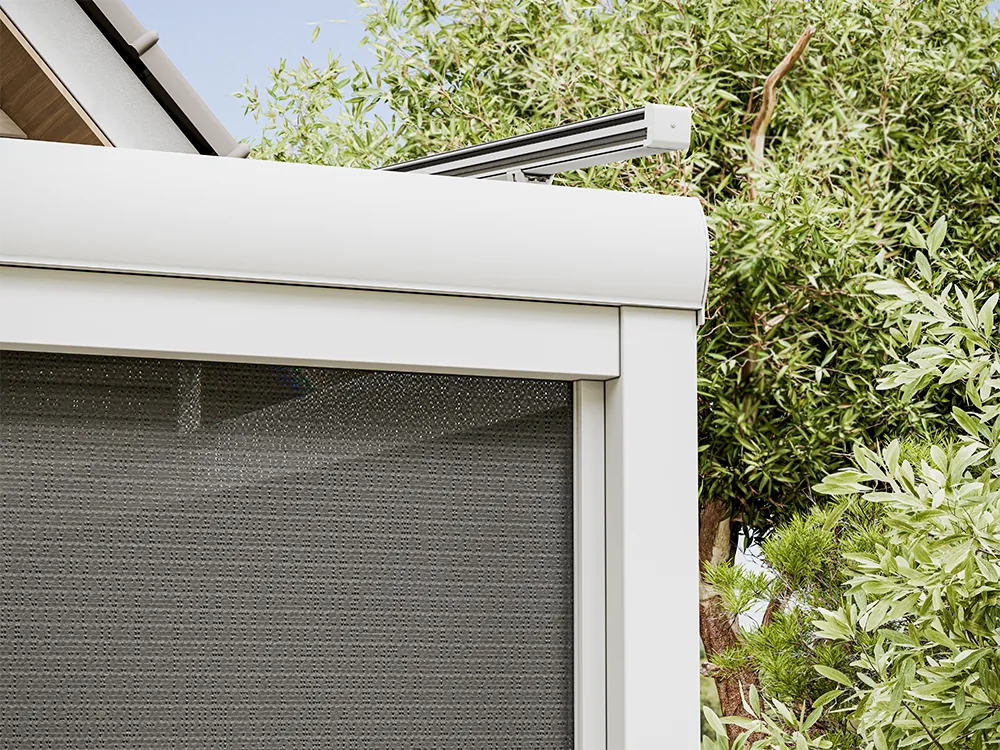
Close-up of a white headbox above grey mesh zip screen fabric beside a garden tree
Blackout or mesh: what each fabric does
Two fabric behaviours are worth separating. PVC-coated blackout cloth stops daylight completely, which suits a room or lounge that has to be darkened or fully private. Mesh cloth lets through up to roughly 5% of the view, so you still see the garden or the street while the glare and heat are cut. Both filter UV, which matters indoors: sofas, flooring and shop stock fade far more slowly when the sun is stopped outside the glass.
Wind reference, sealing and rain
Because both edges run in the side rails, the fabric stays put in gusts. The figure usually quoted for this screen type is up to 90 km/h on the Beaufort scale. Treat that as a typical reference, not a promise for every size, and ask for the value that applies to your width and height.
The zip bead also seals the sides. Less air leaks past the edges, so winter draughts and summer heat gain are reduced and the opening is easier to heat or cool. Rain is handled by water-resistant fabric together with a drainage provision in the system, so a wet screen does not become a pond at the bottom bar.
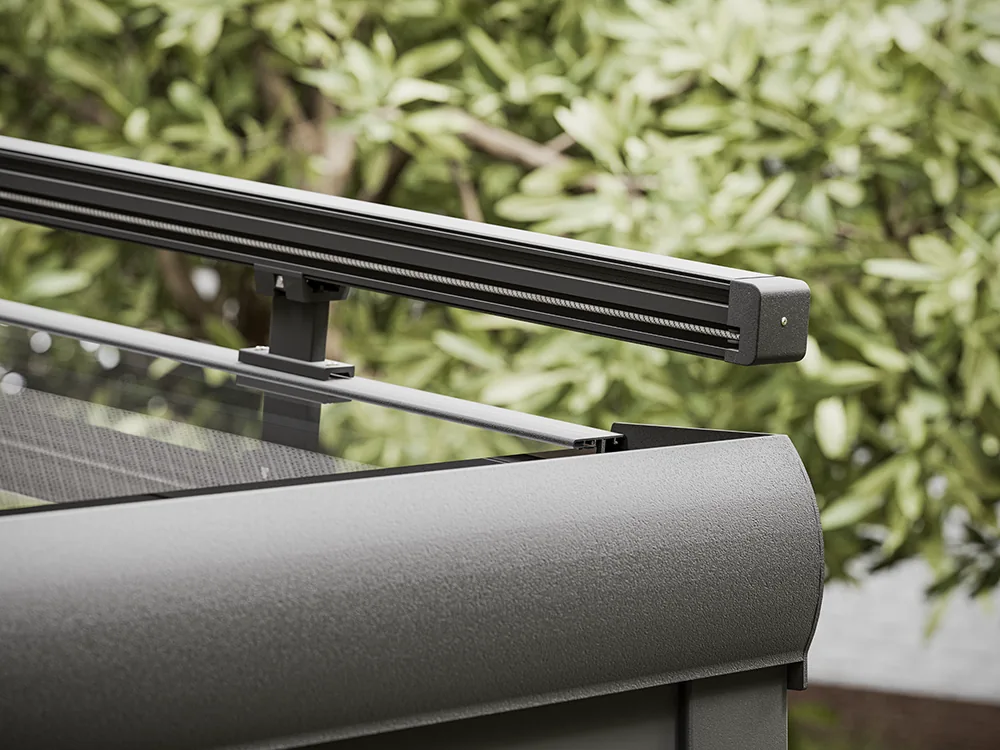
Black aluminium zip rail and headbox end cap at the edge of a glass-roof terrace
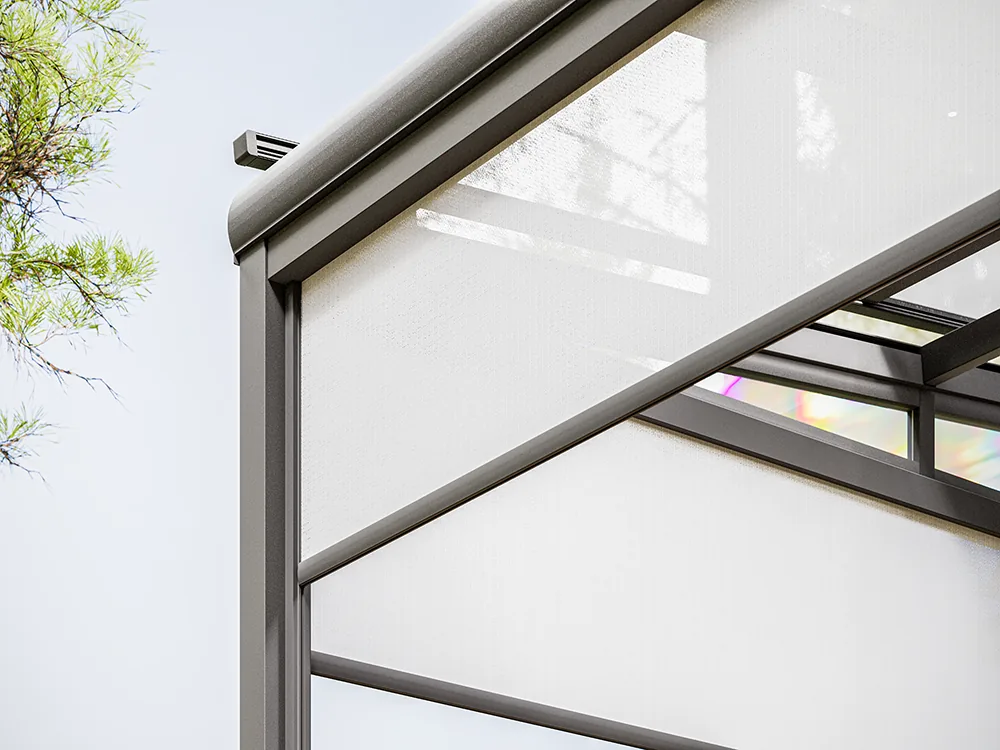
Dark aluminium post and rail profile holding a white vertical zip screen under a glass roof
Motor or manual
A motor can be driven from a remote or from a phone, runs quietly, and can sit in a smart-home routine so the screen moves with the time of day or the weather. A manual drive costs less but is not advised for large openings, where the fabric is heavy to handle. Wide commercial terraces should be motorised.
Installation sequence
- Survey the opening and select the profile system.
- For motorised units, complete the electrical connection.
- Fit the fabric, with its zip bead, into the side rails.
- Test the full travel, the stop positions and the motor.
Other places it is used
Beyond terraces and balconies, vertical zip screens are used at factory and warehouse entrances to keep out dust and weather, and at open pools, sports halls and event areas where wind and sun need managing.
Details on site
The photographs below show the parts described above as installed on glass-roof terraces.
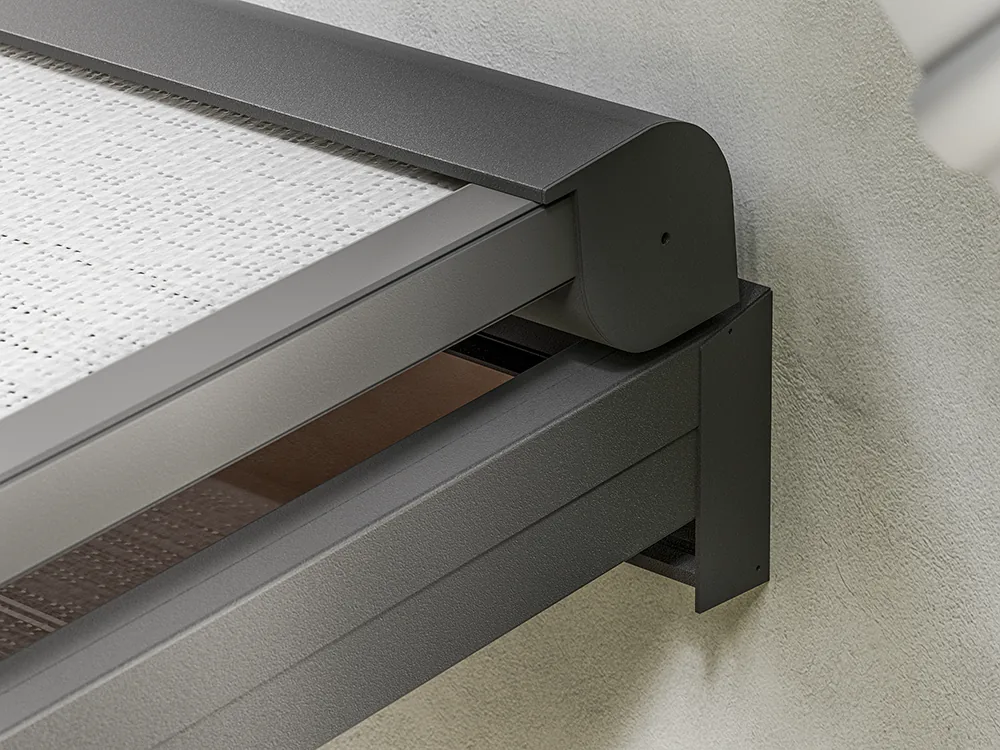
Dark aluminium headbox corner with translucent screen fabric visible beneath
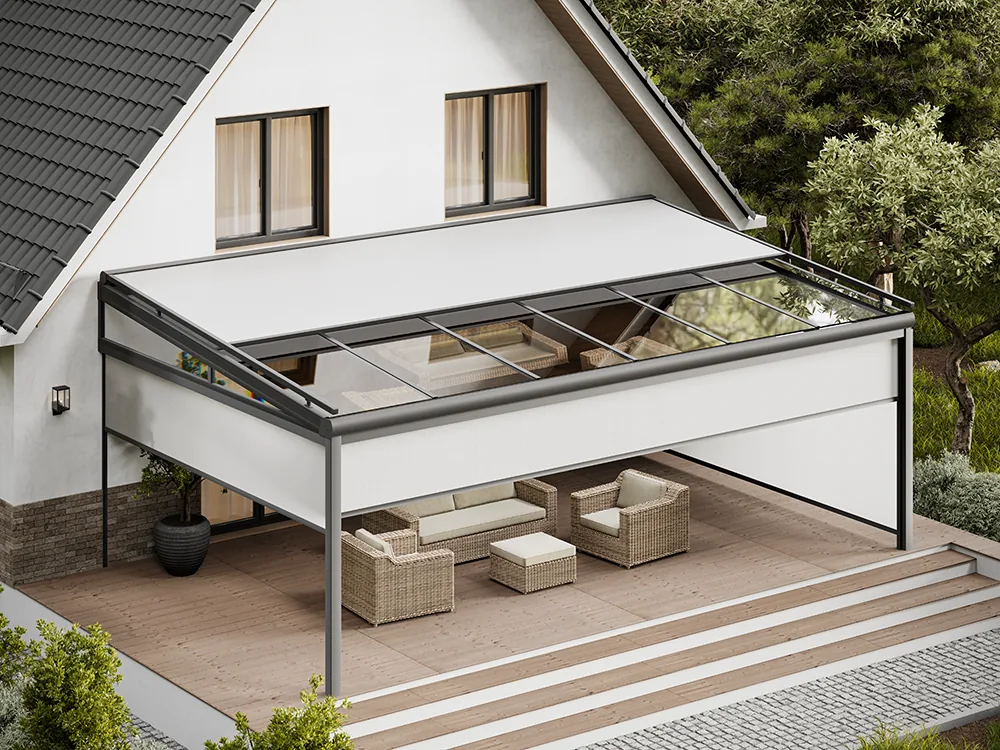
Vertical zip screen on a glass-roof villa terrace with rattan seating, seen in perspective
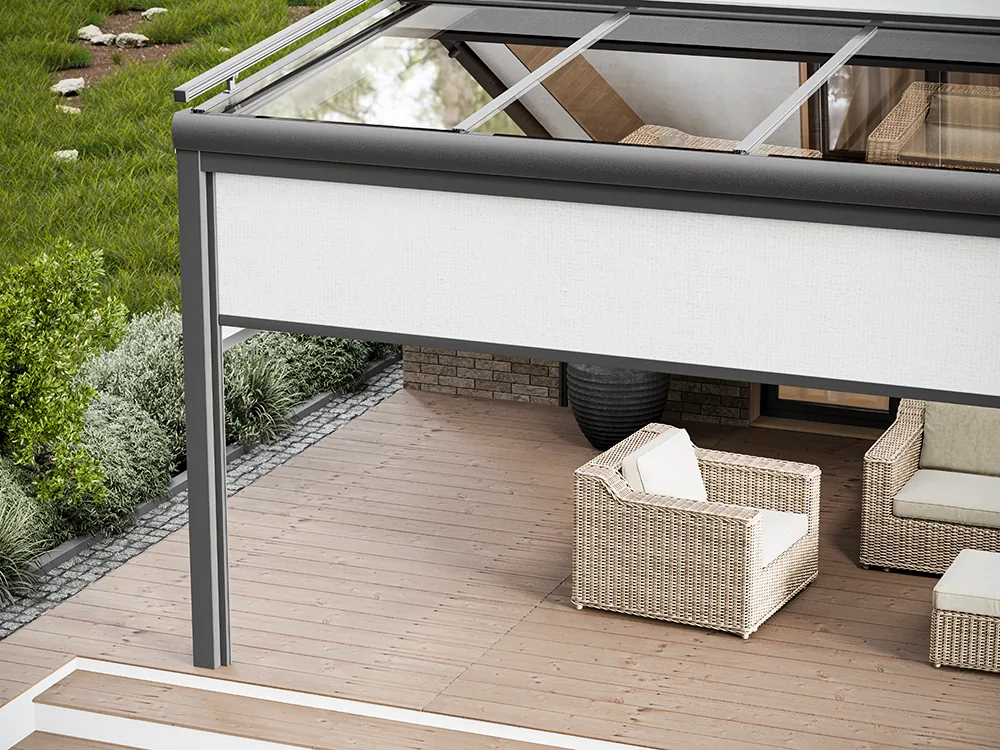
Light vertical zip screen lowered on the open side of a terrace with rattan lounge chairs
Specification overview
| Item | Vertical zip screen |
|---|---|
| Orientation | Vertical, in front of window, balcony or terrace opening |
| Fabric hold | Zip bead locked in side rails on both edges |
| Fabric types | Waterproof, UV-protected PVC with clear window panels, or screen fabric |
| Operation | Motorised or manual; Somfy motor options; optional wind sensor |
| Main benefits | Wind resistance, rain and insect barrier, energy saving, airflow control |
| Housing and rails | Aluminium headbox and side rails |
| Wind reference | Typically quoted up to 90 km/h; confirm per size |
| Sizing | Made to measure; wide spans engineered with the manufacturer |
| Pricing | Quoted per project by size and fabric; dealer terms available |
Project example: villa terrace in Mersin
One reference installation is a residential villa terrace in Mersin, on the Mediterranean coast of Türkiye. The terrace had façades that took the wind directly, which made the space awkward to use even in mild months. Waterproof vertical zip screens were fitted to those exposed sides, so the owner can close them when the wind rises and open them on calm evenings.
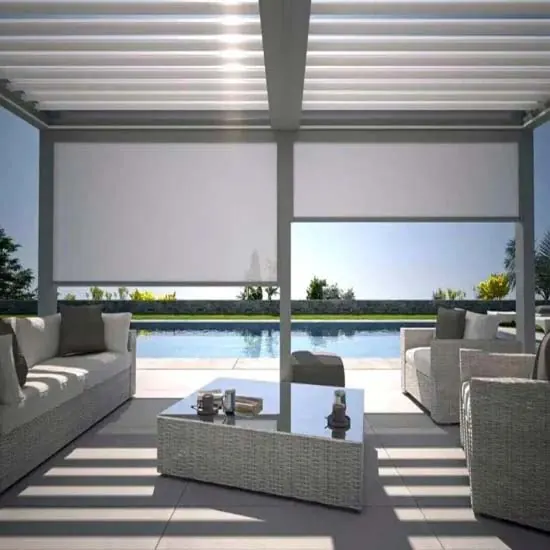
Villa terrace pergola with vertical zip screens lowered beside a swimming pool
Where it is not the right tool
Be honest with the end customer about the limits:
- A zip screen is not a thermal wall. It reduces draughts and wind, but fabric does not insulate like glass. For a heated, year-round room, look at guillotine glass or a winter garden.
- It is not a roof, as noted above.
- It should not be left down in a storm or heavy wind. Automatic wind retraction is the safeguard.
- A very wide opening may need a mullion or a split into several screens.
Part of a wider range
Vertical zip screens sit inside the broader zip screen range, next to ceiling zip screens for glass roofs and skylights. A combined layout, with a pergola or glass roof overhead and zip screens on the sides, gives a terrace that can be closed on all four sides.
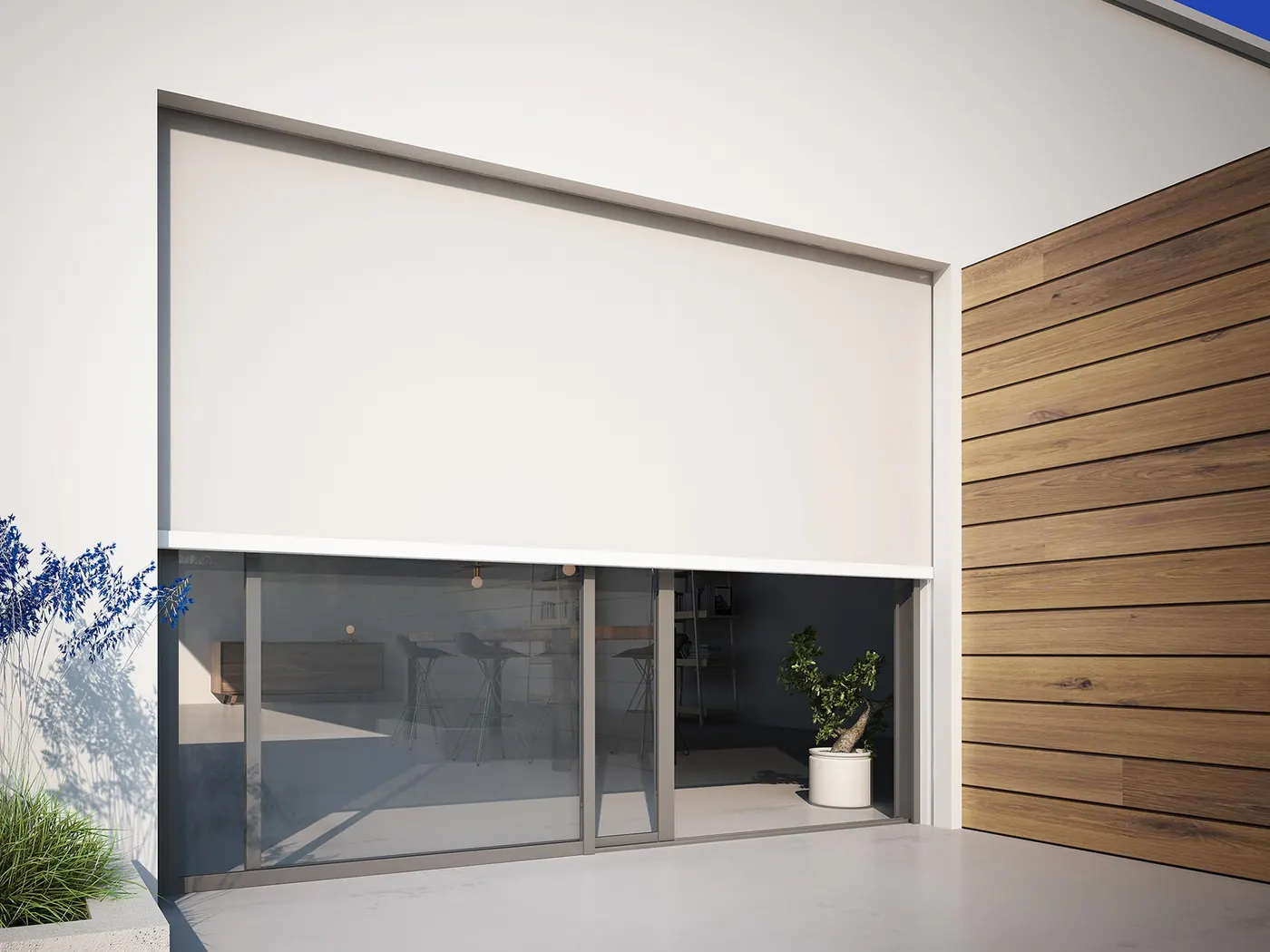
Large vertical zip screen above a sliding glass door on a modern white facade
Frequently Asked Questions
What makes a zip screen more wind-resistant than a normal roller blind?
The fabric edges are locked into side rails by a zip bead, so the screen is held along its full height instead of hanging free. It cannot belly out or pull loose from the guides in gusts. Exact wind ratings depend on the size, fabric and rail design, so ask for the figure for your configuration.Can I see through the screen when it is closed?
Yes, if you choose a fabric with clear window panels. Screen (mesh) fabrics also let you see out while limiting how much people outside can see in. Fully opaque fabrics are available for privacy.Can a vertical zip screen be added to an existing building?
Usually yes. It is mounted on the facade, the pergola frame or the structure around the opening, so it works as a retrofit, provided the surrounding structure can carry the rails. Send dimensions and photos with your enquiry so the manufacturer can check feasibility.Is the screen motorised?
It can be motorised or manual. Motorised operation, with optional wind sensing, is recommended for restaurants, hotels and any installation that is not supervised constantly.How are prices set?
Prices depend on the opening size and the fabric type, and are quoted per project. The manufacturing partner offers dedicated terms for dealers and project buyers.Request a quote with your opening dimensions, fabric preference and destination country.
Related: Zip screen overview · Ceiling zip screens · How to choose a zip screen · Zip screen fabrics · Motorization