Ceiling Zip Screens: Motorised Roof Shading for Skylights
Last updated:
A ceiling zip screen is a motorised shading screen that runs along a roof or sloped opening instead of down a wall. Its fabric is locked into side rails by a zip profile, so it stays flat over glass roofs, skylights and pergola tops while blocking sun, wind-driven rain and dust.
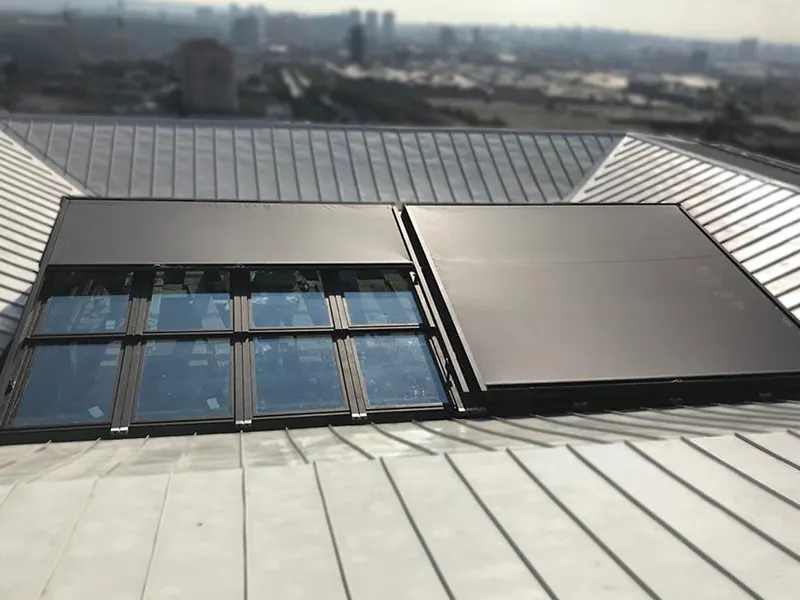
Two ceiling zip screens covering roof windows on a sloped metal roof
What makes it different from a vertical screen
The working principle is the same as on a facade: fabric edges carry a zip bead that travels in a channel along both sides, and the bottom (here the leading) bar pulls the fabric out under tension. The difference is the direction of travel. A vertical screen drops under gravity and the fabric hangs in a plane; a ceiling screen runs flat or on a slope, so gravity pulls the fabric down into a sag rather than keeping it straight.
That is why the product is its own category. The rails, the tension arrangement and the fabric stiffness are chosen for horizontal or inclined work, and the screen has to remain flat across the whole span rather than only at its edges. A loose, hanging blind in this position would bag, gather water and flutter. A tensioned zip screen avoids all three, and the fabric does not rattle against the structure when wind blows across the roof.
If you want the standard model breakdown first, read zip screen models; the underlying mechanics are in zip screen technology. This page covers what is specific to overhead use.
Where ceiling zip screens are used
Overhead screens belong wherever a roof is glazed or open and the sun is the problem:
- Winter gardens and glass roofs. Full-glass roofs trap heat. A screen mounted over the glass stops solar radiation before it enters the room, which is far more effective than an interior blind.
- Skylights and roof lights in offices, atria, showrooms and hotel lobbies, where glare on screens and floors is the complaint.
- Pergola and canopy tops that need a fabric roof, either fixed in summer or as a second layer beneath louvres.
- Sloped openings and lean-to roofs, where a flat fabric has to follow the angle of the structure.
- Restaurant and hotel terraces that want shade and some rain protection without building a solid roof.
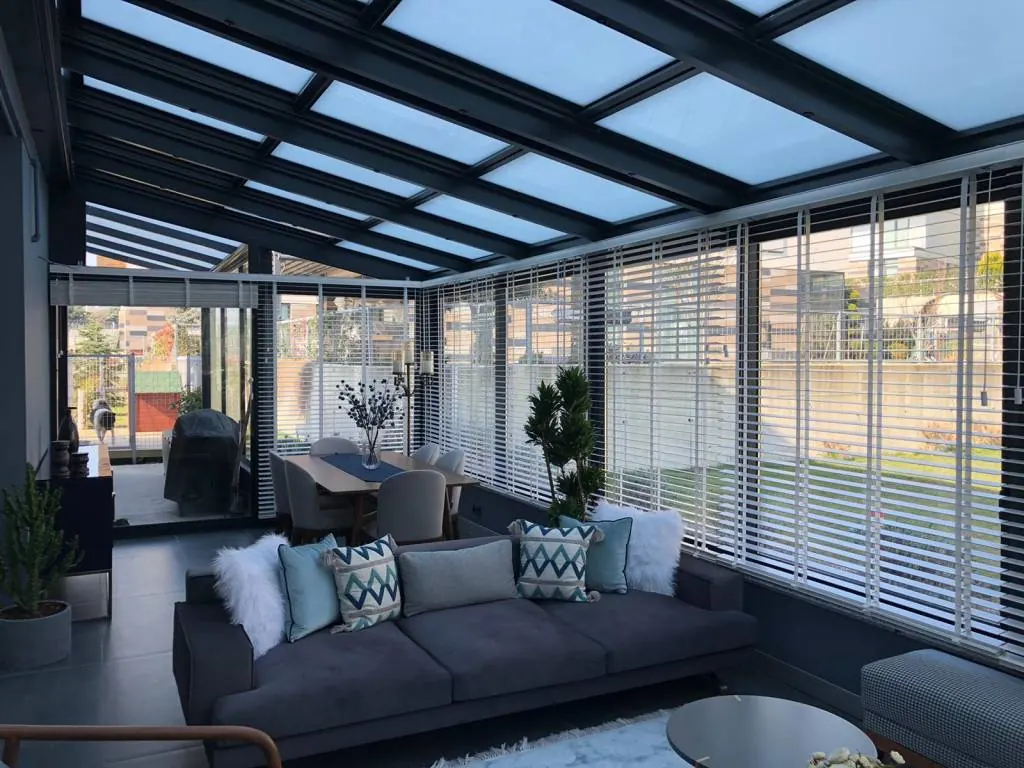
Winter garden with glass roof and blinds, a typical space needing roof shading
For a glass-roofed terrace, the usual combination is a ceiling screen overhead and vertical zip screens on the sides. See vertical zip screens for the facade part of that setup, and glass roof systems for the roof itself.
Materials and fabric choices
The manufacturer produces ceiling zip screens with three fabric families:
- PVC for waterproof coverage and easy cleaning.
- Acrylic for a textile look and good colour stability under sun.
- Technical outdoor textiles designed for high exposure, with weave and coating tuned for UV and weather.
Beyond protection from wind, rain, sun and dust, a fabric roof also adds privacy. A screen drawn over a terrace stops neighbours and passers-by on higher floors looking down into the space, which is relevant for rooftop restaurants and urban villas.
Operation
Ceiling screens can be supplied motorised or manual. For roofs the practical answer is almost always motorised, because the screen is out of arm's reach and long spans are heavy to drive by hand. Motor options from established brands, including Somfy, are available. Sun and wind sensors can be linked so the screen extends when the glass roof overheats and retracts when gusts rise; see motorization for the control options.
Specification overview
| Item | Ceiling zip screen |
|---|---|
| Orientation | Horizontal or sloped, over roofs, skylights and pergola tops |
| Fabric hold | Zip profile locked in side rails |
| Fabric types | PVC, acrylic, technical outdoor textiles |
| Operation | Motorised or manual; sensors optional |
| Protection | Wind, rain, sun, dust; added privacy |
| Behaviour in wind | Fabric stays taut and quiet |
| Sizing and price | Made to measure; quoted per project, dealer terms available |
Planning points for installers and specifiers
Several details decide whether an overhead screen performs well, and they should be settled before the order, not on site:
- Slope. Give the roof pitch. Flat and steeply inclined openings load the rails differently, and a very shallow pitch needs attention to drainage so that water does not pool on the fabric.
- Span and length of run. The longer the run, the more engineering the rails and drive need. Large roofs may be split into several screens with a divider rather than made as one.
- Mounting surface. The rails need a solid frame, such as steel, aluminium or the glass-roof structure itself, and the load path should be checked by the manufacturer.
- Access for service. Place the cassette where motors and fabric can be reached without scaffolding.
- Fabric against use. Match cleaning and fire-performance needs to the building type, especially for public spaces.
Limits to state clearly
A ceiling zip screen is a shading and weather-reduction layer. It is not a watertight roof, and it does not insulate like glass or a panel roof. In heavy rain, snow or strong wind the screen should be retracted or protected by automation, and in snow-load regions the underlying roof does the structural work. Customers who want a fully sealed, heated space need a glass roof and guillotine glass; for a fully flexible open-air solution, a bioclimatic pergola is the alternative. A comparison is in terrace enclosure methods.
Frequently Asked Questions
What is a ceiling zip screen used for?
It shades and shelters roofs, skylights, glass roofs and sloped openings. The fabric is held in zip rails so it stays flat, reducing solar heat and glare and protecting from wind, rain and dust.Is a ceiling zip screen waterproof?
It depends on the fabric. PVC and coated fabrics shed water, but the screen is a weather-reduction layer, not a sealed roof. Tell the manufacturer the roof pitch so drainage is considered, and retract the screen in heavy rain or snow.Can it be fitted over an existing glass roof?
In many cases yes, if the structure can carry the rails. Send dimensions, the roof angle and a few photos with your enquiry so the manufacturer can confirm the fit.Motorised or manual?
Both exist, but motorised drives are recommended for roofs because of reach and span. Sun and wind sensors can be added so the screen reacts without staff.How do I get a price?
Prices are set per project from the dimensions, fabric and drive. The manufacturing partner quotes dealers and project buyers directly.Request a quote with the roof dimensions, slope and fabric preference.
Related: Zip screen overview · Vertical zip screens · How to choose a zip screen · Glass roof systems · Zip screen fabrics