Zip Screen Fabric Collection: Solid, Opaque and Mesh Colours
Last updated:
The fabric collection for our manufacturing partner's zip screens is organised into solid colours, opaque (blackout) colours and mesh weaves, each with its own light, privacy and view behaviour. Choosing the family first, then the colour, avoids most mistakes. This guide explains how to read the collection and what to check on the datasheet.
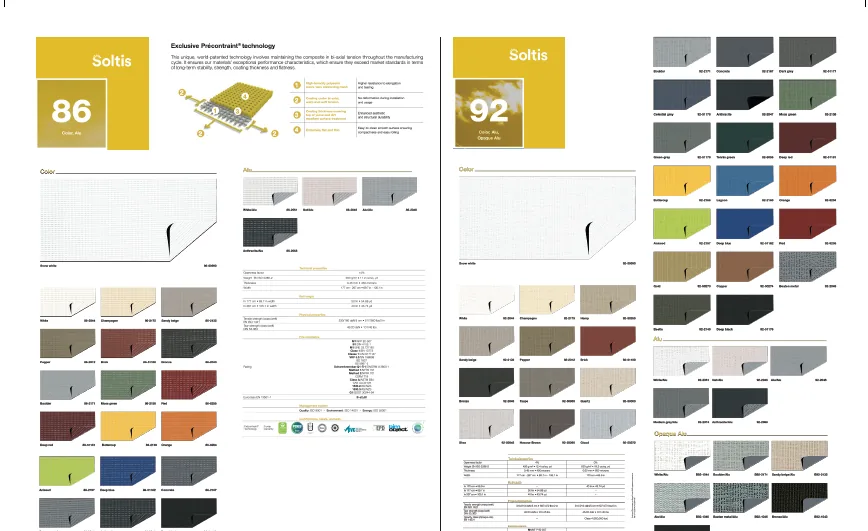
Fabric catalogue pages showing solid and opaque colour swatches for outdoor zip screens
Fabric is a technical part, not a curtain
Search results for "zip curtain fabric" are full of advice about cotton, linen, satin and organza. Those textiles belong to indoor curtains. An outdoor zip screen fabric carries sun, wind load, rain and thousands of open-close cycles, so it is a coated or woven technical textile, supplied as a roll and welded or finished to take the zip bead at its edges.
Indoor-curtain ideas still carry over in a few ways. The fabric has to stay flexible so it rolls and moves smoothly in the rail. It has to resist creasing and keep its shape. It has to cope with repeated opening and closing without losing integrity. And it must be weighed against how much light you want to pass, how much privacy you need and how easy the surface is to clean.
For the performance side of the question, such as openness factors and fire classes in detail, read the existing zip screen fabric guide. This page is about how the collection is structured and how to choose within it.
The three families
Solid colours
Solid colour fabrics are the broad base of the collection. They are woven or coated in a single colour and are normally mesh-type, meaning they filter light and keep the outside view. Neutral tones such as white, sand, grey and anthracite are the safest choices for commercial projects because they sit well against most facades and hide dirt in different ways: light colours reflect more heat, darker ones give better glare control and a cleaner view outwards.
Opaque colours
Opaque fabrics, also called blackout, close the surface so light does not pass. They are used where privacy or full darkness is the point, where a hard shade line is wanted over a seating area, or where a facade must be screened completely. The trade-off is the loss of outward view and, in some cases, less air movement than a mesh, so they are used on part of a building rather than all of it.
Mesh weaves
Mesh weaves have small openings that filter sun but let people see out. In the manufacturer's facade range, mesh is described as having about 3% to 10% openness, and for vertical screens a figure of up to 5% is stated. Lower openness means a darker, more private screen; higher openness means more view and light. Mesh is the standard choice for restaurants, hotel terraces and anywhere guests should keep their sight line.
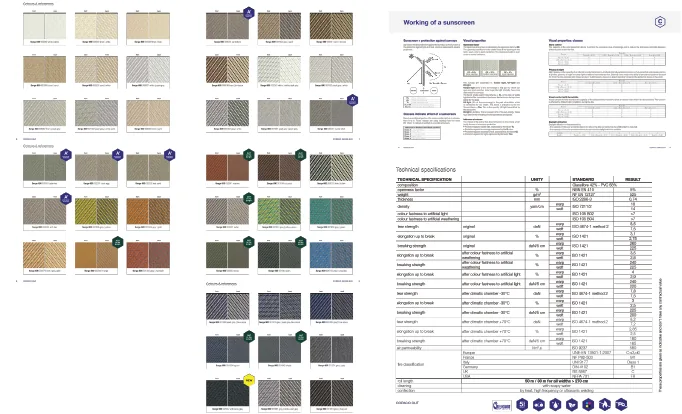
Fabric catalogue page with technical specifications and colour swatch grids
What the catalogue pages show
The collection pages include two kinds of information. The first is the colour grid: each swatch is labelled with a name and reference number, so an order can be written precisely. The second is the technical specification table. Typical entries cover composition, openness factor, weight, thickness, colour fastness to light and weathering, breaking and tear strength, elongation, air permeability and fire classification.
Treat the table as the decision document, not the swatch. Two fabrics of the same colour can differ in openness, weight and fire class. When you request a quote, quote the reference number, not only the colour name.
How to choose, step by step
- Decide the main job. Is it shade, privacy, insect protection, view or all four? Rank them.
- Choose the family. Mesh when view matters; opaque when privacy or darkness matters; a mix across different openings if needed.
- Choose the openness. Within mesh, lower openness for more shade and privacy, higher for more view.
- Choose the colour. Check against the facade, the frame colour and the view from inside. Neutral tones are forgiving.
- Check the datasheet. Fire classification, colour fastness and strength should meet the building type and local rules.
- Order swatches. Colour on a screen is only a guide; judge it in daylight, mounted vertically.
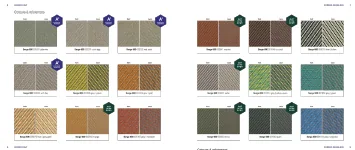
Fabric swatch chart with woven outdoor fabric samples in warm and cool colours
Properties buyers ask about
- Breathability. The manufacturer describes its fabrics as breathable, so air circulates through the weave and the space under the screen does not turn stuffy.
- Privacy. In daylight a mesh is designed so people inside see out while those outside cannot easily see in. At night, with lights on, that relationship can reverse, so use opaque fabric where night privacy matters.
- UV and heat. The fabric filters UV, which protects furniture from fading and reduces the heat load behind glass.
- Noise. The manufacturer states that zip screens reduce outside noise indoors somewhat. Do not treat the screen as an acoustic barrier.
- Replacement. If the fabric is damaged it can be replaced without replacing the rails or housing.
Care in a few lines
Brush off dust when the fabric is dry, wash with a mild soap solution and a soft brush, rinse with clean water and let it dry before rolling it up. Avoid solvents, bleach and pressure washers. More detail is in the installation and maintenance guide.
Matching fabric to the product
| Product | Typical fabric thinking |
|---|---|
| Vertical and facade screens | Mesh for view and shade; opaque on private sides |
| Sky 1500 spring ceiling screen | Fabric chosen for roof exposure and shade level |
| Sky 1600 shock-absorber ceiling screen | Breathable fabric for privacy and insect protection |
| Pergola-integrated screens | Colour matched to the pergola frame |
Frequently Asked Questions
Can I use cotton or linen for an outdoor zip screen?
No. Natural-fibre curtain fabrics are for interiors. Outdoor zip screens use technical textiles built for UV, wind and weather.How do I choose between mesh and opaque fabric?
Choose mesh when guests or residents should keep the view and a gentle shade is enough. Choose opaque where privacy, darkness or a complete screen is more important than the view.Are colours matched across batches?
Fabric comes from dye lots, so small shade differences are possible between batches. Order all fabric for one elevation together and ask for the reference number.Can fabric be changed later?
Yes. Damaged or tired fabric can be replaced while the rails and housing stay in place.Do I need a fire classification?
For hotels, restaurants and public buildings you usually do. Ask for the fire classification on the datasheet and check it against local rules.Request a quote with the fabric reference, or ask for swatches by project.
Related: Zip screen fabric guide · Outdoor facade zip screens · Zip screen model range · Selection guide · Zip screen overview