Awning Models and Prices: What Drives the Cost
Last updated:
Awning prices depend on the model, the size, the fabric class, the motor and sensor package, and the mounting conditions. There is no single price list, because every unit is made to measure. This guide explains how each factor moves the cost so you can compare quotations honestly.
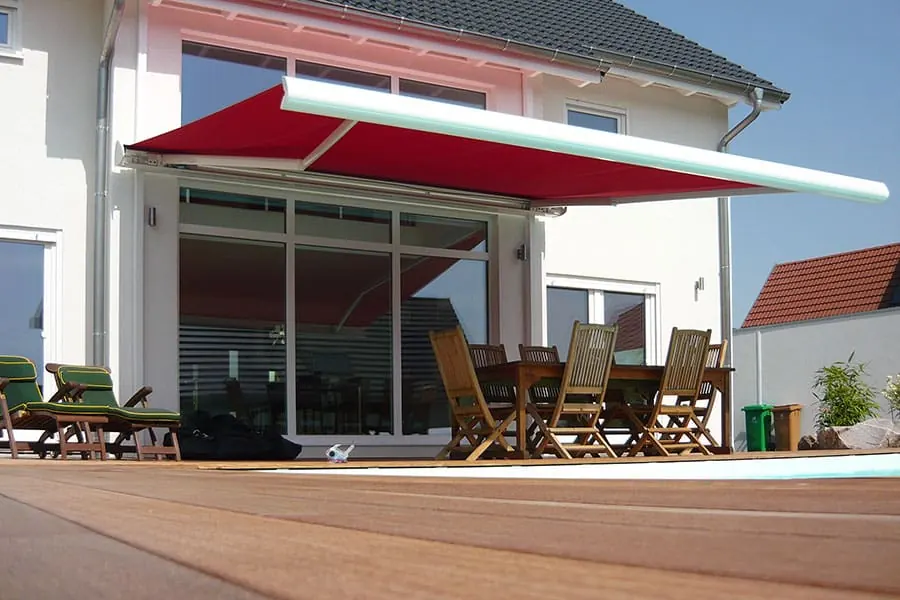
Red folding-arm awning extended over a house terrace and pool deck
One word, several products
An awning is the fastest and most economical way to create shade, but "awning" is not one product. A wrong choice of model gives you one of two outcomes: fabric that ages early, or a system that cannot be used when the wind blows. As the manufacturer's trade partner we see both. The sections below describe each model and where it sits on price and service life.
No price figures are given here. Prices are set per project, based on the dimensions and options you send, so the useful comparison is relative: which model costs more to buy, which costs less to own, and why.
Model by model
Folding-arm (articulated): the economical classic
The folding-arm awning extends forward on jointed arms. It is the most common model and the standard for balconies and storefronts. It is the best value for wide spans because the arms and roller are a simple, proven construction.
The trade-off is that the fabric stays exposed when the awning is closed. Its service life is therefore shorter than a cassette awning's, particularly in strong sun, dust or rain. See the articulated awning page.
Cassette: built to last
In a cassette awning the fabric and arms retract into an aluminium housing, protected from rain, dust and sun. The purchase price is higher than for an articulated unit. Fabric life is significantly longer, which lowers the total cost on facades that are used heavily. See the cassette awning page.
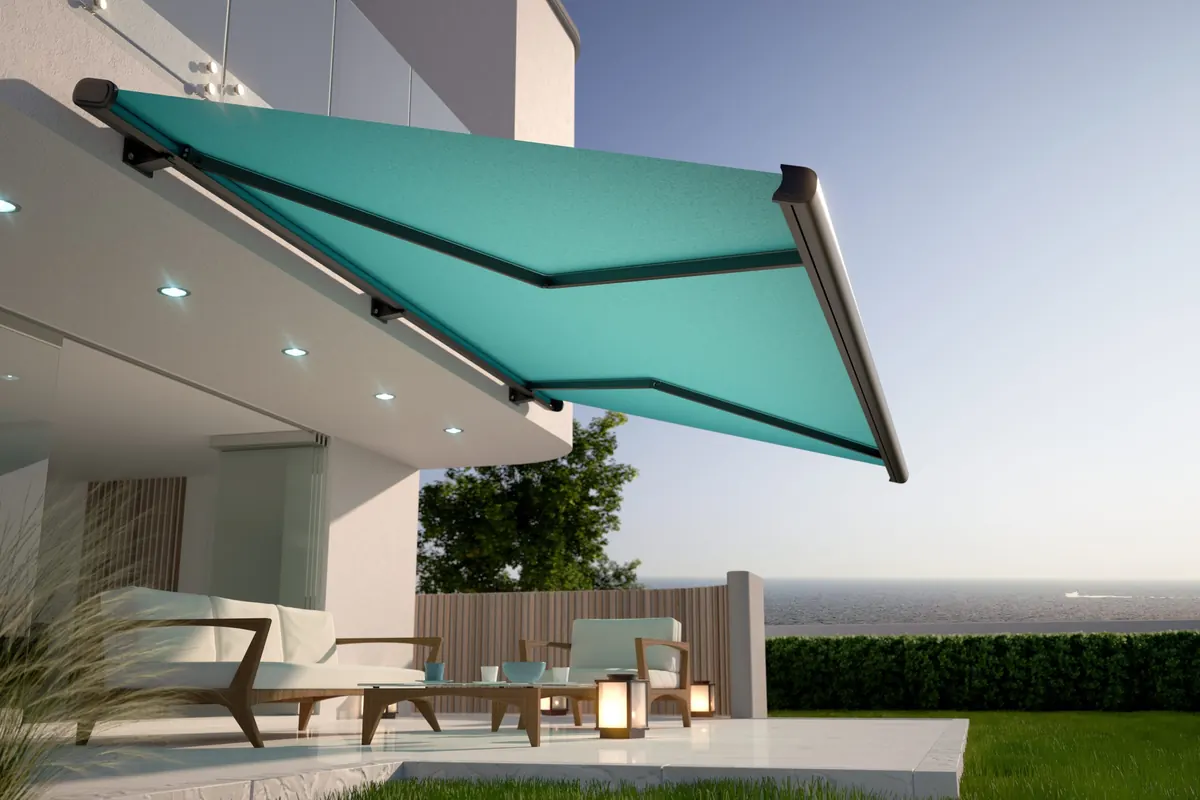
Teal cassette awning extended over a terrace with lounge furniture and recessed lights
Motorised and automatic: comfort and protection
Motorised systems run from a remote or from sensors. A wind sensor retracts the awning automatically in rough weather. A sun sensor extends it as the temperature rises. Motorisation also extends the life of the mechanism, because it replaces uneven manual opening and closing, which is a common cause of mechanical wear.
The motor, sensors and any lighting add to the cost, but for commercial terraces they often prevent more expensive damage. See the automatic awning page.
Track-guided and oval: special forms
A track-guided awning tensions the fabric horizontally along rails and forms a canopy similar to a pergola. An oval awning gives a storefront or facade a distinctive rounded form. Both are made to measure, so there is no standard size to compare against, and the quotation depends on the drawing. See the oval awning page.
Shade and Wintent: practical extremes
The shade awning comes as fixed or retractable shade over terraces, gardens and balconies. Wintent is a modular window-level shade. Both are sized per project, and both sit at the practical end of the range for specific uses.
Relative comparison
| Model | Purchase price | Fabric life | Best use |
|---|---|---|---|
| Folding-arm | Lowest of the arm types | Shorter, fabric exposed when closed | Wide balconies, shopfronts, budget projects |
| Cassette | Higher | Significantly longer | Heavily used facades, visible fronts |
| Motorised / automatic | Higher with motor and sensors | Mechanism life extended | Hotels, restaurants, daily use |
| Track-guided | Project-based | Depends on fabric | Pergola-like canopy over a terrace |
| Oval | Project-based | Depends on fabric | Storefronts, entrances, brand presence |
The table is a relative guide, not a price list. Two quotations for the same model can differ widely when fabric, frame or motor choices differ, so always compare like with like.
What sets the price
- Size and model type. Width times projection drives the quantity of fabric, profile and arms. Wider and deeper units need heavier components. Model type then sets a base level.
- Fabric class. Acrylic, PVC and screen fabrics differ in fade resistance and water resistance, and they differ in cost. A cheaper fabric on a sunny facade can cost more in the long run if it fades or fails early.
- Motor and sensor package. A manual crank is the lowest cost. A motor with remote control adds cost, and wind and sun sensors, smartphone control or lighting add more.
- Mounting height and facade conditions. Installation at height needs access equipment, and some facades need special brackets or reinforcement. Poor substrate also changes the specification.
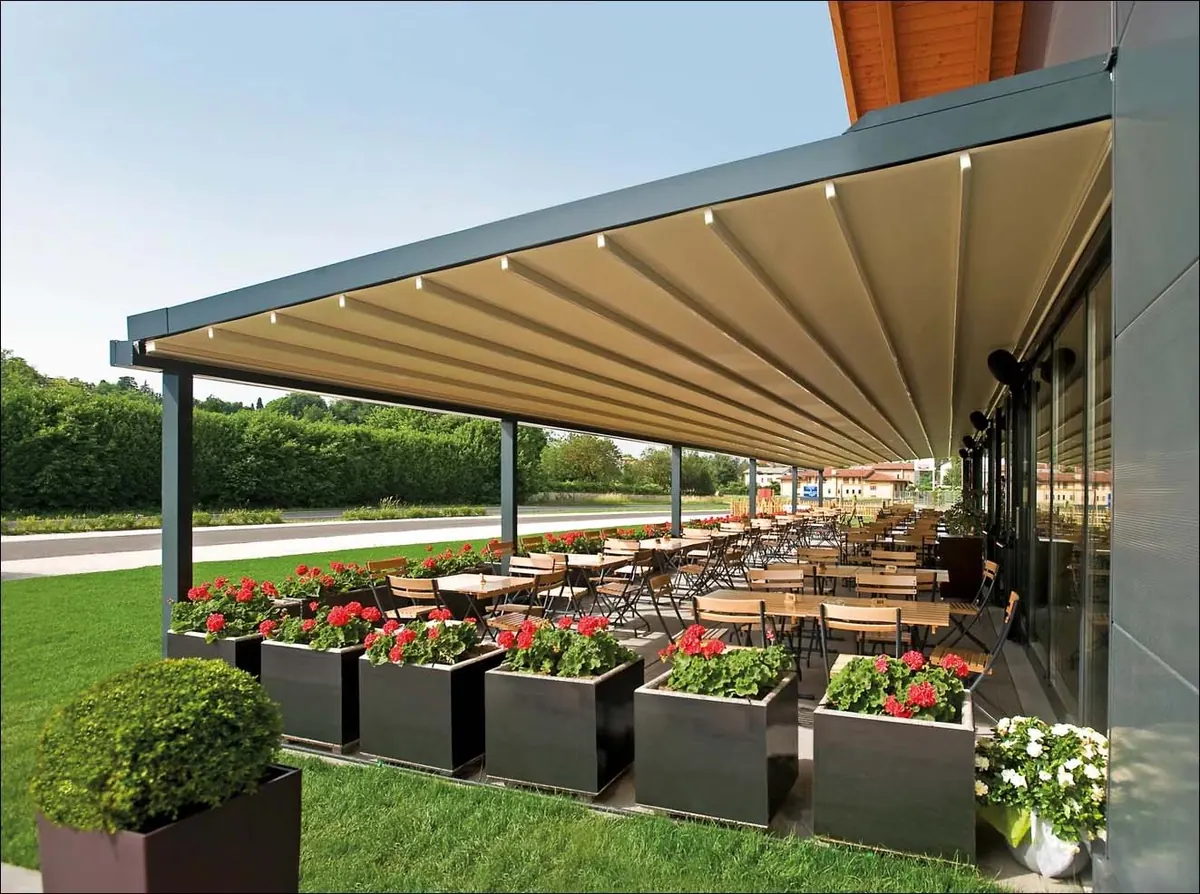
Bronze fabric canopy over a restaurant terrace with tables and flower planters
Beyond these four, frame material (aluminium or stainless steel), colour choices, quantity and shipping destination affect the final price. Larger orders for distributors or contractors usually allow better planning of production and freight, so state the full quantity at enquiry stage.
Total cost: the real comparison
A buyer who compares only the purchase price will often choose the folding-arm awning, and for many sites that is the right decision. But look at three points before you decide.
- Replacement cycle. If fabric needs replacing sooner because it is exposed, the saving on purchase price shrinks.
- Labour. Replacing fabric on a high facade needs access equipment and installers. Fewer replacements mean less of that cost.
- Damage risk. A motorised awning with a wind sensor is less likely to be torn by an unattended gust. Where staff cannot watch the weather, the motor package pays for itself in avoided repairs.
Choosing by situation
- Tight budget, wide span, mostly sheltered site: folding-arm, manual or motorised.
- Busy storefront, visible every day: cassette, ideally motorised.
- Hotel or restaurant terrace, variable weather: automatic with wind sensor, and lighting if evening service matters.
- Facade where look is part of the brand: oval, made to measure.
- A window or a row of windows: Wintent.
- Garden or poolside seating: shade awning, fixed or retractable.
How to request a comparable quotation
If you send the same information to every supplier, you can compare the answers. Provide:
- Width and projection of each unit.
- Mounting surface, height and type of facade.
- Fabric class and colour.
- Manual, motor, remote, smartphone control; sensors and lighting.
- Quantity and destination country.
Terms to settle before ordering
Beyond price, check three commercial points with any supplier. First, what the quotation includes: fabric, frame, motor, sensors and brackets, and whether installation and freight are excluded. Second, the lead time for made-to-measure units, since oval and track-guided models usually need a drawing stage. Third, spare parts: ask whether replacement fabric and motors can be supplied later, and keep the project reference for reordering. Distributors who order several units at once should also ask about packing and consolidated shipping, as awnings are bulky once the housings and arms are packed.
Frequently Asked Questions
Why is a cassette awning more expensive than a folding-arm awning?
It includes a full aluminium housing around the fabric and mechanism. That adds material and manufacturing work. In return the fabric is protected and lasts significantly longer.
Does a motor really extend awning life?
Yes. A motor operates the awning evenly and removes the uneven manual opening and closing that wears the mechanism. Sensors add protection against wind damage.
Which fabric class should I choose?
Acrylic, PVC and screen fabrics differ in fade resistance and water resistance. Choose by climate and use, and ask for samples before the client approves colours.
Can you give a price without dimensions?
No. Size, fabric and motor package set the price, so a quotation starts from your measurements.
How quickly can I get a quotation?
Send width, projection and the options you want through the quote form. The manufacturer provides a factory price based on that information.
Related: Awning systems overview · Cassette awning · Articulated awning · Bioclimatic pergola prices · Export and project supply