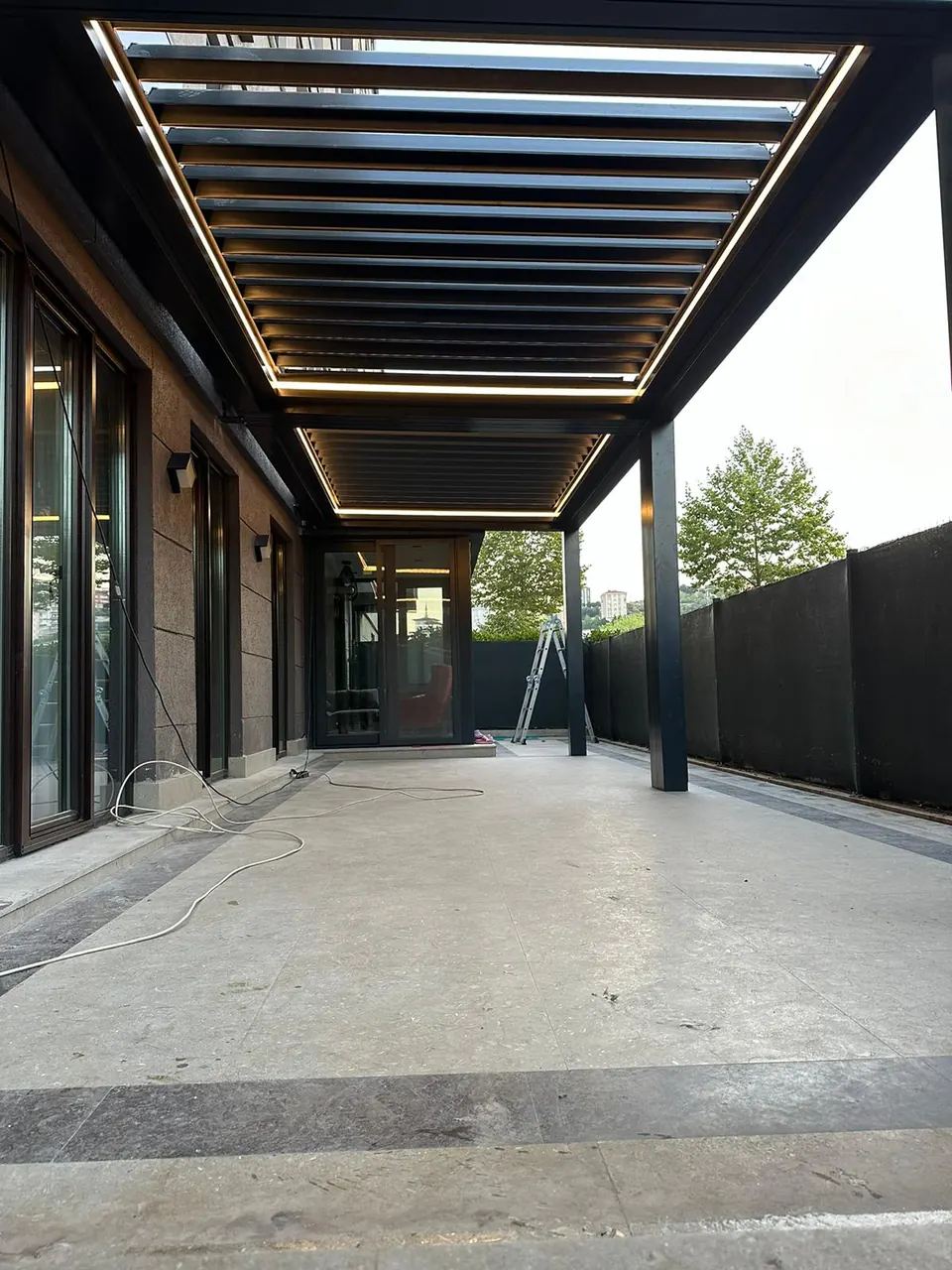
Pergola Accessories: LED, Heaters, Sensors
A bioclimatic pergola can take lighting, heating, sensors and side enclosures, but each accessory needs a power supply, a control point and a mounting detail decided at the order stage. Choosing them late means retrofitting cables after the posts are powder-coated and the louvres are already turning above the terrace.
Which accessories can a bioclimatic pergola take?
The accessory list published by the makers we source from is short and specific: in-channel LED lighting, electric heaters, rain and wind sensors, remote and app control, side zip screens, and sound systems as an option. Side closures also include guillotine glass and sliding glass, which are systems rather than accessories but are specified in the same conversation. The pages behind each item — the bioclimatic pergola overview and the zip pergola page — describe what the structure supports.
Three principles apply to every item on the list:
- Decide at order, not after. Cable routes run inside the posts and beams; a control point that does not exist when the frame is cut cannot be added cleanly later. Accessories named in the enquiry travel with the structure.
- Accessories share one control system. Lighting, heaters, sensors and side screens are designed to sit on the same control unit, so a terrace switches from lunch service to evening service with one command rather than four.
- Availability is per model. Not every accessory fits every configuration — the honest position is that the producer confirms which options apply to the system you are buying, on the quotation, in writing.
Accessory table
Table A: accessory, function, integration point, power/wiring consideration, planning note
| Accessory | Function | Integration point | Power / wiring consideration | Planning note |
|---|---|---|---|---|
| LED strip in the louvre or beam channel | Even perimeter light for evening service without roof-mounted fittings | Control unit; dimmer or RGB as an option on published systems | Low-voltage feed routed with the motor wiring; supply point sized with everything else | Fix colour temperature and control type at order; the strip is built into the channel, not added later |
| Spotlights | Directed light on tables or a walk line | Same lighting circuit or a separate switched group | Extra fixed points on the structure; cabling decided with the frame | Agree positions against the layout plan, not after furniture is placed |
| Electric heaters | Extend usable season into colder evenings | Shared control system; often switched by group | Dedicated supply sized for the heater load, separate from the lighting circuit | Follow the heater maker's clearances and ventilation advice — no distances are quoted here; mounting is to the structure as specified |
| Rain sensor | Closes the roof automatically when moisture is detected | Control unit, commands the drive | Low-voltage sensor wiring back to the control point | Thresholds are programmed at commissioning; agree them with the operator so a light shower does not shut the terrace |
| Wind sensor | Protects the drive in gusts; can retract screens in self-protection | Control unit, commands roof and screens | Sensor wiring; exposed sites should have it specified for the screens too | Set the limit at commissioning with the operator; the sensor protects the mechanism, not the furniture |
| Remote and app control | Manual command without staff going to the post | Control unit | None beyond the control point already present | Hospitality projects usually treat a remote as the baseline and app control as the addition |
| Side zip screens | Close the vertical openings against wind, low sun and insects | Same control system as the roof | Motor wiring per screen, routed in the posts | Specify wind sensing for the screens whenever the site is exposed |
| Guillotine / sliding glass | Full glass closure that still opens | Separate system, coordinated at the design stage | Power where the system is motorised | Decide glass and screens together: the two must not fight for the same opening |
| Sound systems | Music or announcements on the terrace | Option in the maker's range, integrated with the control conversation | Supply point and speaker positions decided with the frame | Confirm at RFQ stage; not every model carries it |
Lighting
The published systems put the lighting inside the channel: a low-voltage LED strip along the louvre or beam, so the roof throws light down the perimeter instead of carrying fittings on its face. Two options decide how the terrace reads after dark — colour temperature, and whether control is simple switching, dimming or RGB.
For a hospitality buyer the planning questions matter more than the strip itself:
- Where does the light fall? Perimeter light suits circulation and a general wash; directed spots suit tables. Mixing the two on separate groups is what lets a restaurant move from a bright lunch to a low evening without changing bulbs.
- What does the operator actually use? A dimmer that nobody can reach from the service station is a specification failure. Put the control position in the plan.
- What has to match? Colour temperature against the interior it faces, and RGB only where it is genuinely wanted — a terrace that must look the same in photographs every evening does not need colour change.
Heating
Electric heaters mount to the structure and sit on the same control system, which is what makes a terrace usable into the colder months. Two rules keep the installation safe and honest:
- The heater maker's clearances govern. Distance to the louvres, to fabric, to heads and to any surface above is set by the heater manufacturer, and this page quotes none — the mount position is agreed from the heater datasheet at design time.
- Ventilation and use-pattern are part of the design. A fully enclosed terrace with heaters has to be thought about as an occupied volume: how heat leaves when the space is shut, where fresh air comes from, and who decides when the heaters run.
Sensors and automation
Sensors are what turn a roof that waits for staff into one that protects itself. The published logic is simple and worth specifying exactly:
- Rain. Moisture is detected, the closing command is sent, and the roof is sealed before the first guests are wet.
- Wind. Gusts are read, and once the set limit is passed the drive retracts or closes — protecting the mechanism. Screens can be tied in too, so heavy weather runs a self-protection mode across the whole terrace.
- Sun. Sun sensors appear across the same manufacturer's range on automatic awnings, extending them as the terrace heats; for pergolas the equivalent question is glare control by louvre angle, which is a manual or scheduled decision unless the project adds the sensor.
Side enclosures: zip screens, guillotine glass, sliding glass
A pergola closes the top; the sides are a separate decision with two families:
- Zip screens run fabric in a zipped guide against the posts, closing the openings against wind, low sun and insects while keeping the view. They belong to the same family as the terrace products on the zip blinds pages, and on an exposed site wind sensing for the screens should be specified with the roof's own wind sensor.
- Guillotine glass lifts its panels vertically, so a closed wall can be opened for service in seconds; the guillotine glass systems page covers the configurations. Sliding glass runs on tracks and suits long straight openings where panels should stack at one end.
Audio and other options
The maker's published range mentions sound systems as an option, integrated into the same equipment conversation as lighting and heating. Positions and supply belong with the frame, since speakers mounted after powder-coating mean exposed cable.
Everything else — misting, fans, sockets — is not part of the published accessory list for these systems, so the correct handling is the same as for any other option: name it in the RFQ and let the producer confirm availability for the specific model. A general guide that promises equipment the range does not carry costs a project more than an honest "not on this model" at quotation stage.
Electrical planning and commissioning
Accessories fail in the same two places: no power where they are needed, and no control point that anyone understands. Four steps prevent both:
- One electrical schedule for the whole terrace. Motors, lighting, heaters, sensors and any audio listed together with their supplies, so the supply point is sized once and correctly instead of being extended twice.
- Cable routes fixed with the frame. In-channel wiring for the lighting, sensor wiring back to the control point, motor wiring per screen — all of it decided while the posts are still open, not chased afterwards.
- Protection and grouping agreed with the electrician. Heaters on their own group, lighting switchable in scenes, sensors on the control circuit — written down, not left to site improvisation.
- A handover test list. Every accessory demonstrated: roof through its full travel, each sensor at its programmed threshold, each lighting group at each control setting, each screen run and held, remotes and app paired. Anything that fails is corrected before the first service, when it still costs an hour rather than a booking.
Frequently Asked Questions
Can accessories be added later?
Some can, most are cheaper at order. Anything with a cable — lighting, sensors, motorised screens — is cleanest when specified with the frame, because routes exist inside the posts and beams while they are still open. Standalone items can be retrofitted at a cost in cable and finish, so name everything in the enquiry even if you expect to confirm it later.
Do heaters damage the louvres?
Follow the heater maker's clearances and ventilation advice, which governs mounting position and distance — this page quotes no figures because they belong to the specific heater's datasheet, and the producer confirms the mount at design time. With the datasheet respected and the load properly supplied, heaters and louvres coexist; the risk comes from improvised mounting close to fabric or finishes.
Are rain sensors included?
They are an option on the published systems rather than a default, so confirm them in the RFQ. Worth specifying for any terrace where staff cannot close the roof personally — thresholds are programmed at commissioning, and the operator should own the final values, because a roof that reacts to every shower is worse than one that never closes.
Can the pergola be controlled by a smartphone?
Yes, on the published systems: remote, wall control and app control are available, with smart-home links where the project needs them. The control route is chosen at order stage, and hospitality projects usually start with a remote plus sensors and add the app for management. The details sit on the motorization page and the automation page.
What power supply is needed?
It depends on what you specify — motors, lighting, heaters and any audio each add load, and the correct answer is a single electrical schedule agreed with your electrician before production, not a figure quoted in isolation. Heaters dominate the load, which is why they normally sit on their own supply group; ask the producer for the load list for your configuration when the quotation is prepared.
Which accessories matter most for restaurants?
Rain sensing and wind sensing first, because they protect the roof without staff watching the sky; then lighting with dimming, because the same terrace must work at lunch and at night; then side enclosures on the exposed edges. Heaters follow where the season demands them. The ordering logic is the one on this page: decide at order stage, wire with the frame, and commission with the operator.
Sources and standards
- Accessory statements follow this site's published pergola pages — bioclimatic pergola, zip pergola and the piston and scissor system pages — which name in-channel LED lighting, electric heaters, rain and wind sensors, remote/app control, side zip screens and sound systems as an option, with accessories on a shared control system.
- Somfy is named as the motorisation and control route referenced on the group's homepage; no other product brands are claimed here.
- No wattages, ingress-protection ratings, heater throw distances, prices or claims that every accessory fits every model appear on this page; the producer confirms availability per configuration in writing with the quotation.
- Structural and wind questions for screens and posts are handled on the structural loads page; threshold programming and commissioning are agreed with the operator.
Related pages
Bioclimatic pergola · Zip pergola · Pergola structural loads · Guillotine glass systems · Zip blinds motorization · Automation and Somfy · Request a quote