Automation & Smart Sensors (Somfy)
Last updated:
Modern HoReCa projects demand smart infrastructure. Our Zip Screen systems are powered by the world's most reliable tubular motors to ensure longevity and...
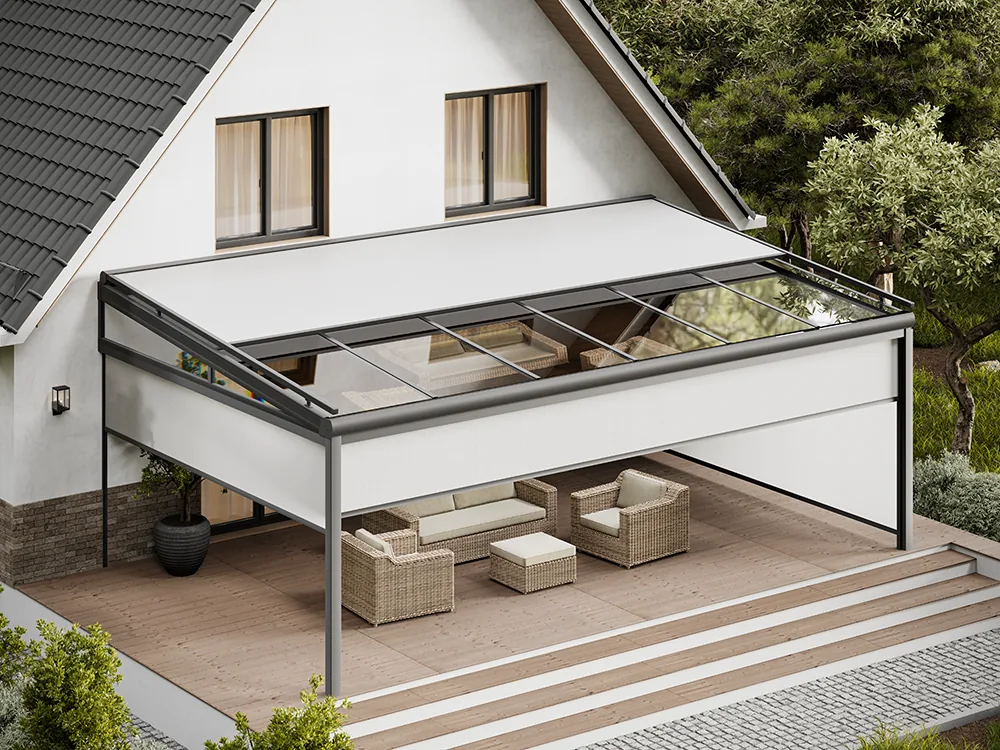
Somfy Powered Zip Screen
Modern HoReCa projects demand smart infrastructure. Our Zip Screen systems are powered by the world's most reliable tubular motors to ensure longevity and ease of use.
Somfy & Becker Motor Technology
We exclusively use Somfy (France) or Becker (Germany) motors with obstacle detection technology.- RTS / io-homecontrol: Radio technology allowing for wireless control without complex cabling.
- Obstacle Detection: The motor automatically stops if it detects a chair or object in the path of the blind, preventing fabric damage.
- Silent Performance: Specialized vibration-isolation mounts reduce acoustic levels during operation.
Sensor-Driven Automation
To protect the investment and maximize guest comfort, we integrate autonomous sensors:
- Wind Sensors (Eolis): Automatically retracts all blinds if wind speeds exceed safe thresholds (configurable).
- Sun Sensors (Sunis): Automatically lowers blinds when solar intensity reaches a specific level to keep the interior cool.
- Building Management System (BMS): Full integration via KNX, Control4, or Crestron for large-scale hotel automation.
Technical Specifications (Motors)
| Feature | Somfy Maestria io | Becker Centronic |
|---|---|---|
| Voltage | 230V / 50Hz | 230V / 50Hz |
| Torque | 6Nm - 40Nm | 8Nm - 50Nm |
| Protection | IP44 (Outdoor Rated) | IP44 (Outdoor Rated) |
| Warranty | 5 Years | 5 Years |
> Automation Insight: Using the Somfy Tahoma bridge, hotel managers can control hundreds of blinds simultaneously via a single tablet or smartphone app.
Somfy Motor Families: io-homecontrol vs. RTS vs. Wired
Not every property needs the same control architecture. We specify the motor platform during the technical survey, based on the building's existing infrastructure and the level of feedback the operator requires.
| Platform | Communication | Position Feedback | Typical Application |
|---|---|---|---|
| io-homecontrol | Bidirectional radio (868 MHz, encrypted) | Full: real-time position, error codes, cycle counter | Premium hotels, BMS-integrated new builds |
| RTS (Radio Technology Somfy) | One-way radio (433 MHz) | None — command only | Boutique properties, retrofits, cost-sensitive rollouts |
| Wired (animeo / KNX actuators) | Physical bus cable | Full, via actuator | New construction with structured cabling |
For serviced apartments and boutique properties, the TaHoma bridge additionally exposes shading scenes to Apple HomeKit, Google Home and Amazon Alexa, enabling app-based and voice control without a full BMS investment.
Integration Options: KNX, BMS and Hotel PMS
Large hospitality properties rarely run shading as a standalone system. Typical integration scope:
- KNX: Somfy animeo KNX interfaces or third-party gateways map every motor to a KNX group address, so screens appear on the same touch panels as lighting and HVAC.
- BMS: BACnet or Modbus gateways expose motors to building management platforms (Siemens Desigo, Schneider EcoStruxure, Honeywell), enabling central scheduling, load shedding and alarm reporting.
- Hotel PMS: Property management systems (Opera, Mews, protel) do not address motors directly. The BMS acts as the translation layer: check-in/check-out and room status events from the PMS trigger shading scenes — for example, blinds fully open at checkout for housekeeping, or a privacy scene when a room flips to occupied at night.
Wind and Sun Sensor Logic
Autonomous protection follows a strict priority hierarchy:
- Wind has absolute priority. When the Eolis sensor reads above the threshold (commonly 40–60 km/h for zip screens, set per site exposure), affected zones retract within seconds and stay locked until wind drops below the threshold for a configurable reset period (typically 3–5 minutes). Sun logic cannot override a wind event.
- Sun logic uses hysteresis. The Sunis sensor triggers deployment above a set lux level, but retraction requires the light level to stay below a lower threshold for 10–20 minutes. This prevents hunting — constant up-down cycling on partly cloudy days — and extends motor life.
- Facade orientation matters. Thresholds are configured per zone: a west-facing terrace needs earlier deployment than a north facade. Initial settings are documented in the handover dossier and refined during the first seasonal review.
Serviceability and Spare Parts
Zip screen systems are designed for commercial duty cycles, and service planning is part of our supply package:
- Access: Motors are reachable from the side channel or headbox without dismantling the guides; fabric panels can be replaced without removing the motor.
- Diagnostics: io-homecontrol motors report error codes and cycle counts through TaHoma, allowing remote triage before a technician visit.
- Spares: We hold common spares (drive adapters, idlers, control cards); replacement motor lead times are confirmed at order stage.
- Maintenance schedule: We recommend an annual inspection — limit setting verification, guide rail cleaning, gasket check — which most hotel engineering teams perform in-house after a short induction.
Frequently Asked Questions
What is Somfy TaHoma and how does it integrate hotel automation?
Somfy TaHoma is a smart home/building hub that connects and controls all Somfy-compatible motorized products (blinds, pergolas, awnings, gates) via a single app or building management system. In hotels, it enables centralized control of all room and terrace shading, reducing energy consumption and improving guest comfort through automated sun/wind response.What communication protocols does Somfy use for building automation?
Somfy uses io-homecontrol (proprietary, bidirectional, encrypted) as its primary protocol for high-end applications. RTS (Radio Technology Somfy) is the one-way protocol for simpler installations. For BMS integration, Somfy supports KNX, BACnet, and Modbus via dedicated gateways, enabling full integration with hotel building management systems.What energy savings can hotels achieve with automated shading?
Automated solar shading (blinds/pergolas responding to sun position and intensity) can reduce cooling energy consumption by 20–40% in glass-facade buildings. Combined with automated heating control, total HVAC energy savings of 15–25% are achievable. This typically results in ROI within 3–5 years for commercial hotel installations.What is the warranty and maintenance requirement for Somfy motors?
Somfy tubular motors carry a 5-year warranty for commercial applications. Maintenance requirements are minimal: annual inspection of limit settings and lubrication of mechanical components (guide rails, bearings). Motor replacement is tool-free in most modern systems. Somfy's global service network covers 58 countries.Can zip screens integrate with an existing hotel BMS, or is new infrastructure required?
New dedicated infrastructure is rarely required. Somfy animeo KNX interfaces or BACnet/Modbus gateways bridge the motor network into an existing BMS, exposing each screen or zone as standard data points the integrator maps into graphics and schedules. Properties without a BMS can run standalone via the Somfy TaHoma bridge and integrate later without replacing motors.What happens to motorized screens during a power failure?
Standard tubular motors stop in position during an outage. On power restoration, io-homecontrol motors retain their limits and settings — no recommissioning is required. For sites with extreme wind exposure, where the wind sensor's protective function matters most, manual override cranks or backed-up supply on critical zones can be specified.How are wind thresholds determined for a specific site?
Thresholds are set per zone during commissioning, based on facade height, exposure category and screen dimensions. Typical zip screen settings are 40–60 km/h; exposed rooftop installations may be set lower for conservatism. Facilities staff can adjust settings with the configuration tool, and all values are documented in the handover pack.More Frequently Asked Questions
Do you work with hotel chains and project buyers?Yes — we supply hospitality projects, distributors and multi-property programs.
Can systems be customized to site dimensions?
Yes — measure-based manufacturing is standard for ZIP screens, pergolas and many FF&E items.
What about motors and automation?
Somfy and comparable motor/control packages are available; integration scope defined per project.
Do you ship internationally?
Yes — FOB/CIF/DAP worldwide with export packing suited to the product.
How do we get project pricing?
RFQ with drawings, quantities, finishes and destination port.
For project-specific terms, contact WorldwideTradeX via RFQ.